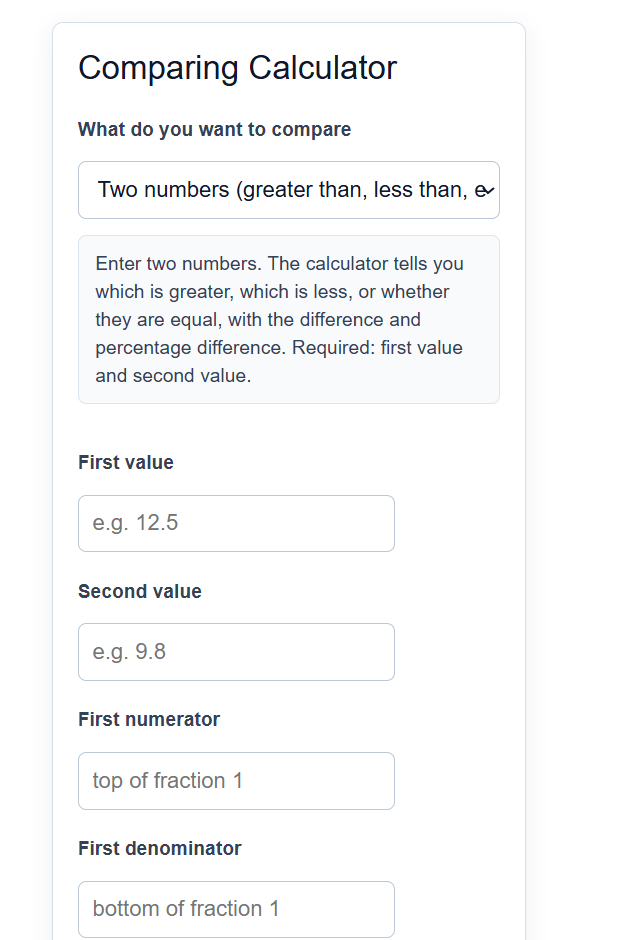
Compare two numbers, fractions, or a full list to find which is greater, less than, or equal, plus the exact and percentage difference.
Comparing Formula
To compare two numbers, look at the sign of their difference. If a minus b is positive, then a is greater than b. If it is negative, a is less than b. If it is zero, the two values are equal.
a - b > 0 -> a is greater a - b < 0 -> a is less a - b = 0 -> equal
The size of the gap between two numbers is the absolute difference. The percentage difference scales that gap against the average of the two values, which is useful when the numbers carry equal weight and neither one is a fixed reference.
Percentage difference = 100 * |a - b| / ((a + b) / 2)
To compare two fractions without converting them to decimals, cross multiply. Multiply the first numerator by the second denominator, then the second numerator by the first denominator, and compare the two products.
Compare a/b and c/d: a*d vs c*b
- a = the first value, or the numerator of the first fraction
- b = the second value, or the denominator of the first fraction
- c = the numerator of the second fraction
- d = the denominator of the second fraction
In two-number mode you enter a and b, and the calculator returns the relation, the larger and smaller value, the absolute difference, and the percentage difference. In fraction mode it converts each fraction to a decimal, cross multiplies, and reports which fraction is larger. In list mode it sorts every value you enter and returns the minimum, maximum, range, sum, and average.
Comparison Symbols and What They Mean
These are the symbols the calculator uses to state a result.
| Symbol | Name | Meaning | Example |
|---|---|---|---|
| > | Greater than | Left value is larger | 9 > 4 |
| < | Less than | Left value is smaller | 4 < 9 |
| = | Equal to | Both values match | 5 = 5 |
| ≥ | Greater than or equal | At least as large | 7 ≥ 7 |
| ≤ | Less than or equal | At most as large | 3 ≤ 8 |
The next table shows how absolute difference and percentage difference can tell different stories about the same pair of numbers.
| First value | Second value | Absolute difference | Percentage difference |
|---|---|---|---|
| 10 | 12 | 2 | 18.18% |
| 100 | 102 | 2 | 1.98% |
| 50 | 75 | 25 | 40.00% |
Example Problems
Example 1. Compare 12.5 and 9.8 in two-number mode. The difference is 12.5 minus 9.8, which is 2.7, so 12.5 > 9.8. The average of the two is 11.15, so the percentage difference is 100 times 2.7 divided by 11.15, which is about 24.22%.
Example 2. Compare the fractions 3/4 and 5/8 in fraction mode. Cross multiply: 3 times 8 is 24, and 5 times 4 is 20. Because 24 is greater than 20, the first fraction is larger, so 3/4 > 5/8. As a check, 3/4 is 0.75 and 5/8 is 0.625.
FAQ
What is the difference between percentage difference and percentage change? Percentage change compares a new value against an old reference value, so the order matters and the starting number sits in the denominator. Percentage difference is used when the two numbers carry equal weight and there is no clear reference, so it divides by their average instead. Use percentage change for before-and-after values, and percentage difference for two independent measurements.
How do you compare two fractions without converting them to decimals? Cross multiply. Multiply the numerator of the first fraction by the denominator of the second, then multiply the numerator of the second by the denominator of the first. Whichever product is larger belongs to the larger fraction. If the products are equal, the fractions are equal. This works for any positive fractions and avoids rounding errors from long decimals.
Can you compare negative numbers? Yes. A number further to the left on the number line is always the smaller one, so -3 is less than 4, and -10 is less than -2. The calculator handles negative values, decimals, and whole numbers in every mode.