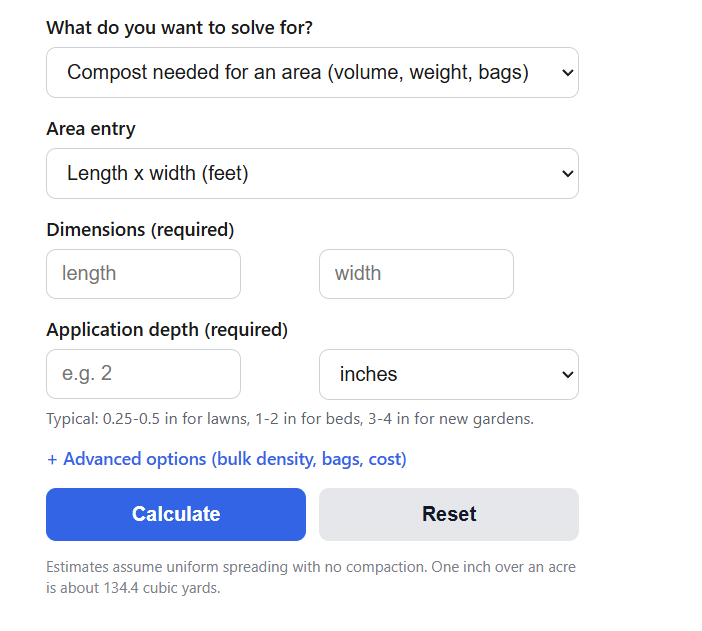
Calculate compost application rates from area and depth, including cubic yards, tons per acre, bag counts, and nitrogen-based agronomic rates.
Compost Application Rate Formula
V = (A * D/12) / 27
W = (V * BD) / 2000
R = N / (2000 * (TN/100) * (AF/100))
- V is the compost volume needed (cubic yards)
- A is the area to be covered (square feet)
- D is the application depth (inches)
- W is the compost weight (tons)
- BD is the compost bulk density (pounds per cubic yard, typically 800 to 1,200)
- R is the nitrogen-based application rate (tons per acre)
- N is the target plant-available nitrogen (pounds per acre)
- TN is the total nitrogen content of the compost (percent)
- AF is the first-year nitrogen availability factor (percent)
The calculator works in three directions. The first mode uses the volume formula: it multiplies your area by the application depth to get cubic feet, then divides by 27 to convert to cubic yards, and applies the bulk density to estimate weight, bag count, and cost. The second mode runs the same formula in reverse, taking an amount of compost you already have and dividing its volume by the depth to find the area it will cover. The third mode uses the nitrogen formula: since a ton of compost contains 2000 * (TN/100) pounds of total nitrogen but only the fraction AF becomes plant-available in the first year, the target nitrogen amount divided by the available nitrogen per ton gives an agronomic rate in tons per acre, which the calculator also converts to cubic yards and an equivalent spreading depth.
Application Depths and Per-Acre Equivalents
The right depth depends on what you are amending. This table shows common depth recommendations converted into volume so you can order the right amount. A useful anchor: one inch of compost spread over one acre is about 134.4 cubic yards.
| Use | Depth (in) | Cu Yd per 1,000 Sq Ft | Cu Yd per Acre |
|---|---|---|---|
| Lawn topdressing | 0.25 - 0.5 | 0.8 - 1.5 | 34 - 67 |
| Established beds and perennials | 1 - 2 | 3.1 - 6.2 | 134 - 269 |
| Vegetable garden (annual) | 2 - 3 | 6.2 - 9.3 | 269 - 403 |
| New garden bed (incorporated) | 3 - 4 | 9.3 - 12.3 | 403 - 538 |
| Field or pasture amendment | 0.25 - 0.5 | 0.8 - 1.5 | 34 - 67 |
If you are applying compost for its fertilizer value rather than a set depth, the nitrogen mode needs two numbers from your compost analysis: total nitrogen and how much of it actually becomes available the first season. Typical values by compost source are below.
| Compost Source | Bulk Density (lb/cu yd) | Total N (%) | First-Year N Availability (%) |
|---|---|---|---|
| Yard waste / leaf compost | 800 - 1,000 | 1.0 - 1.5 | 5 - 15 |
| Food scrap compost | 900 - 1,100 | 1.5 - 2.5 | 10 - 20 |
| Manure-based compost | 1,000 - 1,200 | 1.5 - 3.0 | 15 - 30 |
| Mushroom compost (spent substrate) | 900 - 1,100 | 1.0 - 2.0 | 10 - 15 |
| Biosolids compost | 1,000 - 1,200 | 2.0 - 4.0 | 20 - 30 |
Immature compost with a high carbon to nitrogen ratio can sit at the bottom of these availability ranges or even tie up nitrogen temporarily, so use the low end of the availability range unless your supplier provides a maturity test.
Example Problems
Example 1: Volume for a vegetable garden. You have a 20 ft by 30 ft garden and want a 3 inch layer worked into the soil. The area is 600 square feet. Volume = (600 * 3/12) / 27 = 150 / 27 = 5.56 cubic yards. At a bulk density of 1,000 pounds per cubic yard, that weighs about 5,560 pounds, or 2.78 tons. If bulk compost costs 35 dollars per cubic yard, expect to pay about 194 dollars.
Example 2: Nitrogen-based field rate. Your soil test calls for 100 pounds of plant-available nitrogen per acre. Your compost analysis shows 1.5 percent total nitrogen, and you assume 15 percent first-year availability. Available N per ton = 2000 * 0.015 * 0.15 = 4.5 pounds. Rate = 100 / 4.5 = 22.2 tons per acre. At 1,000 pounds per cubic yard, that is about 44.4 cubic yards per acre, an equivalent depth of roughly a third of an inch.
Frequently Asked Questions
How do I convert cubic yards of compost to tons? Multiply cubic yards by the bulk density in pounds per cubic yard, then divide by 2,000. Finished compost typically runs 800 to 1,200 pounds per cubic yard depending on moisture, so one cubic yard is roughly 0.4 to 0.6 tons. If your supplier sells by the ton, ask for the bulk density of their product so the conversion matches what actually arrives on the truck.
Can I apply too much compost? Yes. Depth applications beyond about 4 inches can smother roots, and repeated heavy applications build up phosphorus and soluble salts faster than plants use them. If you apply compost every year, base the rate on a soil test rather than a fixed depth, and switch to the nitrogen-based rate once your soil organic matter is in a healthy range of roughly 3 to 6 percent.
Why does only part of the nitrogen in compost count? Most nitrogen in compost is bound in organic matter and must be mineralized by soil microbes before plants can take it up. Only about 5 to 30 percent of the total nitrogen becomes plant-available in the first year, with the remainder released slowly over following seasons. That is why the nitrogen mode multiplies total nitrogen by an availability factor instead of treating compost like a bagged fertilizer.