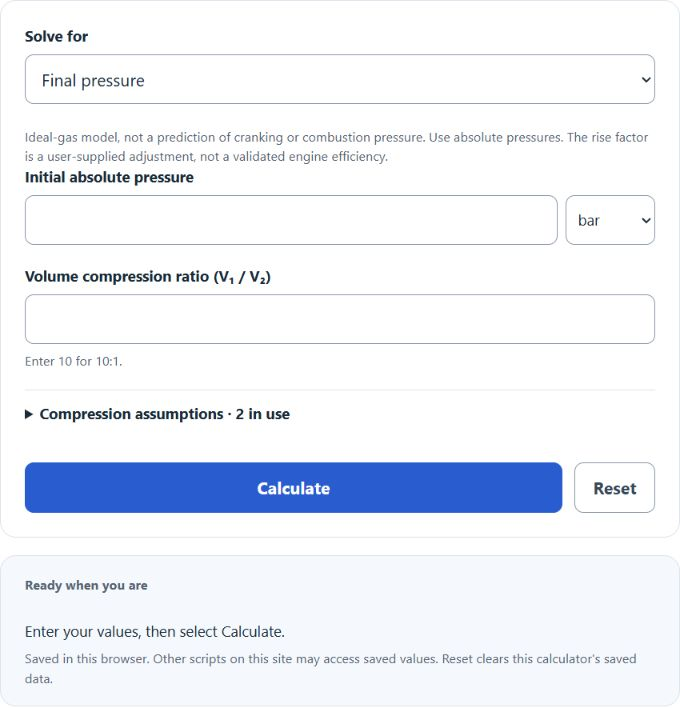
Convert a volume compression ratio to ideal and factor-adjusted final absolute pressure, or reverse-solve compression ratio from absolute pressure or rise above P1.
Related Calculators
- Compression Height Calculator
- Piston To Wall Clearance Calculator
- Lambda Air/Fuel Ratio Calculator
- Supercharger RPM Calculator
- All Automotive Calculators
Compression Ratio to Pressure Formula
The calculator uses the ideal-gas polytropic relation P₂ = P₁ × rⁿ. For reversible adiabatic compression with constant heat capacities, n = γ. The default n = 1.4 approximates air at ordinary temperatures; real engine conditions can differ. A user-supplied rise factor f gives P₂ = P₁ + f(P₁rⁿ − P₁); f is entered as a percentage and is not a calibrated engine efficiency. The equations and examples below use f = 100%.
- P₁ = initial absolute pressure
- P₂ = final absolute pressure after compression
- CR = compression ratio, such as 10 for 10:1
- γ = heat capacity ratio, also called the specific heat ratio
To calculate final pressure, enter compression ratio and initial pressure. The calculator applies P₂ = P₁ × CRγ.
To calculate initial pressure, choose Initial absolute pressure and enter the volume ratio and final pressure with its reference. For f = 100%, the absolute-pressure relation is P₁ = P₂ / CRn; other factors use P₁ = P₂ / [1 + f(CRⁿ − 1)].
To calculate compression ratio, enter the initial and final absolute pressures. The calculator solves CR = (P₂ / P₁)1/γ.
Pressure values must be absolute pressure, not gauge pressure. If you start with gauge pressure, add atmospheric pressure before using the value.
Typical Heat Capacity Ratio Values
For air at ordinary temperatures, γ is commonly taken as 1.40. Other gases can use different values.
| Gas | Typical γ | Notes |
|---|---|---|
| Air | 1.40 | Default value for many compression estimates |
| Nitrogen | 1.40 | Very close to air for many calculations |
| Oxygen | 1.40 | Approximate room-temperature value |
| Carbon dioxide | 1.30 | Approximate value, varies with temperature |
| Helium | 1.66 | Monatomic gas |
Pressure Unit Reference
| Unit | Equivalent in bar | Equivalent in psi |
|---|---|---|
| 1 bar | 1 bar | 14.5038 psi |
| 1 atm | 1.01325 bar | 14.696 psi |
| 1 kPa | 0.01 bar | 0.145038 psi |
| 1 Pa | 0.00001 bar | 0.000145 psi |
Examples
Example 1: Calculate final pressure from compression ratio
You have air with a compression ratio of 10:1, initial pressure of 1 atm absolute, and γ = 1.40.
The final pressure is about 25.12 atm absolute.
Example 2: Calculate compression ratio from pressure
You have an initial pressure of 1 bar absolute, a final pressure of 16 bar absolute, and γ = 1.40.
The compression ratio is about 7.25:1.
FAQ
Should I use absolute pressure or gauge pressure?
Use absolute pressure. The isentropic relation uses pressure ratios based on absolute pressure. If you have gauge pressure, add atmospheric pressure first. For example, 100 psi gauge is about 114.7 psi absolute at sea level.
Why does γ change the final pressure so much?
γ is the exponent in the formula P₂ = P₁ × CRγ. A higher γ produces a higher final pressure for the same compression ratio. For example, helium with γ around 1.66 gives a larger pressure rise than air with γ around 1.40.
Is this the same as real engine cylinder pressure?
Not exactly. This calculation is an ideal isentropic estimate. Real engine cylinder pressure depends on valve timing, heat loss, leakage, fuel mixture, combustion, temperature changes, and measurement conditions. Use this result as an ideal compression estimate, not as a full engine pressure prediction.