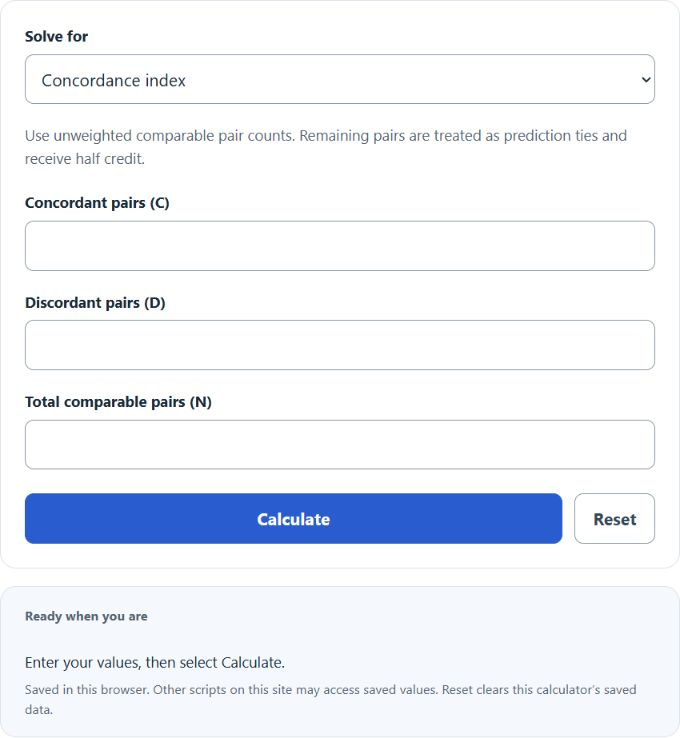
Select the concordance index or pair count to solve, enter the three known values, and infer prediction ties among comparable pairs.
Related Calculators
- D Prime Calculator
- AIC Rating Calculator
- Hit Ratio Calculator
- Event Rate Calculator
- All Statistics Calculators
Concordance Index Formula
The concordance index, or C-index, measures how often a model correctly ranks comparable pairs. This calculator uses unweighted counts, gives prediction ties among comparable pairs half credit, and infers those ties from the total. Counts must already exclude incomparable pairs; censoring and outcome ties require a comparability rule before counting.
Rearranged formulas used for the selected solve mode:
- C = number of concordant pairs
- D = number of discordant pairs
- T = number of tied pairs, inferred as total minus concordant minus discordant
- N = total number of comparable pairs
- C-index = concordance index, ranging from 0 to 1
Select C-index to find it from concordant pairs, discordant pairs, and total comparable pairs. Select C, D, or N to rearrange the same relationship for that count. In all cases, ties are inferred as T = N − C − D, so the total must be at least as large as concordant plus discordant pairs.
Concordance Index Interpretation
| C-index value | General meaning | Pair-ranking interpretation |
|---|---|---|
| 1.00 | Perfect concordance | Every comparable pair is ranked correctly. |
| 0.70 to 0.90 | Above the 0.5 reference | The half-credit score is above 0.5; suitability depends on context. |
| 0.50 | No better than chance | Concordant and discordant information balances out. |
| Below 0.50 | Worse than chance ranking | The model more often ranks comparable pairs in the wrong order. |
Pair Type Summary
| Pair type | Symbol | How it affects the C-index |
|---|---|---|
| Concordant pair | C | Counts as 1 correct ranking. |
| Discordant pair | D | Counts as 0 correct ranking. |
| Tied pair | T | Counts as 0.5 correct ranking. |
| Comparable pairs | N | Used as the denominator for the index. |
Example Calculations
Example 1: Calculate the C-index
Suppose you have 70 concordant pairs, 20 discordant pairs, and 100 total comparable pairs.
The C-index is 0.75.
Example 2: Calculate the number of discordant pairs
Suppose you know there are 65 concordant pairs, 100 total comparable pairs, and the C-index is 0.70.
The number of discordant pairs is 25. The inferred ties are 100 − 65 − 25 = 10.
FAQ
What is a concordance index?
A concordance index is a measure of ranking accuracy for comparable pairs. A pair is concordant when the predicted ordering agrees with the observed ordering. A C-index of 1 means perfect ranking, 0.5 means chance-level ranking, and values below 0.5 mean the rankings are more often reversed than correct.
How are ties handled in this calculator?
Prediction ties among comparable pairs are not entered directly. They are inferred from the total number of comparable pairs:
Each tied pair contributes half credit in the C-index formula. For example, 10 tied pairs add 5 to the numerator.
Why can some inputs be inconsistent?
The values must describe a possible set of comparable pairs. Concordant and discordant counts cannot be negative, the C-index must be between 0 and 1, and the total number of comparable pairs must be at least C + D. If a calculation would produce negative ties, a negative pair count, or a total that does not fit the formula, the inputs are inconsistent. Pair counts must be whole numbers; an inverse using a rounded index may imply a fractional count. When C = D and the index is 0.5, N is not uniquely determined.