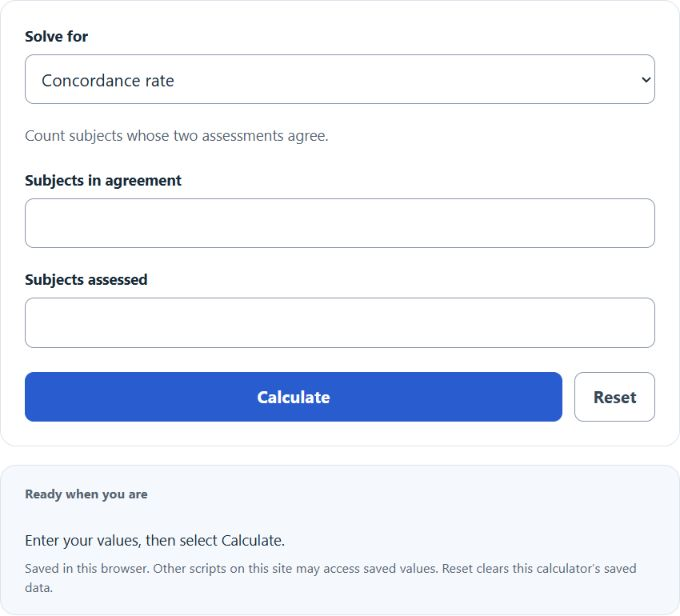
Calculate concordance rate, total agreement counts, or Cohen’s kappa from subject totals or 2×2 table counts for paired assessments.
- All Statistics Calculators
- Discrepancy Rate Calculator
- Concordance Index Calculator
- Inter-Rater Reliability Calculator
- ICC Intraclass Correlation Calculator
- Jaccard Coefficient Calculator
Concordance Rate Formula
Variables:
- CONR is the Concordance Rate (%)
- C is the total number of subjects in concordance
- SA is the total number of subjects assessed
To calculate Concordance Rate, divide the total number of subjects in concordance by the number of subjects assessed, then multiply by 100.
How to Calculate Concordance Rate?
The following steps outline how to calculate the Concordance Rate.
- First, determine the total number of subjects in concordance.
- Next, determine the total number of subjects assessed.
- Next, gather the formula from above: CONR = C / SA *100.
- Finally, calculate the Concordance Rate.
- After inserting the variables and calculating the result, check your answer with the calculator above.
Example Problem :
Use the following variables as an example problem to test your knowledge.
total number of subjects in concordance = 78
total number of subjects assessed = 100; concordance rate = 78%
FAQ
What is Concordance Rate and why is it important?
Concordance Rate measures how often two assessments of the same subjects agree. It describes agreement; it does not establish accuracy, validity, or replicability.
How can Concordance Rate impact the interpretation of a study’s results?
A high Concordance Rate means the assessments frequently match. Its interpretation depends on the task and category prevalence. Matching assessments can still both be incorrect.
Are there any limitations to using Concordance Rate as a measure?
Yes. Percent agreement does not adjust for expected agreement from category frequencies. The 2×2 modes also provide unweighted Cohen’s kappa, κ = (Po − Pe)/(1 − Pe), where Po is observed agreement and Pe is the expected agreement from marginal proportions. Kappa is undefined when Pe = 1. Counts must be whole numbers; rounded inverse rates may imply fractional counts.
Can Concordance Rate be applied to any type of study?
While Concordance Rate is a versatile measure, its applicability depends on the nature of the study. It’s most useful in studies where the assessment of agreement or consistency among subjects is relevant, such as in clinical trials, psychological tests, or reliability studies.