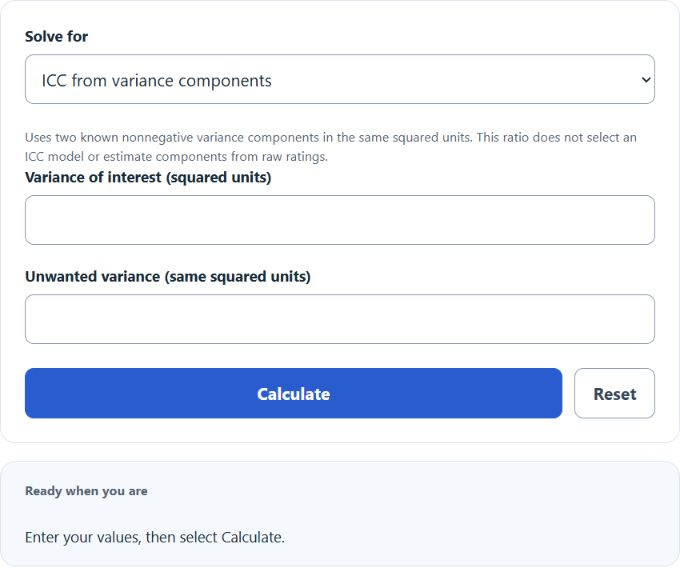
Calculate ICC, variance of interest, or unwanted variance from two known values with this intraclass correlation calculator online.
- All Statistics Calculators
- Inter-Rater Reliability Calculator
- Cronbach Alpha Calculator
- Kendall Coefficient of Concordance Calculator
- Standard Error of Measurement Calculator
- Spearman Rank Correlation Calculator
ICC (Intraclass Correlation) Formula
This calculator estimates the proportion of total variance that is attributable to the variance of interest. In practical terms, it shows how much of the observed variability is meaningful signal versus unwanted noise.
Where:
- ICC = intraclass correlation coefficient
- VOI = variance of interest
- UV = unwanted variance
You can also think of the calculation as the variance of interest divided by the total variance.
What the ICC Means
Intraclass correlation is a reliability-style measure used when observations belong to the same subject, item, group, or class. A larger ICC means measurements within the same class are more similar because more of the total variance comes from the signal you care about rather than random or unwanted variation.
For nonnegative variance inputs:
- An ICC close to 1 means that most of the specified total variance is attributable to the variance of interest. Whether this measures consistency, absolute agreement, or clustering depends on the selected ICC model.
- An ICC close to 0 indicates that most of the variability is unwanted variance.
How to Calculate ICC
- Determine the variance of interest.
- Determine the unwanted variance.
- Add those values to get the total variance.
- Divide the variance of interest by the total variance.
As unwanted variance decreases, the ICC increases. As unwanted variance grows relative to the variance of interest, the ICC decreases.
Interpretation Guide
Interpretation depends on the field and study design, but these rough benchmarks are often useful for quick screening.
| ICC Range | General Interpretation |
|---|---|
| Below 0.50 | Low reliability or weak agreement |
| 0.50 to 0.75 | Moderate reliability |
| 0.75 to 0.90 | Good reliability |
| Above 0.90 | Excellent reliability |
Example
If the variance of interest is 18 and the unwanted variance is 6, then:
An ICC of 0.75 means that 75% of the total variance is attributable to the variance of interest, while 25% is unwanted variance.
If the variance of interest is much smaller than the unwanted variance, the ICC drops quickly. For example:
This indicates that only 20% of the specified total variance is attributable to the variance of interest. Reliability interpretation depends on how the components were estimated and the ICC model.
Special Cases
If both variance components are zero, the calculation is undefined because there is no total variance to divide by.
When This Calculator Is Useful
- Estimating how much of the total variation comes from true differences between subjects or groups
- Summarizing reliability from known variance components
- Comparing signal versus noise in repeated measurements
- Describing the relative sizes of known variance components; this ratio alone does not establish statistical significance
Important Notes
- Enter only nonnegative variance values.
- This calculator uses a variance-components interpretation of ICC.
- In applied statistics, there are several ICC model types for different study designs, but this calculator is best for quick ratio-based estimation when the two variance components are already known.