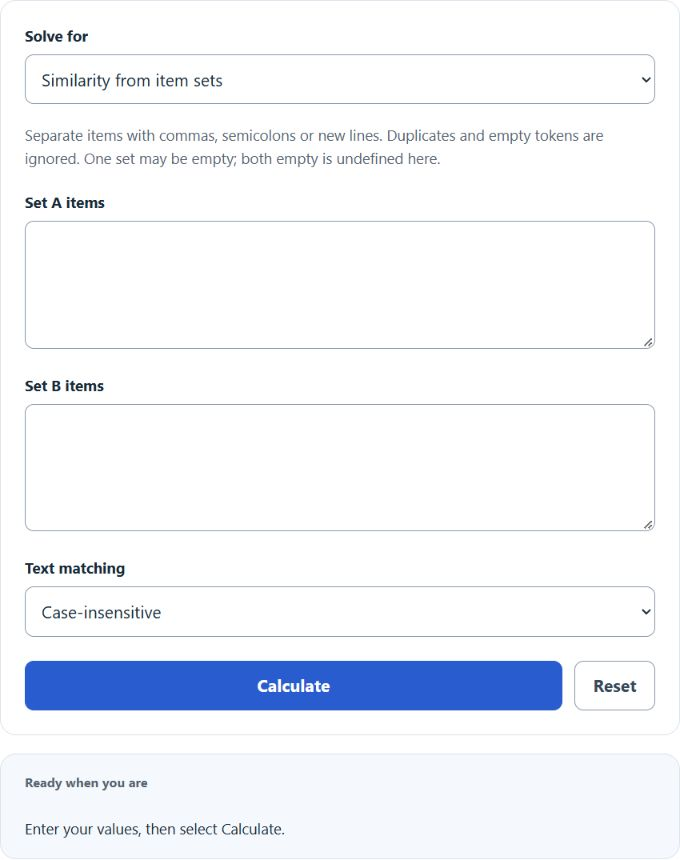
Calculate Jaccard similarity from item sets or overlap counts, compare Dice and distance, or reverse-solve the shared items needed for a target.
- All Statistics Calculators
- Sorensen Index Calculator
- Similarity Index Calculator
- Dissimilarity Index Calculator
- Simpson’s Diversity Index Calculator
- Shannon-Wiener Index Calculator
- Biodiversity Index Calculator
Jaccard Coefficient Formula
The following formula is used to calculate the Jaccard Coefficient.
- Where JC is the Jaccard Coefficient
- Na is the number of elements in set A
- Nb is the number of elements in set B
- Ni is the number of intersecting elements
To calculate the Jaccard coefficient, divide the number of intersecting elements by the result of the number of elements in set A plus the number of elements in set B minus the number of intersection elements.
How to Calculate Jaccard Coefficient?
The following example problems outline how to calculate Jaccard Coefficient.
Example Problem #1
- First, determine the number of elements in set A.
- The number of elements in set A is calculated to be 4.
- Next, determine the number of elements in set B.
- The number of elements in set B is measured to be 5.
- Next, determine the number of intersecting elements.
- The number of intersecting elements is found to be 2.
- Finally, calculate the Jaccard Coefficient using the formula above:
JC = Ni / (Na+Nb-Ni)
The values given above are inserted into the equation below and the solution is calculated:
JC = 2 / (4+5-2) = 2 / 7 ≈ 0.2857
Example Problem #2
The variables needed for this problem are provided below:
number of elements in set A = 7
number of elements in set B = 10
number of intersecting elements = 3
This example problem is a test of your knowledge on the subject. Use the calculator above to check your answer.
JC = Ni / (Na+Nb-Ni) = 3 / (7+10-3) = 3 / 14 ≈ 0.2143