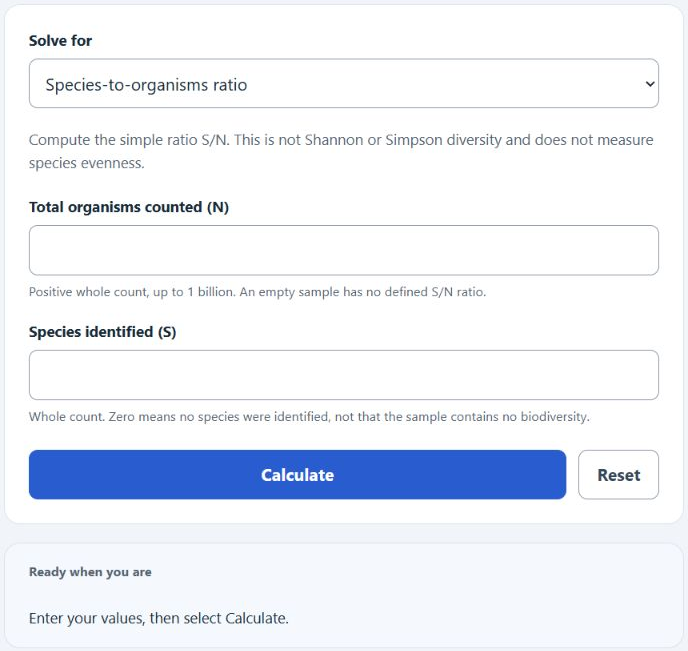
Select the value to calculate, then enter the two requested values using BI = S ÷ N. Organism and species counts must be whole numbers.
- All Biology Calculators
- Simpson’s Diversity Index Calculator
- Species Richness Calculator
- Dominance Index Calculator
Biodiversity Index Formula
The calculator uses a simple biodiversity index based on the number of species identified divided by the total number of organisms counted.
- BI = biodiversity index
- S = number of species identified
- N = total number of organisms counted
Select a reverse calculation to rearrange the formula. Reverse solutions require whole-number counts; a rounded ratio may not determine a valid count. N = S / BI requires BI > 0; when both S and BI are zero, N is not uniquely determined.
- Calculate biodiversity index: enter total organisms and species identified. The calculator divides species identified by total organisms.
- Calculate species identified: enter total organisms and biodiversity index. The calculator multiplies the biodiversity index by total organisms.
- Calculate total organisms: enter species identified and biodiversity index. The calculator divides species identified by the biodiversity index.
Interpreting Biodiversity Index Values
This sample-size-dependent ratio ranges from 0 to 1 for a positive organism count, with identified species no greater than organisms. It does not measure species evenness or ecosystem health. No universal low, moderate, or high diversity thresholds apply. Compare samples collected and identified using comparable methods.
| Biodiversity Index | Ratio Description | Interpretation Limit |
|---|---|---|
| 0 | No species recorded | No species were identified among a positive organism count. An empty sample has no defined ratio. |
| 0.01 to 0.10 | 1–10 species per 100 organisms | This ratio alone does not provide an ecological diversity rating. |
| 0.11 to 0.50 | 11–50 species per 100 organisms | This ratio does not describe the abundance of each species. |
| 0.51 to 1.00 | 51–100 species per 100 organisms | A high ratio does not establish ecosystem health. |
Sample Count Checks
| Total Organisms | Species Identified | Biodiversity Index |
|---|---|---|
| 100 | 10 | 0.100000 |
| 80 | 20 | 0.250000 |
| 50 | 25 | 0.500000 |
Example Problems
Example 1: You count 120 total organisms and identify 18 species.
The biodiversity index is 0.150000.
Example 2: You know the biodiversity index is 0.25 and the total number of organisms is 64.
The number of species identified is 16.
FAQ
What does a higher biodiversity index mean?
A higher value means there are more identified species relative to the total number of organisms in the sample. For this calculator, a value closer to 1 means the sample has a high number of different species compared with its total count.
Can the number of species be greater than the total number of organisms?
No. Each species must be represented by at least one organism in the count. If you counted 40 total organisms, the number of species identified cannot be more than 40.
Is this the same as the Shannon or Simpson biodiversity index?
No. This calculator uses a simple ratio of species identified to total organisms. Shannon and Simpson indexes use the abundance of each species, so they require a more detailed breakdown of how many organisms belong to each species.