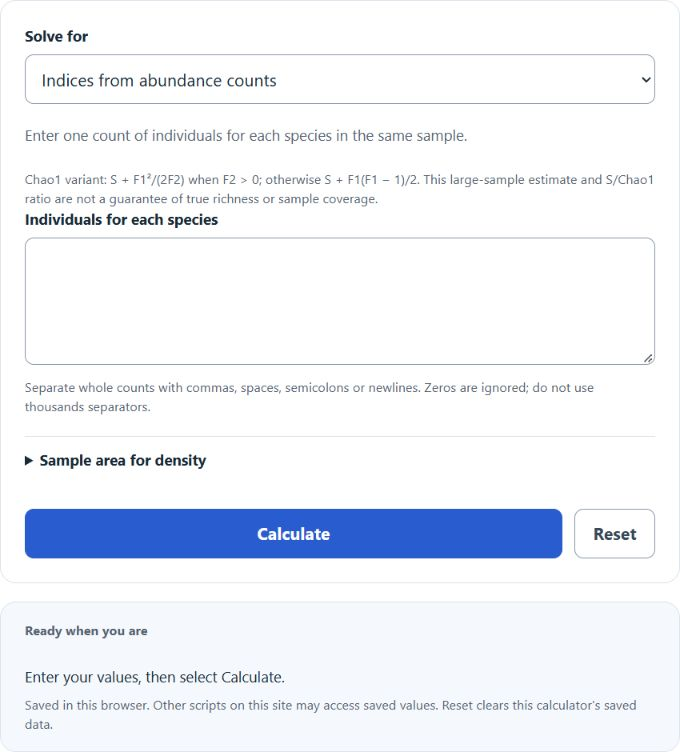
Calculate observed species richness, Shannon and Simpson diversity, evenness, optional richness density, and an observed/Chao1 richness ratio, or estimate Chao1 richness from rare-species counts.
- All Biology Calculators
- Simpson’s Diversity Index Calculator
- NDVI Calculator
- Berger-Parker Index Calculator
Species Density (Richness per Area) Formula
The following formula is used to calculate species density (species richness per unit area).
- Where SD is the species density (species richness per unit area)
- S is the species richness (total number of species observed)
- A is the total area
Dividing observed richness by sampled area gives a descriptive species-per-area ratio. For example, 400 species over 100 ha gives 4 species/ha, while 400 species over 10,000 ha gives 0.04 species/ha. The ratio differs by 100, but dividing by area does not make different habitats, sampling designs, taxonomic groups or levels of detectability directly comparable, and does not by itself determine conservation priority.
What Species Richness Measures and What It Does Not
Species richness (S) is the count of distinct observed species in a defined sample, site or region, without weighting by their abundances. A plot with 1 oak, 1 maple and 1 pine has S = 3, as does a plot with 10,000 oaks, 1 maple and 1 pine. The sampling unit and taxonomic definitions are part of the interpretation.
Equal richness can accompany different abundance distributions. A sample with 50 equally abundant species and one with 50 species dominated by a single species have the same S, but their Shannon and Simpson indices differ. These indices describe chosen aspects of abundance and evenness; a larger value is not automatically a verdict about ecological condition or conservation value.
Richness can be reported without abundance data, but comparisons still need a defined taxonomic scope, sampling method, area and effort. Changes in species identification or detection can change the observed count. Richness alone does not supply an ecological assessment or replace the context of a conservation study.
Alpha, Beta, and Gamma Diversity: Three Scales of Richness
Alpha, beta and gamma distinguish local diversity, differences among local samples, and pooled diversity at a broader scale. The exact partition depends on the diversity measure and convention used. State the sampling units and the definition before interpreting a value.
Alpha diversity describes diversity within a specified local sample. For richness, it is the number of distinct species in that sample. The abundance mode reports this observed richness; it does not infer a universal expected range for a habitat or taxon.
Beta diversity describes differentiation among samples, with several definitions in use. Under a multiplicative richness convention, beta = gamma/mean alpha; gamma = 200 and mean alpha = 50 give beta = 4. Some conventions report this ratio minus 1, so the convention must be identified. The ratio does not mean that four sites are sufficient to recover the regional species pool, nor does compositional overlap alone establish that sites are redundant for conservation.
Gamma diversity for richness is the number of unique species in the pooled region or set of samples. Count species in the union once, rather than summing duplicate local records. Samples with species A/B and B/C have local richness 2 each but pooled richness 3, not 4. This calculator summarizes one supplied sample or count summary and does not perform a multi-site partition.
Richness Indices That Account for Sample Size: Margalef and Menhinick
Observed richness depends on sampling effort and detection, so raw counts from different surveys may not be directly comparable. Margalef and Menhinick combine observed S with total individuals N, but neither transformation alone standardizes sampling design or completeness.
Margalef’s richness index uses total individuals N in the natural-log denominator and is defined here only for N greater than 1:
Menhinick’s richness index divides observed richness by the square root of total individuals:
These are count-based descriptive indices. At a fixed positive N, S cannot exceed N, so Menhinick’s S/√N cannot exceed √N; there is no constant upper bound independent of N. Margalef’s (S−1)/ln(N) is undefined at N =1 and is bounded above by (N−1)/ln(N) for fixed N greater than 1. Neither index removes all sample-size dependence. Chao1 addresses estimation of unobserved richness, a different goal, and is not guaranteed to outperform every alternative for every sample.
Observed Richness vs. True Richness: The Sampling Problem
A finite survey can miss species, but it can also detect all species in a defined assemblage. With correct species identification and a fixed assemblage, the observed set cannot exceed the full set; equality is possible. Accumulation curves describe detections as samples are added, but the shape and apparent flattening depend on the design and assemblage. Misidentifications or changing taxonomic definitions can also alter observed richness.
Rarefaction estimates expected richness in a smaller random subsample of genuine individual counts; it need not discard the original observations. It supports comparisons at a stated sample size, while coverage-based approaches address another form of standardization. These procedures require their own assumptions and uncertainty estimates. The calculator above does not perform rarefaction or extrapolation curves; see vegan’s rarefaction documentation and the authors’ iNEXT introduction.
Chao1 uses observed richness S, singleton species F1 and doubleton species F2 to estimate unobserved richness. This calculator retains the large-sample form S + F1²/(2F2) when F2 is positive, and uses S + F1(F1−1)/2 when F2 is zero. Other implementations can use a different bias-corrected variant. Although often described as a lower-bound estimator under its model, the estimated value is not a deterministic lower bound on the true richness of every realized sample. The displayed 100 × S/Chao1 is an estimated species-count ratio, not probability-mass sample coverage or a promise of complete detection. See vegan’s estimator distinctions and Chao and colleagues on completeness measures.
Species-Area Relationship: How Richness Scales with Habitat Size
One model for a species-area relationship is S = c × A^z. The fitted constants c and z describe a specified taxon, sampling design, spatial grain and extent. A fitted relationship can summarize richness over its studied range; doubling an arbitrary habitat area does not guarantee a particular number of additional species.
In the power model, z is the slope of log(S) against log(A). Its interpretation depends on how areas and species are sampled and on the spatial range used. It should be estimated or justified for the study, rather than selected from universal mainland, island, connectivity or dispersal ranges. The calculator above does not fit a species-area curve or choose z.
A single species-area curve does not determine whether one large reserve or several smaller reserves of the same total area retain more species. Species overlap, habitat differences, spatial distributions and population dynamics also matter. Sampling an expanding area is not automatically the inverse of losing the last occurrences of species during habitat removal; He and Hubbell’s analysis explains this distinction. This calculator does not forecast extinctions or evaluate reserve networks.
Global Patterns of Species Richness
Large-scale richness patterns are research findings for particular taxa, data and spatial scales. They provide context, but cannot be inferred from a single observed species count or density value.
The latitudinal diversity gradient describes a broad tendency toward lower richness at higher absolute latitude. Hillebrand’s meta-analysis supported a general gradient while finding variation with spatial scale, sampling grain, organisms and habitats. This is not a rule that every group or local site peaks at the equator, and it does not establish a single cause for a particular dataset.
Elevational gradients require comparisons across defined elevation bands and sampling units. A reported mid-elevation peak is a description to test, not evidence by itself for a mid-domain mechanism or a worldwide richness ranking. Compare the taxa, sampled areas and effort before treating the shape as a general ecological rule.
Marine richness patterns can differ among coastal and oceanic groups. In their analysis of 13 major groups, Tittensor and colleagues reported Western Pacific maxima for coastal groups and broad mid-latitude peaks for oceanic groups. These are findings for the analyzed data, not a universal Coral Triangle species count or a causal result produced by this calculator.
The importance of spatial scale is that plot richness, richness per hectare and pooled regional richness are different quantities. Pooling samples adds only species not already recorded, so turnover and the arrangement of sampling units affect the result. State taxonomic scope, spatial grain, extent, sampling effort and detection context before comparing values; dividing by area does not substitute for those definitions.
FAQ
A species is a group of organisms classified together in biology. Under the biological species concept, it is most commonly defined as a group whose members can interbreed and produce fertile offspring, though this definition cannot be applied to asexual organisms, fossils, or populations with incomplete reproductive isolation. Alternative frameworks include the morphological species concept (defined by physical characteristics), the phylogenetic species concept (defined by shared derived characters on an evolutionary tree), and the ecological species concept (defined by occupying a distinct ecological niche). The choice of species concept can meaningfully change observed richness counts, particularly in microbial communities and species-rich tropical groups where morphological and genetic boundaries often diverge.
Species richness counts distinct species; evenness describes how uniformly individuals are distributed among them. Pielou’s J is H divided by ln(S) and is undefined when S is 1. Samples can have the same richness but different evenness. These descriptive values do not identify the cause of dominance or establish invasion, ecological condition or conservation priority.
A finite sample may miss species, but it need not miss some in every case. Chao1 uses observed species and the singleton/doubleton frequencies to estimate unobserved richness under sampling assumptions. This calculator states its large-sample formula and no-doubleton fallback explicitly. The estimate is uncertain and can exceed or fall below the true richness in an individual sample; it is not a guaranteed correction. The observed/Chao1 species ratio is not probability-mass sample coverage, and the calculator supplies no confidence interval.
A fitted species-area model can be explored as a conditional scenario, not treated as a guaranteed extinction forecast. If one assumes z = 0.25 and an area ratio of 0.10, the model gives a richness ratio of about 0.5623. That arithmetic does not prove 44% of species will be lost, set a time to extinction, or decide between one large reserve and several small reserves. Species distributions, overlap, habitat and population dynamics require additional data; this calculator does not fit that model or assess reserve designs.
Species density = S/A (species per unit area); observed species richness is S.