Calculate geometric or refraction-adjusted horizon distance from observer height, or find maximum line of sight to a raised target in km, miles, and nautical miles.
Related Calculators
- Beacon Distance Calculator
- Glide Distance Calculator
- Earth Curve Calculator
- Line of Sight Calculator
- Height Distance Calculator
- All Physics Calculators
How the Horizon Distance Calculator Works
The horizon distance is the maximum geometric distance from your eye position to the point where the Earth’s curvature hides the surface. This calculator estimates that distance from your eye height, making it useful for boating, coastal viewing, photography, surveying, observation decks, and understanding how elevation changes visibility.
Core Formula
The exact geometry uses the Earth’s radius and your height above the surface:
For normal viewing heights, your height is tiny compared with the Earth’s radius, so the expression simplifies to:
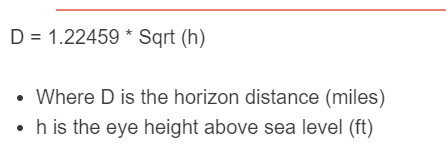
That produces the practical forms most people use:
- d = distance to the horizon
- R = Earth’s radius
- h = eye height above the observed surface
What Height Should You Enter?
Use your total eye height above the surface you are viewing across. If you are standing on a cliff, bridge, tower, ship deck, or rooftop, include that elevation plus your eye level. For example, if you are on a 50 ft bluff and your eyes are about 6 ft above the ground, enter roughly 56 ft.
How to Use the Calculator
- Measure or estimate your eye height.
- Enter the value and choose its unit (feet, meters, centimeters, inches, kilometers or miles). Unit changes convert the entered quantity.
- Select Calculate, then read the model tangent distance in kilometers, statute miles and nautical miles, with model arc and dip angle below.
- Choose the raised-target mode and enter the target height to add both endpoint horizon distances. Geometry does not guarantee actual visibility.
When the Distant Object Also Has Height
If both the observer and the target rise above the surface, the maximum line-of-sight range is approximately the sum of both horizon distances:
This is especially helpful for ships, lighthouses, antennas, mountain peaks, offshore platforms, and tall buildings.
Quick Reference Values
| Eye Height | Approx. Horizon Distance |
|---|---|
| 6 ft (1.8 m) | 3.0 mi (4.8 km) |
| 30 ft (9.1 m) | 6.7 mi (10.8 km) |
| 100 ft (30.5 m) | 12.2 mi (19.7 km) |
| 500 ft (152.4 m) | 27.4 mi (44.1 km) |
Important Assumptions
- The calculation assumes an unobstructed view over a curved Earth.
- It estimates the geometric horizon, not guaranteed recognition distance of a target.
- Terrain, trees, buildings, waves, haze, and lighting can reduce what you actually see.
- Atmospheric refraction varies. The optional7/6 effective-radius scenario is a chosen approximation, not measured weather. Its reported tangent length, surface arc and dip are quantities on the effective sphere, not exact real-Earth ray-path or surface distances.
Why Height Helps So Much
At heights small compared with Earth’s radius, horizon distance grows approximately with the square root of height. Raising your viewpoint helps a lot, but doubling the visible distance requires much more than doubling your height.
Common Questions
- Is this the same as distance across flat ground?
- No. Horizon distance is limited by Earth curvature, not just by straight-line ground distance.
- Should I enter eye height or elevation above sea level?
- Use the height of your eyes above the surface you are viewing over. If you are above the water or ground on a structure or natural feature, include that extra elevation.
- Why can I sometimes see a tall object even when its base is hidden?
- The top of the object may still rise above the horizon. That is why combining observer height and target height gives a more realistic visibility range.
- Does this calculator work only on Earth?
- The built-in constant is for Earth. A different planetary radius would produce a different horizon distance.