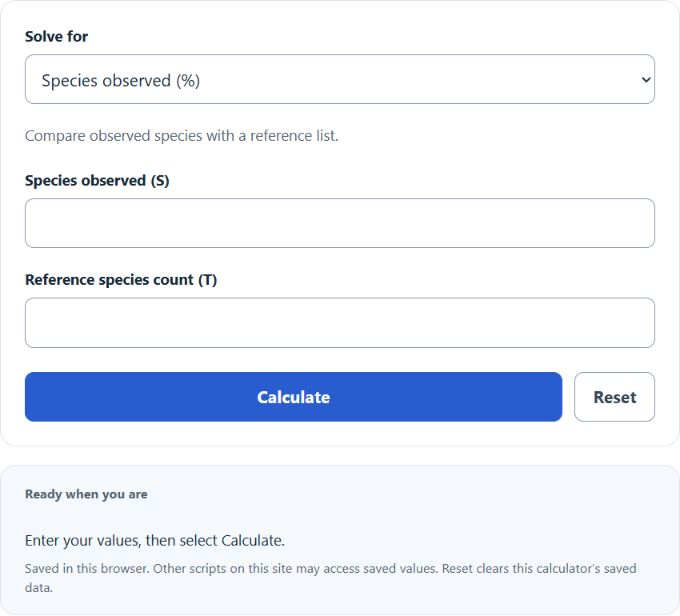
Calculate species dominance using observed and total species or species counts to find percent observed, Simpson dominance, or Berger–Parker d.
- All Statistics Calculators
- Species Richness Calculator
- Berger-Parker Index Calculator
- Simpson’s Diversity Index Calculator
Formulas Used
The calculator includes a simple species coverage percentage and two common dominance indices based on species abundances.
Variables:
- P is the percent of total species observed in the sample (%)
- S is the number of species observed in the sample
- T is the total number of species in the reference population/list
- D is finite-sample Simpson dominance (a proportion from 0 to 1), using whole species counts and sampling without replacement
- ni is the number of individuals of species i
- N is the total number of individuals across all species (N = Σni)
- d is the Berger–Parker dominance (a proportion from 0 to 1)
- Nmax is the number of individuals in the most abundant species
For P, divide the number of species observed in your sample (S) by the total number of species in the reference population/list (T). Multiply by 100 to express it as a percentage. For dominance based on abundance, choose Simpson dominance or Berger–Parker dominance and enter the count of individuals for each species.
What is a Dominance Index?
In ecology, a dominance index quantifies how strongly one species (or a few species) dominates a community based on relative abundance. When one species makes up a large share of the individuals, dominance is higher; when individuals are more evenly distributed among species, dominance is lower. Common dominance indices include Simpson’s dominance (D) and the Berger–Parker index (d).
How to Calculate Percent Species Observed (P) and Dominance Indices
The following steps outline how to calculate the percent of total species observed (P). Choose a solve mode rather than leaving an unknown field blank. Observed species must not exceed the reference count; inverse estimates from rounded percentages can be fractional. For dominance based on abundance, choose Simpson dominance or Berger–Parker dominance and enter per-species individual counts.
- Determine the number of species observed in the sample (S).
- Determine the total number of species in the reference population/list (T).
- Use the formula P% = (S / T) × 100.
- Calculate P, or check your result with the calculator above.
Example Problem:
Use the following variables as an example problem to test your knowledge.
Number of species observed in the sample (S) = 15
Total number of species in the reference population/list (T) = 50, so P% = (15 / 50) × 100 = 30%.