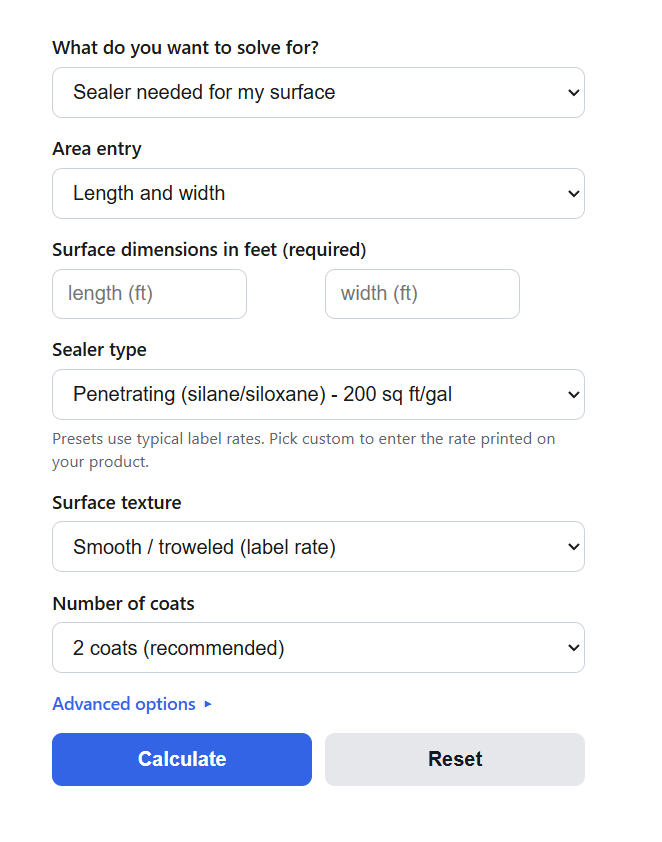
Calculate how many gallons of concrete sealer you need from area, sealer type, texture, and coats, or the area your sealer on hand will cover, plus container counts and cost.
Concrete Sealer Coverage Formula
G = (A / (R * T)) * C * (1 + W/100)
- G = gallons of sealer needed
- A = surface area (sq ft)
- R = label coverage rate (sq ft per gallon)
- T = texture factor (1.00 smooth or troweled, 0.85 broom finish, 0.70 rough or exposed aggregate)
- C = number of coats
- W = waste factor (%)
The calculator divides your surface area by the effective coverage rate, which is the label rate reduced by the texture factor, to get gallons per coat. It multiplies that by the number of coats, then adds the waste factor to account for sealer lost in the sprayer, roller nap, and spills. From the total it also reports how many 1-gallon containers or 5-gallon pails to buy, the best mix of the two container sizes, and the material cost if you enter a price per gallon.
The second mode works the equation in reverse. If you already own sealer, it tells you how much surface you can cover:
A = (G / (1 + W/100)) * R * T / C
This is useful when you have a partial pail left over and want to know whether it will handle the next slab, or when sealer is already purchased and you need to decide how far to extend the job.
Coverage Rates, Recoat Intervals, and Annual Cost by Sealer Type
Coverage varies more by sealer chemistry than by brand. The last column annualizes the material cost so you can compare sealers on equal footing: it assumes 2 coats plus 10% waste at the midpoint coverage and price, divided by the typical recoat interval. Film-forming coatings like epoxy and polyurethane cost more per gallon but often cost less per year of protection because they last far longer between recoats.
| Sealer Type | Coverage (sq ft/gal) | Typical Price/gal | Recoat Interval | Material Cost/sq ft/yr |
|---|---|---|---|---|
| Penetrating (silane/siloxane) | 150-250 | $30-50 | 3-5 years | $0.09-0.13 |
| Acrylic, solvent-based | 250-350 | $25-45 | 1-3 years | $0.12-0.15 |
| Acrylic, water-based | 300-400 | $20-40 | 1-2 years | $0.12-0.14 |
| Epoxy coating | 200-300 | $50-80 | 5-10 years | $0.07-0.09 |
| Polyurethane | 350-450 | $60-90 | 3-7 years | $0.07-0.10 |
Surface texture changes how far a gallon goes. The label rate assumes a smooth test surface, so the calculator applies these factors:
| Surface Texture | Texture Factor | Effect on Consumption |
|---|---|---|
| Smooth / troweled | 1.00 | Matches label rate |
| Broom finish | 0.85 | About 15% more sealer |
| Rough / exposed aggregate | 0.70 | About 30% more sealer |
Example Problems
Example 1: sealer needed. You want to seal a 24 ft by 30 ft broom-finished driveway with a penetrating silane/siloxane sealer rated at 200 sq ft per gallon, applying 2 coats with a 10% waste factor. The area is 24 x 30 = 720 sq ft. The effective coverage rate is 200 x 0.85 = 170 sq ft per gallon, so each coat takes 720 / 170 = 4.24 gallons. Two coats need 8.47 gallons, and adding 10% waste brings the total to 9.32 gallons. Two 5-gallon pails cover the job with a small reserve for touch-ups.
Example 2: area from sealer on hand. You have a 5-gallon pail of solvent-based acrylic rated at 300 sq ft per gallon and plan 2 coats on a smooth troweled patio, holding back 10% for waste. Usable sealer is 5 / 1.10 = 4.55 gallons. Coverable area is 4.55 x 300 x 1.00 / 2 = 682 sq ft, roughly a 26 x 26 ft area.
Frequently Asked Questions
How many gallons of concrete sealer do I need per 1,000 square feet?
At 2 coats with 10% waste on a smooth surface: a penetrating sealer at 200 sq ft per gallon takes about 11 gallons, a solvent-based acrylic at 300 sq ft per gallon takes about 7.3 gallons, a water-based acrylic at 350 sq ft per gallon takes about 6.3 gallons, and polyurethane at 400 sq ft per gallon takes about 5.5 gallons. On broom-finished or rough concrete, add 15-30% to those figures.
Why did I run out of sealer even though I followed the label coverage rate?
Label rates are measured on smooth, low-porosity test panels. Real concrete, especially broom-finished, exposed aggregate, unsealed, or older than about 5 years, absorbs significantly more product. The first coat on raw concrete is always the heaviest consumer because the pores drink in sealer before a film can form. Use the texture setting in the calculator, plan on the low end of any range printed on the label, and keep at least a 10% waste factor. Buying everything in one purchase also matters: a touch-up gallon from a different lot number can dry to a visibly different sheen.
How do I know when concrete needs resealing?
Pour a small amount of water on the surface. If it beads up and sits on top, the sealer is still working. If it darkens the concrete and soaks in within a few minutes, the protection is gone and it is time to reseal. Film-forming sealers also show wear visually through dull traffic paths, flaking, or fading. Most acrylics need recoating every 1-3 years, penetrating sealers every 3-5 years, and epoxy or polyurethane coatings every 5-10 years depending on traffic and sun exposure.