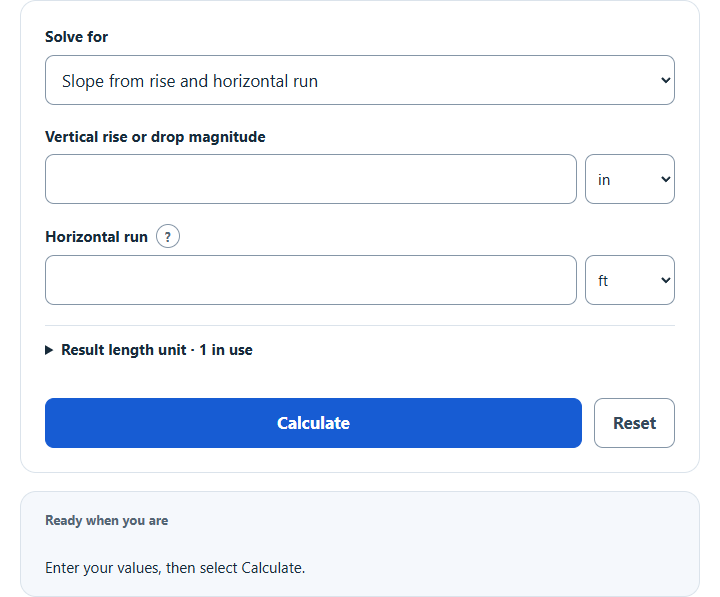
Calculate concrete slope as a percent or fall per foot from rise and run, or find the drop for a slab or patio length using the common ¼ inch per foot.
- All Construction Calculators
- Concrete Weight Calculator
- All Slope Calculators
- Average Slope Calculator
- Pipe Slope Calculator
- Grade Slope Calculator
- Concrete Footing Calculator
Calculator Functions
| Function | What it does | What it requires |
|---|---|---|
| Slope from rise and horizontal run | Finds the slope of a slab as a percent grade from its rise and run | Requires the vertical rise or drop and the horizontal run |
| Drop over a slab length (from slope) | Finds how far a slab drops over its length at a set slope | Requires the horizontal run and the slope as fall per foot, percent grade, a 1 : X ratio or an angle |
| Horizontal run from slope and rise | Finds the horizontal run needed to gain or lose a set height at a set slope | Requires the vertical rise or drop, above zero, and the slope as fall per foot, percent grade, a 1 : X ratio or an angle |
Rise and run each take their own unit: in, ft, yd, mm, cm or m. Fall per foot starts at 0.25 in/ft and can be changed. Every result lists the slope as a percent grade, a 1 : X ratio, an angle, inches per foot and mm per meter, along with the rise, the run and the length of the sloping surface. An optional setting changes the unit of the length results, which start in feet.
Concrete Slope Formulas
| CS | Concrete slope as a percent grade (%) |
| H | Vertical rise or drop, in the same unit as L |
| L | Horizontal run: the level distance, not the length along the sloping surface |
Slope from rise and horizontal run
Rise and run are converted to the same unit and divided. A patio that drops 2 in over a run of 8 ft (96 in) has a slope of 2 ÷ 96 × 100 = 2.083%, which is 0.25 in of fall per foot. A drop of 50 mm over 800 mm is 6.25%.
Drop over a slab length (from slope)
g is the slope as a plain number: fall per foot ÷ 12, percent ÷ 100, 1 ÷ X for a 1 : X ratio, or the tangent of the angle. A 12 ft slab at 0.25 in/ft drops 12 × 0.25 ÷ 12 = 0.25 ft, which is 3 in.
Horizontal run from slope and rise
A drop of 6 in at a 2% grade needs a run of 6 ÷ 0.02 = 300 in, or 25 ft. A slope of zero has no answer, because a level surface never gains height.
Common Slab Slopes
| Fall per foot | Percent grade | Ratio | Angle |
|---|---|---|---|
| 1/8 in | 1.042% | 1 : 96 | 0.597° |
| 1/4 in | 2.083% | 1 : 48 | 1.193° |
| 1/2 in | 4.167% | 1 : 24 | 2.386° |
| 1 in | 8.333% | 1 : 12 | 4.764° |
The angle is the arctangent of g, and the length of the sloping surface is √(H² + L²). The International Residential Code requires impervious surfaces within 10 ft of a foundation to slope at least 2% away from the building, and the ground itself to fall at least 6 in within the first 10 ft, which is 5% [1]. A 2% grade is 0.24 in per foot, just under 1/4 in per foot.
Limits of This Estimate
- The result is geometry only. It does not check drainage, accessibility or any other code requirement, and the code adopted locally decides the slope a slab needs.
- The run must be the level distance. Measuring along the sloping surface overstates the run and understates the slope, although the difference is small on a nearly flat slab.
- The calculation assumes one even slope from end to end, with no crown, valley or change of grade.
Sources
- International Code Council, 2021 International Residential Code, Section R401.3: minimum 2% slope for impervious surfaces near a foundation and 6 in of fall within 10 ft