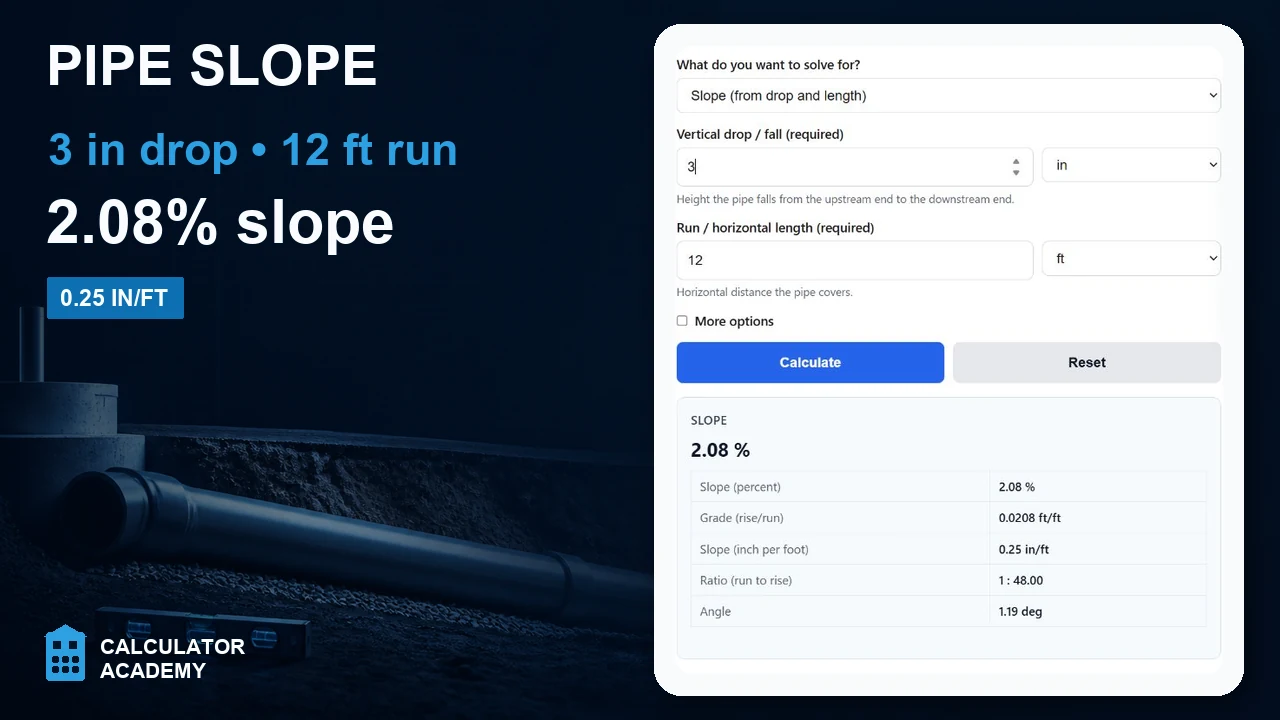
Calculate pipe slope, fall, or length by entering any two values, with results in percent or inches per foot plus common plumbing slope guidance.
Recommended Pipe Slopes For Plumping, Sewer, and Drainage
| Usage | Common Slope | Percent | Typical Use |
|---|---|---|---|
| Small fixture drain lines up to 2 in | 1/4 in per ft | 2.0833% | Lavatories, sinks, smaller branch drains |
| Larger building drains 3 in or more | 1/8 in per ft | 1.0417% | Main horizontal drains and larger pipe runs |
| Building sewer line | 1/8 in per ft to 1/4 in per ft | 1.0417% to 2.0833% | Building sewer laterals and site sewer runs |
| Very flat large-diameter runs where allowed | 1/16 in per ft | 0.5208% | Special cases only where permitted |
- All Slope Calculators
- Grade Slope Calculator
- All Construction Calculators
- Two Point Slope Calculator
- Compound Pipe Angle Calculator
Pipe Slope Formula
Pipe slope is the vertical fall of a pipe divided by its horizontal run. When you know the fall and the run, the slope as a percent is:
Slope (%) = (Fall / Run) * 100
The same ratio written as a decimal is the grade, and multiplying the grade by 12 gives the drop in inches for every foot of run:
Grade = Fall / Run
Slope (in/ft) = Grade * 12
Rearrange the first formula to find the fall needed for a target slope over a known run, or the run a given fall covers at a set slope:
Fall = (Slope / 100) * Run
Run = Fall / (Slope / 100)
When you work from surveyed elevations instead of a measured drop, the fall is the difference between the two invert elevations, and the slope follows from the run:
Fall = Upstream invert - Downstream invert
Variables:
- Slope is the steepness of the pipe, usually written as a percent but also as inches per foot, a decimal grade, or a 1:n ratio
- Fall (also called drop) is the vertical distance the pipe descends from its upstream end to its downstream end
- Run is the horizontal length the pipe covers, measured level rather than along the pipe
- Grade is the fall divided by the run as a plain decimal, the same value as slope before it is multiplied by 100
- Upstream invert and downstream invert are the inside-bottom (flow line) elevations at the high and low ends of the run
Pick what you want to solve for at the top of the calculator. The default slope mode takes the drop and the run and returns the slope as a percent, a grade, inches per foot, a ratio, and an angle. Switch to the drop mode when you know the slope and run and need the fall, or to the run mode when you know the slope and drop and need the length. The invert mode takes two flow line elevations and a run and returns the fall and the slope, and it flags an adverse slope when the downstream invert sits higher than the upstream one. Turn on the code check under More options to compare a computed slope against the plumbing code minimum for a chosen pipe size.
Minimum Drainage Pipe Slopes by Size
Smaller pipes need a steeper slope so the flow stays fast enough to carry solids, while larger pipes move more volume and can run flatter. The first table lists the minimum slopes in the International Plumbing Code. The second table converts the common pipe slopes between the formats you enter into a laser or read off a plan, so you can check the number the calculator returns.
| Pipe diameter | Minimum slope (inch per foot) | Minimum slope (percent) |
|---|---|---|
| 2.5 in or smaller | 1/4 in/ft | 2.08% |
| 3 in to 6 in | 1/8 in/ft | 1.04% |
| 8 in or larger | 1/16 in/ft | 0.52% |
These are code minimums, not targets. Many engineers design gravity sewers a little steeper, and a common floor for an 8 inch sewer on a set of plans is about 0.4 to 0.5 percent to keep a self-cleaning velocity.
| Slope (percent) | Inches per foot | Grade (ft/ft) | Ratio (run to rise) |
|---|---|---|---|
| 0.5% | 0.06 in/ft | 0.005 | 1:200 |
| 1.04% (1/8 in/ft) | 0.125 in/ft | 0.0104 | 1:96 |
| 2.08% (1/4 in/ft) | 0.25 in/ft | 0.0208 | 1:48 |
| 2% | 0.24 in/ft | 0.02 | 1:50 |
| 4% | 0.48 in/ft | 0.04 | 1:25 |
Example Problems
Example 1: Find the slope from a measured drop.
A 24 foot branch drain falls 6 inches from one end to the other. Put the fall and the run in the same units, then divide and multiply by 100. The run of 24 feet is 288 inches:
Slope = (6 / 288) * 100 = 2.08 percent, which is 1/4 inch per foot, or a 1:48 ratio.
Example 2: Find the fall needed for a target slope.
You want a 2 percent slope on a 50 foot run. Multiply the grade by the run:
Fall = (2 / 100) * 50 = 1 foot, which is 12 inches of drop across the run.
Frequently Asked Questions
What is the minimum slope for a drainage pipe?
Under the International Plumbing Code, pipes 2.5 inches and smaller need at least 1/4 inch of fall per foot, which is about 2.08 percent. Pipes from 3 to 6 inches need at least 1/8 inch per foot, about 1.04 percent, and pipes 8 inches and larger need at least 1/16 inch per foot, about 0.52 percent. Smaller pipes are held to a steeper minimum because the flow has to move fast enough to carry solids instead of letting them settle. Your local code can be stricter, so confirm the requirement for your jurisdiction before you set a grade.
What is the difference between slope, grade, and fall?
Fall is the raw vertical drop between the two ends of the pipe, measured in inches, feet, or millimeters. Slope is that fall spread over the horizontal run and written as a percent. Grade is the same ratio written as a plain decimal, so a fall of 1 foot over a 200 foot run is a fall of 1 foot, a slope of 0.5 percent, and a grade of 0.005 ft/ft. They describe one relationship in three formats, and pipe grades on plans are almost always labeled in percent.
How do you convert percent slope to inches per foot?
Divide the percent by 100 to get the grade, then multiply by 12, since there are 12 inches in a foot. A 2 percent slope is 0.02 times 12, or 0.24 inch per foot. Working the other way, the plumbing standard of 1/4 inch per foot is 0.25 divided by 12, which is 0.0208, or 2.08 percent. The calculator shows the percent, inches per foot, grade, and ratio together so you do not have to convert by hand.lope, a 4-inch PVC pipe achieves approximately 2.9 ft/s, well above the 2 ft/s self-cleaning threshold.