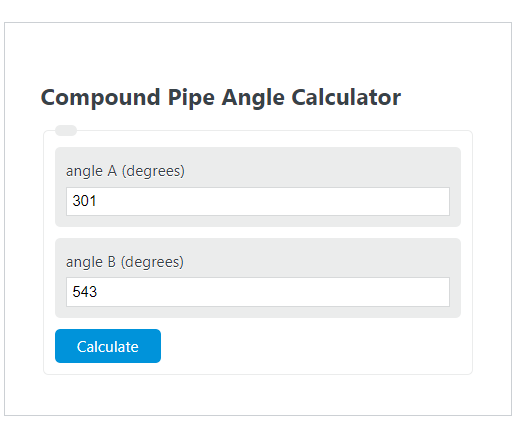
Calculate rolling pipe offset travel, run, roll angle, and cut length or add coplanar bend angles with real length and angle conversions.
- All Construction Calculators
- Pipe Bend Weight Calculator
- Rod Bending Force Calculator
- Boom Angle Calculator
Compound Pipe Angle Formula
The calculator uses two formulas depending on the mode you pick.
Rolling Offset mode finds the pipe length (travel) between two fittings when the offset goes both up and sideways:
- Rise — vertical offset between the two pipe centerlines
- Roll — horizontal offset between the two pipe centerlines
- True Offset — the diagonal offset the pipe actually spans
- Fitting Angle — the angle of the fittings on each end (45°, 22.5°, etc.)
- Travel — the center-to-center pipe length you cut
- Run — the straight-line distance along the original pipe direction
- Roll Angle — how far to rotate the fitting from vertical
Assumes both end fittings are the same angle and that rise and roll are measured perpendicular to each other. Travel is center-to-center, so subtract fitting take-off to get the cut length.
Angle Sum mode simply adds two fitting angles to get the combined bend:
- Angle A, Angle B — the individual fitting angles being stacked
This applies when both bends lie in the same plane. If the second fitting is rotated out of plane, use Rolling Offset mode instead.
Reference Tables
Common fitting multipliers for the travel calculation. Multiply your true offset by the value below to get pipe travel.
| Fitting Angle | Travel Multiplier (1/sin) | Run Multiplier (1/tan) |
|---|---|---|
| 11.25° | 5.126 | 5.027 |
| 22.5° | 2.613 | 2.414 |
| 30° | 2.000 | 1.732 |
| 45° | 1.414 | 1.000 |
| 60° | 1.155 | 0.577 |
Typical fitting take-offs to subtract from travel for a clean cut length (varies by manufacturer; verify against your spec sheet):
| Pipe Size | 45° Take-Off (each end) | 90° Take-Off (each end) |
|---|---|---|
| 1/2" | 1/4" | 5/8" |
| 3/4" | 5/16" | 3/4" |
| 1" | 3/8" | 7/8" |
| 1-1/2" | 1/2" | 1-1/8" |
| 2" | 5/8" | 1-3/8" |
Worked Example
You need to route around an obstacle that forces the pipe up 12 inches and over 8 inches, using 45° fittings on both ends.
- True offset = √(12² + 8²) = √208 = 14.42 in
- Travel = 14.42 / sin(45°) = 14.42 × 1.414 = 20.39 in
- Roll the fitting atan(8 / 12) = 33.69° from vertical
- Subtract two take-offs from 20.39 in for your cut length
FAQ
What is a rolling offset?
A rolling offset happens when a pipe shifts both vertically and horizontally between two points. The pipe rolls around its axis as it offsets, hence the name.
Why can't I use a 90° fitting in the calculator?
The travel formula divides by sin of the fitting angle. At 90° the math still works, but you no longer have an offset path; the pipe just turns the corner. The calculator restricts input to angles between 0° and 90° where the rolling offset method applies.
Is travel the same as the cut length?
No. Travel is center-to-center between fittings. Subtract the take-off (or lay-in) of each fitting to get the actual pipe cut length.