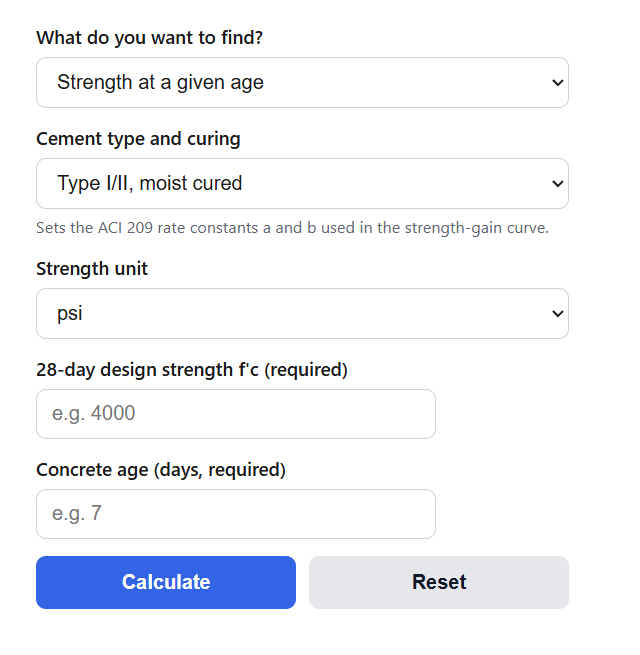
Calculate concrete strength gain over time from the 28-day design strength, find the days to reach a target strength, or project 28-day strength from an early break.
Concrete Strength Gain Formula
Concrete keeps gaining compressive strength for weeks and months after it is placed, with most of the gain happening in the first 28 days. The calculator models that curve with the ACI 209 hyperbolic relationship. To find the strength at any age from the 28-day design strength:
fc(t) = t / (a + b*t) * f'c
To go the other way and estimate the age at which the concrete reaches a target strength, the same relationship is rearranged to solve for time:
t = a*R / (1 - b*R)
Variables:
- fc(t) is the compressive strength at age t, in the same unit as f’c
- f’c is the 28-day design (specified) compressive strength
- t is the concrete age in days
- R is the target strength written as a fraction of f’c (for example 0.75 for 75 percent)
- a and b are curing constants from ACI 209 that set how fast the curve rises
The a and b constants depend on the cement type and how the concrete is cured. Pick the cement and curing option at the top of the calculator and it loads the matching constants. Choosing “Strength at a given age” returns the strength and percentage for the age you enter. Choosing “Days to reach a target strength” solves the formula backward and returns the age at which your target percent or target strength is reached. Choosing “Estimate 28-day strength from an early test” takes a break result from an earlier age and projects it forward to 28 days. Strength unit only changes the label; the ratio is the same in psi or MPa.
ACI 209 Curing Constants and Strength by Age
The first table lists the a and b values the calculator uses for each cement and curing choice. Steam curing and rapid-hardening (Type III) cement reach a high percentage of f’c faster, which is why their constants are smaller.
| Cement and curing | a | b |
|---|---|---|
| Type I/II, moist cured | 4.0 | 0.85 |
| Type I/II, steam cured | 1.0 | 0.95 |
| Type III, moist cured | 2.3 | 0.92 |
| Type III, steam cured | 0.7 | 0.98 |
Using the Type I/II moist-cured curve, the typical share of the 28-day strength at common ages is:
| Age | Approx. percent of f’c |
|---|---|
| 1 day | 16 to 21% |
| 3 days | 40 to 46% |
| 7 days | 65 to 70% |
| 14 days | 88 to 90% |
| 28 days | 99 to 100% |
Strength Thresholds for Common Construction Steps
Strength gain matters most when it decides what you can do next on site. The percentages below are common starting points from ACI 347 and post-tensioning practice, not a substitute for the values in your project specification or the engineer of record. Enter the threshold you need in the “Days to reach a target strength” mode to see when the curve reaches it.
| Construction step | Typical strength target |
|---|---|
| Remove side forms on walls and beams | Enough to resist handling, often a few hundred psi |
| Strip forms and reshore slabs | About 70 to 75% of f’c |
| Stress post-tensioning tendons | Commonly 3000 psi, per the PT design |
| Open concrete to foot or light traffic | Around 75% of f’c |
| Full design service load | 100% of f’c |
Example Problems
Example 1. A slab is specified at f’c of 4000 psi using Type I cement with moist curing. You want the strength at 7 days. With a = 4.0 and b = 0.85, the ratio is 7 / (4.0 + 0.85 * 7) = 7 / 9.95 = 0.703. The strength is 0.703 * 4000 = about 2810 psi, or roughly 70 percent of the design strength.
Example 2. Using the same mix, you need 75 percent of f’c (R = 0.75) before you strip the forms. Solving for time gives t = 4.0 * 0.75 / (1 – 0.85 * 0.75) = 3.0 / 0.3625 = about 8.3 days. You would plan the strip for day 9 and confirm with field-cured test cylinders.
Frequently Asked Questions
Does concrete stop gaining strength at 28 days? No. The 28-day value is a reference point for design and acceptance, not the end of the curve. Well-cured concrete keeps gaining strength for months, often reaching 110 to 125 percent of f’c by 90 days to a year, though the rate slows sharply after 28 days.
Why does the calculator ask for cement type and curing? The rate of the strength-gain curve changes with the cement and curing method. Rapid-hardening Type III cement and steam curing push a larger share of the strength into the first week, so they use smaller a and b constants and a steeper early curve.
Can I use this to decide when to remove formwork or load the slab? Use it for planning and comparison only. Real in-place strength depends on the actual mix, temperature history, and curing, so decisions about stripping forms, stressing tendons, or loading a member should be confirmed with field-cured cylinders or another accepted test and signed off by the responsible engineer.