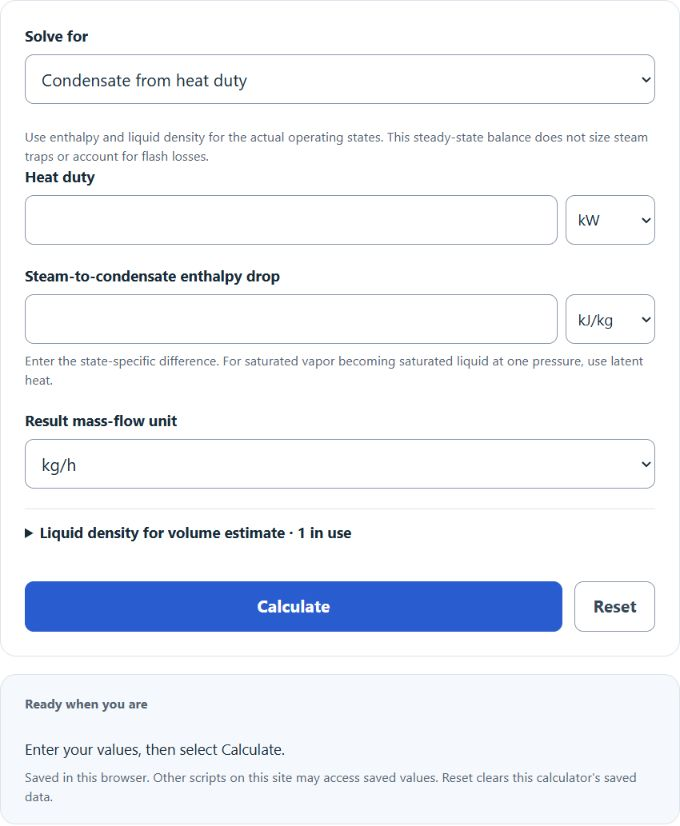
Calculate steam condensate from heat duty and enthalpy or wet-steam flow and quality, convert kg/h and lb/h, estimate gpm, or reverse heat load.
Related Calculators
- Hazen Williams Equation Calculator
- Hot Water Recovery Calculator
- TDH (Total Dynamic Head) Calculator
- Subcooling Calculator
- All Construction Calculators
Condensate Flow Rate Formulas
This page includes two common ways to estimate condensate flow rate, depending on what you mean by “condensate” and what data you have: (1) the liquid water (moisture) fraction carried with wet steam based on steam quality, and (2) the condensate generated by a heat load when saturated steam condenses.
Variables:
- CFR is the condensate (liquid water) mass flow rate (e.g., lb/hr, kg/hr)
- SF is the total wet-steam mass flow rate (e.g., lb/hr, kg/hr)
- SQ is the steam quality, x, expressed as a percent vapor by mass (0–100%)
- Q is the heat load (e.g., Btu/hr or kW)
- hfg is the latent heat for saturated vapor becoming saturated liquid at the same pressure. More generally, enter the actual inlet-to-outlet enthalpy drop Δh (kJ/kg or Btu/lb, International Table).
For the steam-quality method, multiply total wet-steam flow by the liquid fraction (1 − x). For the heat-load method, use mass flow (kg/h) = heat duty (kW) × 3600 / Δh (kJ/kg), or use consistent Btu/h and Btu/lb for lb/h. The reverse mode uses heat duty (kW) = mass flow (kg/h) × Δh (kJ/kg) / 3600. Use hfg only for saturated vapor condensing to saturated liquid at one pressure; an actual enthalpy drop can include superheat or subcooling. The density field affects only the liquid-volume estimate; 958 kg/m³ approximates water near 100°C. See the NIST saturation table for state-dependent properties. This steady-state balance does not size traps or include flash losses.
What is Condensate Flow Rate?
Condensate flow rate is the mass flow rate of liquid water (condensate) in a steam system. Depending on context, it may refer to (a) liquid water carried with wet steam (moisture present because the steam quality is less than 100%), or (b) condensate produced when steam gives up heat and condenses in equipment such as heat exchangers and coils. Steam quality (vapor mass fraction) is only used in case (a); for case (b), condensate depends primarily on the heat removed from the steam (latent heat).
How to Calculate Condensate Flow Rate?
The following steps outline how to calculate the Condensate Flow Rate.
- Choose Liquid moisture in wet steam for wet-steam flow and vapor mass percentage, Condensate from heat duty for heat duty and the actual enthalpy drop, or Heat duty from condensate for the reverse energy balance. The calculator does not infer enthalpy from steam pressure.
- For the steam-quality method, determine the total wet-steam flow (SF) in a mass flow unit (e.g., lb/hr).
- Determine the steam quality (SQ), which is the percent vapor by mass (0–100%).
- Compute CFR using the appropriate formula: CFR = SF × (1 − SQ/100) (steam-quality moisture) or CFR = Q / hfg (condensing saturated steam from a heat load).
- After inserting the variables and calculating the result, check your answer with the calculator above.
Example Problem :
Use the following variables as an example problem to test your knowledge.
steam flow (SF) = 500 lbs/hr
steam quality (SQ) = 90% (so the liquid water/moisture portion is CFR = 500 × (1 − 0.90) = 50 lbs/hr)