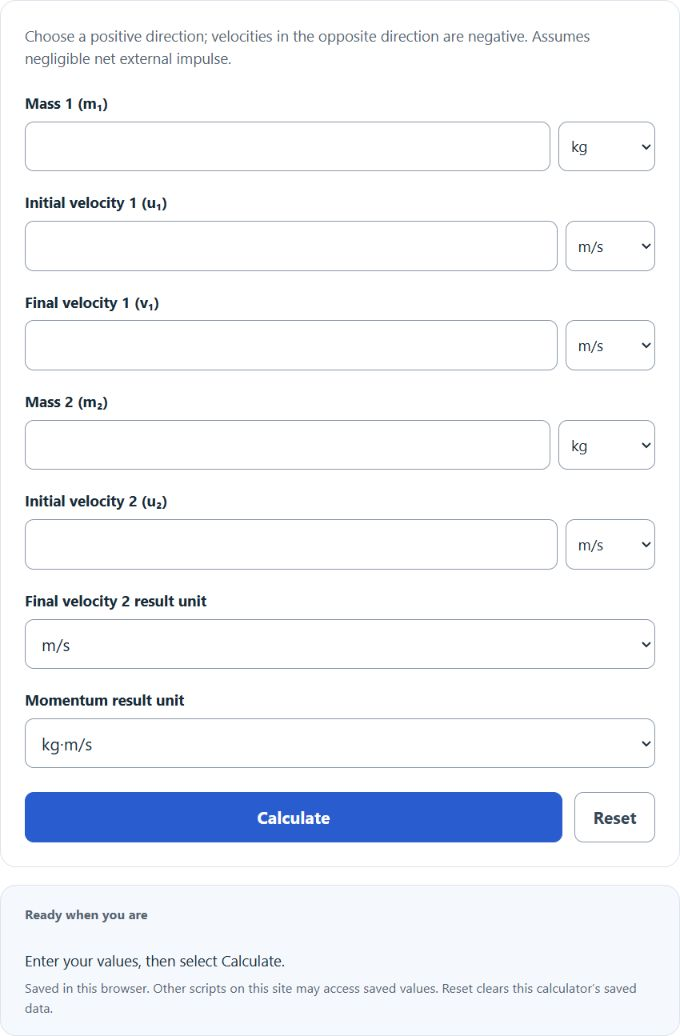
Calculate 1D conservation of momentum by entering two masses and initial/final velocities to find final velocity 2 and compare total momentum.
- All Physics Calculators
- Conservation of Energy Calculator
- Elastic Collision Calculator
- Velocity Calculator
- Total Momentum Calculator
- Change in Momentum Calculator
- Impulse Calculator
- Inelastic Collision Velocity Calculator
Conservation of Momentum Formula
The following formula is used for two objects interacting in one dimension when the net external impulse on the system is negligible (so total momentum is conserved).
m₁u₁ + m₂u₂ = m₁v₁ + m₂v₂
v₂ = u₂ + (m₁ / m₂)(u₁ − v₁)
- Where m₁ is the mass of object 1
- u₁ is the initial velocity of object 1
- v₁ is the final velocity of object 1
- m₂ is the mass of object 2
- u₂ is the initial velocity of object 2
- and v₂ is the final velocity of object 2
Choose a positive direction along the line of motion and use positive/negative velocities accordingly. Conservation of momentum states that the system’s total momentum before the interaction equals the system’s total momentum after the interaction (assuming negligible net external impulse).
Conservation of Momentum Definition
Conservation of momentum is a law of physics that says the total momentum of an isolated system remains constant. In other words, the system’s total momentum can only change if there is a net external impulse (e.g., due to outside forces) on the system.
How to calculate the conservation of momentum?
How to use conservation of momentum (1D) to solve for an unknown velocity.
- First, define a sign convention and list known values.
Choose a positive direction along the line of motion, then write down m₁, m₂, and the known initial/final velocities (u₁, u₂, v₁, v₂).
- Next, write and rearrange the momentum equation.
Use m₁u₁ + m₂u₂ = m₁v₁ + m₂v₂ and rearrange to solve for the unknown variable.
- Finally, calculate the unknown and (optionally) verify.
Compute the missing value and check that total momentum before and after matches (within rounding).
FAQ
Conservation of momentum is a law of physics that says the total momentum of an isolated system remains constant. In other words, the system’s total momentum can only change if there is a net external impulse (e.g., due to outside forces) on the system.
Total momentum of a system changes when there is a net external impulse (net external force over time). For a single object in classical mechanics, p = mv, so (at constant mass) its momentum changes when its velocity changes.