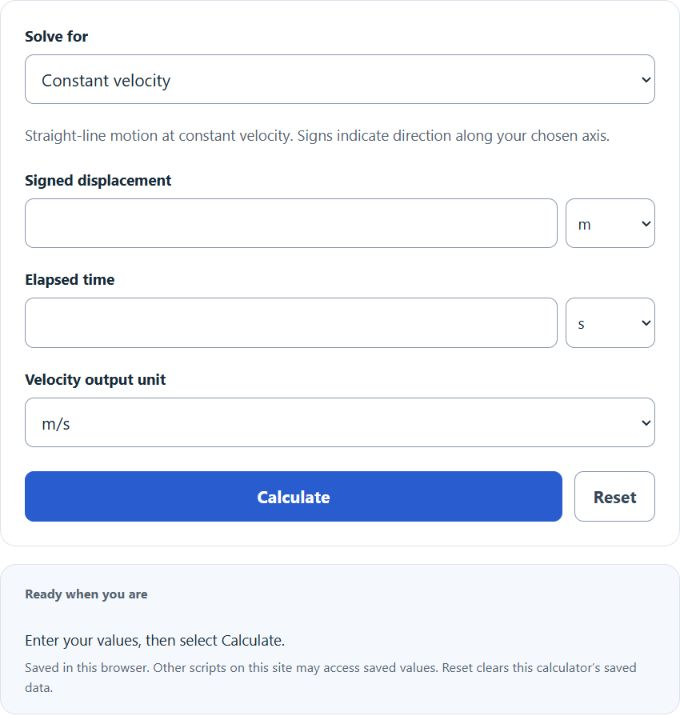
Calculate constant velocity, signed displacement (with distance traveled), elapsed time, or final position from signed displacement, velocity, and time in common metric and imperial units.
- All Physics Calculators
- All Velocity Calculators
- Final Velocity Calculator
- Maximum Velocity Calculator
- Velocity Calculator
- Initial Velocity Calculator
- Acceleration Calculator
Constant Velocity Formula
Constant velocity motion means the object covers equal displacements in equal time intervals. The calculator uses one base relationship and rearranges it for each mode.
- v = constant velocity
- Δx = displacement (change in position)
- t = elapsed time
- x₀ = initial position
- x = final position
The four calculator modes map to the four equations above. The Velocity mode divides displacement by time. The Displacement / distance mode multiplies velocity by time and also shows the nonnegative distance traveled. The Time mode divides displacement by velocity. The Final Position mode adds the displacement (v × t) to the initial position x₀, so negative velocity decreases the position coordinate.
Reference Values and Unit Conversions
These are illustrative approximate speeds, not recommended speeds or diagnostic categories. Unit conversion factors are rounded where shown.
| Motion | m/s | km/h | mph |
|---|---|---|---|
| Walking | 1.4 | 5.0 | 3.1 |
| Jogging | 3.0 | 10.8 | 6.7 |
| City driving | 13.4 | 48.3 | 30 |
| Highway | 29.1 | 104.6 | 65 |
| Speed of sound (air, approximately 20°C) | 343 | 1235 | 767 |
| Convert | Multiply by |
|---|---|
| m/s to km/h | 3.6 |
| m/s to mph | 2.2369 |
| mph to m/s | 0.44704 |
| ft/s to m/s | 0.3048 |
| mi to km | 1.6093 |
Worked Examples
Example 1: Find velocity. A train covers 480 m in 24 s at constant velocity. Using v = Δx / t, v = 480 / 24 = 20 m/s. That converts to 72 km/h.
Example 2: Find final position. A cyclist starts at x₀ = 50 m moving at v = -4 m/s for t = 10 s. Using x = x₀ + v × t, x = 50 + (-4)(10) = 10 m. The negative velocity moved the cyclist 40 m back along the axis.
FAQ
Is constant velocity the same as constant speed? No. Constant velocity requires constant speed and constant direction. A car going around a curve at 30 mph has constant speed but changing velocity.
What if acceleration is not zero? These formulas do not apply. Use kinematic equations that include acceleration, such as Δx = v₀t + ½at².
Why does the time mode reject zero velocity? At zero velocity, nonzero displacement has no solution. Zero displacement at zero velocity permits any nonnegative elapsed time and therefore has no unique inverse.
Can displacement be negative? Yes. A negative sign indicates motion opposite to the chosen positive direction. The calculator preserves the sign through all four modes.