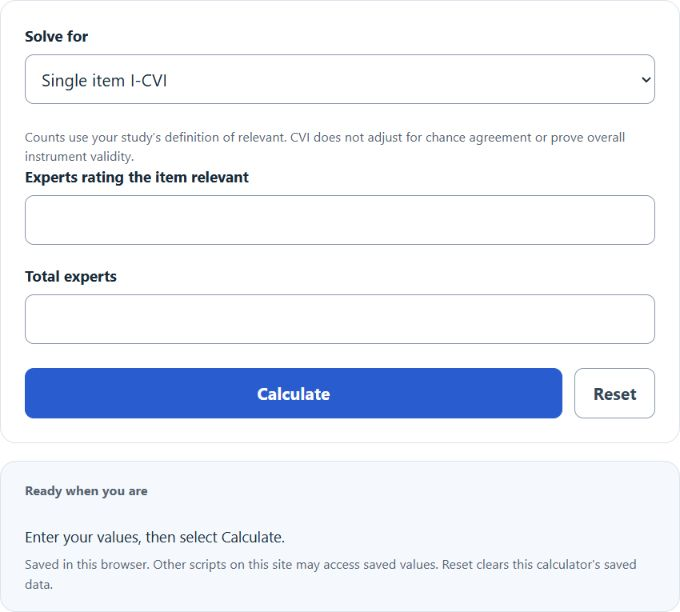
Calculate item-level I-CVI from expert ratings or scale-level S-CVI/Ave from relevant-count values across multiple items.
Related Calculators
- P-hat Calculator
- Discrepancy Rate Calculator
- Jaccard Coefficient Calculator
- Variation Ratio Calculator
- All Statistics Calculators
Content Validity Index (I-CVI) Formula
The single item content validity index is the proportion of experts who rated an item as relevant.
I-CVI = R/N
For a full scale, the S-CVI/Ave is the average of the I-CVI values across all items.
S-CVI/Ave = (I-CVI_1 + I-CVI_2 + … + I-CVI_k)/k
- I-CVI = item-level content validity index
- S-CVI/Ave = scale-level content validity index by averaging item CVIs
- R = number of experts who rated the item as relevant
- N = total number of experts
- k = number of items in the scale
- I-CVI1, I-CVI2, … = the I-CVI values for each item
In the single item mode, enter the number of experts who judged the item relevant and the total number of experts. The calculator divides the relevant count by the total expert count.
In the whole scale mode, enter the total number of experts and the relevant-count values for each item. The calculator first converts each item count into an I-CVI, then averages those I-CVI values to produce S-CVI/Ave.
Common Content Validity Interpretation Cutoffs
These are illustrative conventions, not universal pass/fail rules. Choose and report a study-specific protocol. Polit, Beck and Owen (2007) discuss I-CVI ≥ 0.78 for panels of three or more experts; other conventions demand unanimity for small panels. The summary tables do not adjust for chance agreement and cannot establish overall instrument validity.
| Expert panel size | I-CVI result | Typical interpretation |
|---|---|---|
| 5 or fewer experts | 1.00 | Acceptable. All experts rated the item relevant. |
| 5 or fewer experts | Less than 1.00 | Usually not acceptable. Revise the item or review the ratings. |
| 6 or more experts | 0.78 or higher | Acceptable item-level content validity. |
| 6 or more experts | 0.70 to 0.779 | Borderline. Consider revising the item. |
| 6 or more experts | Less than 0.70 | Not acceptable. Revise or discard the item. |
| S-CVI/Ave result | Typical interpretation | What it means |
|---|---|---|
| 0.90 or higher | Excellent | The scale has strong average item relevance across the expert panel. |
| 0.80 to 0.899 | Acceptable but could improve | Review lower-scoring items and revise where needed. |
| Less than 0.80 | Below recommended level | The scale likely needs revision before use. |
Examples
Example 1: Single item I-CVI
An item is reviewed by 6 experts. Five experts rate the item as relevant.
I-CVI = 5/6 ≈ 0.833
The I-CVI is 0.833. With 6 experts, this is above 0.78, so the item is typically considered acceptable.
Example 2: Whole scale S-CVI/Ave
A scale has 5 items and 6 experts. The relevant counts for the items are 6, 5, 6, 4, and 6.
Item I-CVIs = 6/6, 5/6, 6/6, 4/6, 6/6
S-CVI/Ave = (1.000 + 0.833 + 1.000 + 0.667 + 1.000)/5 ≈ 0.900
The S-CVI/Ave is 0.900, which is commonly interpreted as excellent scale-level content validity.
FAQ
What counts as a “relevant” rating?
In many content validity studies, experts rate each item on a relevance scale, such as 1 to 4. Ratings of 3 or 4 are often counted as relevant, while ratings of 1 or 2 are counted as not relevant. Use the rule stated in your study protocol, then enter only the number of experts who meet that relevance rule.
What is the difference between I-CVI and S-CVI/Ave?
I-CVI is calculated for one item. It tells you what proportion of experts judged that item relevant. S-CVI/Ave is calculated for a group of items. It averages the I-CVI values across all items to summarize the content validity of the full scale.
Can the relevant count be higher than the total number of experts?
No. The relevant count must be less than or equal to the total number of experts. For example, if 6 experts reviewed the item, the relevant count can be 0 through 6 only.