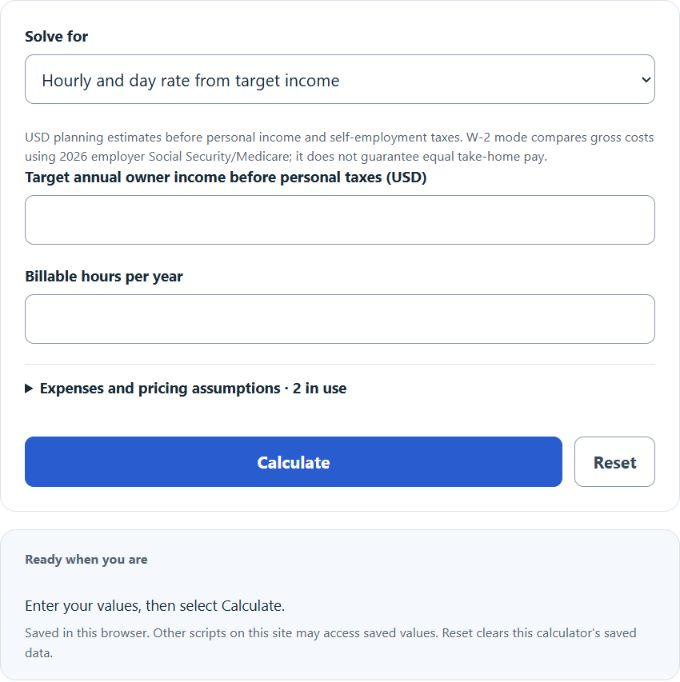
Calculate an illustrative hourly rate, day rate, or project bid, plus a gross W-2 cost comparison, from your target income, expenses, billable hours, and margin.
Contractor Calculator Formula
This calculator works in three modes. Pick what you want to solve for, and it uses the matching formula below.
Hourly Rate = (Income + Expenses) / (1 – Margin) / Billable Hours
Gross Cost Rate = (Salary + Employer Payroll + Salary * Benefits + Expenses) / Billable Hours
Bid = (Labor + Materials) * (1 + Overhead) / (1 – Margin)
- Income = the owner income before personal taxes pay you want for the year
- Expenses = your yearly business costs such as insurance, tools, software, and a vehicle
- Billable Hours = hours per year you can actually bill a client, not total hours worked
- Margin = profit margin as a decimal, so 15 percent is 0.15
- Salary = your current W-2 salary before the switch to contracting
- Benefits = value of lost benefits as a decimal share of salary. For 2026, employer payroll here is 6.2% of salary up to $184,500 plus 1.45% of all salary; other payroll costs are excluded.
- Labor = labor hours times your labor rate; Materials = cost of materials for the job
- Overhead = overhead markup as a decimal applied to job cost
The required rate mode starts from the income you want, adds your expenses, divides by one minus your margin to leave room for profit, then spreads that revenue over your billable hours. The W-2 mode adds the modeled 2026 employer payroll component, benefits and expenses to gross salary. It compares costs before personal taxes and does not calculate equal net pay or actual self-employment tax. The project bid mode adds labor and materials, marks the total up for overhead, then prices it so your target margin survives.
Billable Hours and Margin Illustrations
These values are illustrations rather than verified industry benchmarks. Enter your actual hours and costs; the percentage and day-length defaults are editable assumptions.
| Input | Illustrative range | Notes |
|---|---|---|
| Billable hours per year | 1,200 to 1,900 | For illustration, 60 to 75 percent of 2,080 hours is 1,248 to 1,560 hours; actual capacity varies. |
| Business expenses | 30 to 50 percent of revenue | Insurance, vehicle, tools, licenses, software, marketing |
| Profit margin | 10 to 20 percent | Margin kept after salary and overhead are covered |
| Lost benefits | 25 to 30 percent of salary | Health insurance, retirement match, paid time off |
| W-2 salary | Naive rate (salary / 2,080) | Gross cost comparison rate |
|---|---|---|
| $80,000 | $38.46 | About $59 per hour |
| $120,000 | $57.69 | About $88 per hour |
| $160,000 | $76.92 | About $117 per hour |
The 1099 column assumes 25 percent lost benefits, $6,000 of expenses, and 1,880 billable hours. Your own result will shift with those inputs.
Example Problems
Example 1. You want $90,000 of owner income before personal taxes pay, expect $15,000 of business expenses, can bill 1,500 hours, and want a 15 percent margin. Revenue needed is (90,000 + 15,000) / (1 – 0.15) = $123,529. Divided by 1,500 hours that is $82.35 per hour, or about $659 for an eight-hour day.
Example 2. You earn a $120,000 W-2 salary and switch to 1099 with 25 percent lost benefits, $6,000 of expenses, and 1,880 billable hours. The target revenue is 120,000 * 1.0765 + 120,000 * 0.25 + 6,000 = $165,180, which is $87.86 per hour. A plain salary divided by 2,080 would have been only $57.69, so the modeled gross costs differ by about $30 per billable hour; this is not an equal-net-pay estimate.
Frequently Asked Questions
Why are billable hours lower than the hours I work? Time spent on admin, travel, quotes, invoicing, and finding the next client is real but not billable. Spreading your income only over the hours you can actually bill is what keeps the rate high enough to cover the unpaid time.
What is the difference between markup and margin? Markup is added on top of cost, so cost times 1.2 adds 20 percent of the cost. Margin is a share of the final price, so dividing cost by 0.80 gives a true 20 percent margin. This calculator uses the divisor method for margin so the percentage you enter is the share of revenue you actually keep.
How much higher should a 1099 rate be than a W-2 wage? There is no universal percentage. Billable hours, benefits, expenses and taxes differ. This calculator models gross costs; it excludes personal income and self-employment tax and cannot determine equal net pay.