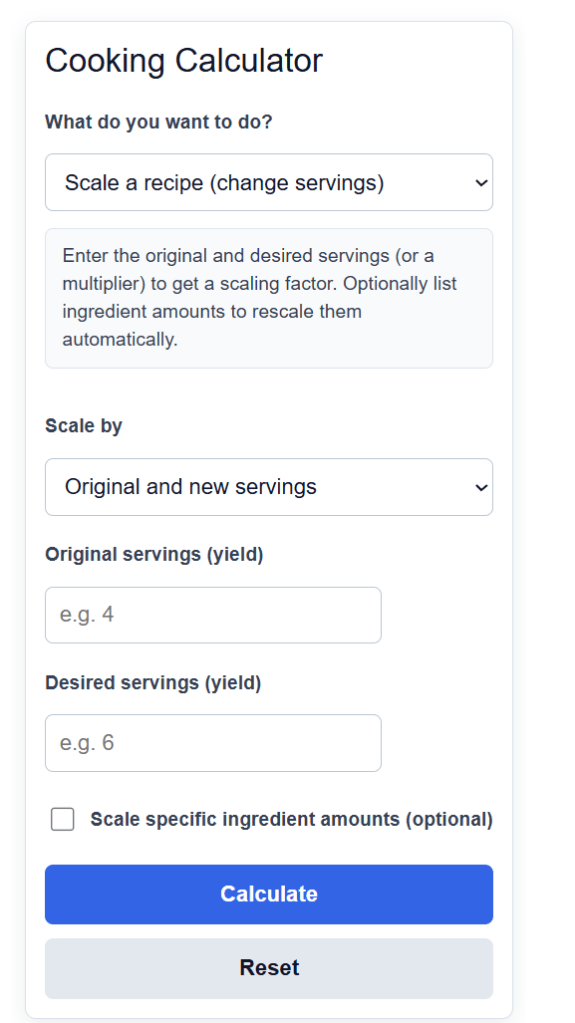
Calculate recipe scaling, ingredient conversions, and oven temperatures fast with this free cooking calculator.
Cooking Calculator Formula
This calculator runs three separate cooking tasks, and each one uses its own formula.
To scale a recipe to a new yield:
Scaled Amount = Original Amount * (Desired Yield / Original Yield)
To convert one measurement unit into another within the same type (volume to volume or weight to weight):
Output = Amount * (From Factor / To Factor)
To convert between volume and weight for a specific ingredient:
Weight (g) = Volume (ml) * Density (g/ml)
To convert an oven temperature:
C = (F - 32) * 5 / 9 F = C * 9 / 5 + 32 Gas Mark = (F - 250) / 25
- Original Amount: the quantity of an ingredient in the original recipe.
- Original Yield and Desired Yield: the number of servings the recipe makes now and the number you want.
- From Factor and To Factor: the size of each unit measured against a common base (milliliters for volume, grams for weight).
- Density: the weight of one milliliter of the ingredient, used to move between cups, grams, and ounces.
- F, C, Gas Mark: the Fahrenheit, Celsius, and UK gas mark versions of the same oven temperature.
The scaling tool finds the ratio between the yields and multiplies each ingredient you enter by that ratio. The conversion tool changes every unit to a common base and then back out to the unit you want, so any volume or weight unit can convert to any other. The volume and weight mode adds an ingredient density so a cup of flour and a cup of honey return different weights. The temperature tool converts your value to Celsius first, then produces all three scales at once.
Common Cooking Conversions and Oven Temperatures
These reference values match what the calculator returns. Use them for quick checks without re-running a conversion.
| Volume | Tablespoons | Teaspoons | Milliliters |
|---|---|---|---|
| 1 cup | 16 | 48 | 237 |
| 1/2 cup | 8 | 24 | 118 |
| 1/4 cup | 4 | 12 | 59 |
| 1 tablespoon | 1 | 3 | 15 |
One cup weighs a different amount depending on the ingredient. The values below are the densities the volume and weight mode uses.
| Ingredient | Grams per cup |
|---|---|
| All-purpose flour | 120 |
| Granulated sugar | 200 |
| Brown sugar (packed) | 220 |
| Butter | 227 |
| Honey | 340 |
| Fahrenheit | Celsius | Gas Mark | Description |
|---|---|---|---|
| 325 | 163 | 3 | Moderate |
| 350 | 177 | 4 | Moderate |
| 400 | 204 | 6 | Hot |
| 425 | 218 | 7 | Hot |
| 450 | 232 | 8 | Very hot |
Example Problems
Example 1: Scaling a recipe up. A soup recipe serves 4 and you need to serve 10. The scaling factor is 10 / 4 = 2.5. If the recipe calls for 3 cups of broth, you need 3 * 2.5 = 7.5 cups. If it calls for 1 cup of cream, you need 1 * 2.5 = 2.5 cups. Reduce the salt slightly from the full scaled amount and taste before adding more.
Example 2: Converting flour by weight. A recipe lists 2 cups of all-purpose flour and you want grams. One cup of flour is 120 grams, so 2 cups is 2 * 120 = 240 grams. The volume and weight mode returns the same result when you set the ingredient to all-purpose flour, the amount to 2, the from unit to cups, and the to unit to grams.
Frequently Asked Questions
Why should I not scale salt and spices by the same factor as everything else? Flavor compounds in salt and strong spices do not increase in taste at the same rate that their quantity increases. If you triple a recipe and triple the salt, the result often tastes too salty. Start at about 60 to 70 percent of the scaled amount, then taste and adjust upward.
Why do a cup of flour and a cup of honey give different weights? A cup is a fixed volume, but ingredients have different densities. Honey is dense and heavy, so a cup weighs about 340 grams, while a cup of flour is light and airy at about 120 grams. The volume and weight mode applies the correct density for each ingredient, which is why weighing is more accurate than measuring by cup.
Do cooking time and oven temperature change when I scale a recipe? Yes. Doubling a recipe does not double the cooking time, and a larger or deeper pan changes how heat reaches the center. Keep the oven temperature the same in most cases, check for doneness earlier than you expect, and adjust the pan size so the depth of the food stays similar to the original.