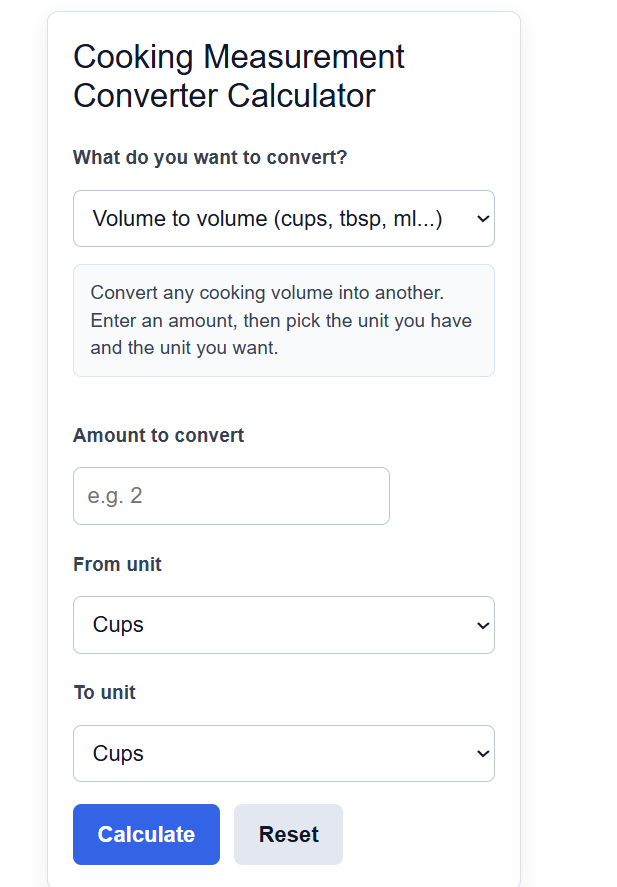
Convert cooking measurements between cups, tablespoons, grams, ounces, and more, including volume to weight by ingredient.
Cooking Measurement Converter Formula
This calculator works in three modes, and each mode uses its own formula.
To convert one unit into another of the same type (volume to volume or weight to weight), every unit is measured against a common base, milliliters for volume and grams for weight:
Output = Amount * (From Factor / To Factor)
To convert between volume and weight for a specific ingredient, the ingredient density is applied:
Weight (g) = Volume (ml) * Density (g/ml)
The reverse direction divides instead of multiplies:
Volume (ml) = Weight (g) / Density (g/ml)
- Amount: the number you want to convert.
- From Factor and To Factor: the size of each unit measured against the common base (1 cup = 236.59 ml, 1 tablespoon = 14.79 ml, 1 ounce = 28.35 g, and so on).
- Density: the weight of one milliliter of the chosen ingredient, used to move between volume units and weight units.
- Output: the converted value in the unit you selected.
In volume to volume mode the calculator changes your amount to milliliters and then back out to the volume unit you want. Weight to weight mode does the same through grams. The volume and weight mode adds a density step so a cup of flour and a cup of honey return different weights, which is why you pick the ingredient first in that mode.
Common Cooking Conversions and Ingredient Weights
These reference values match what the calculator returns. Use them for quick checks without re-running a conversion.
| Volume | Tablespoons | Teaspoons | Milliliters |
|---|---|---|---|
| 1 cup | 16 | 48 | 237 |
| 1/2 cup | 8 | 24 | 118 |
| 1/4 cup | 4 | 12 | 59 |
| 1 tablespoon | 1 | 3 | 15 |
| 1 teaspoon | 1/3 | 1 | 5 |
One cup weighs a different amount depending on the ingredient. The values below are the densities the volume and weight mode uses.
| Ingredient | Grams per cup | Grams per tablespoon |
|---|---|---|
| All-purpose flour | 120 | 7.5 |
| Granulated sugar | 200 | 12.5 |
| Brown sugar (packed) | 220 | 13.8 |
| Butter | 227 | 14.2 |
| Honey | 340 | 21.3 |
Example Problems
Example 1: Converting cups to milliliters. You have 2 cups of stock and a recipe written in milliliters. One cup is 236.59 ml, so 2 cups is 2 * 236.59 = 473.18 ml. Set the mode to volume to volume, the from unit to cups, and the to unit to milliliters to get the same result.
Example 2: Converting flour by weight. A recipe lists 2 cups of all-purpose flour and you want grams. One cup of flour is 120 grams, so 2 cups is 2 * 120 = 240 grams. Use the volume and weight mode, set the ingredient to all-purpose flour, the amount to 2, the from unit to cups, and the to unit to grams.
Frequently Asked Questions
Why does a cup of flour weigh less than a cup of honey? A cup is a fixed volume, but every ingredient has its own density. Honey is heavy and dense, so a cup weighs about 340 grams, while flour is light and airy at about 120 grams. The volume and weight mode applies the correct density for each ingredient, which is why a scale is more accurate than a measuring cup for dense or sticky items.
Can I convert grams straight to cups? Only if you tell the calculator what the ingredient is. Grams measure weight and cups measure volume, so the conversion depends on density. Pick the ingredient in the volume and weight mode, then convert grams to cups or cups to grams in either direction.
Are US and metric cups the same? No. This calculator uses the US customary cup of about 236.6 ml. A metric cup is 250 ml and a UK cup is about 284 ml, so a recipe that lists metric cups will read slightly low if you measure with US cups. Check which system your recipe uses before converting.