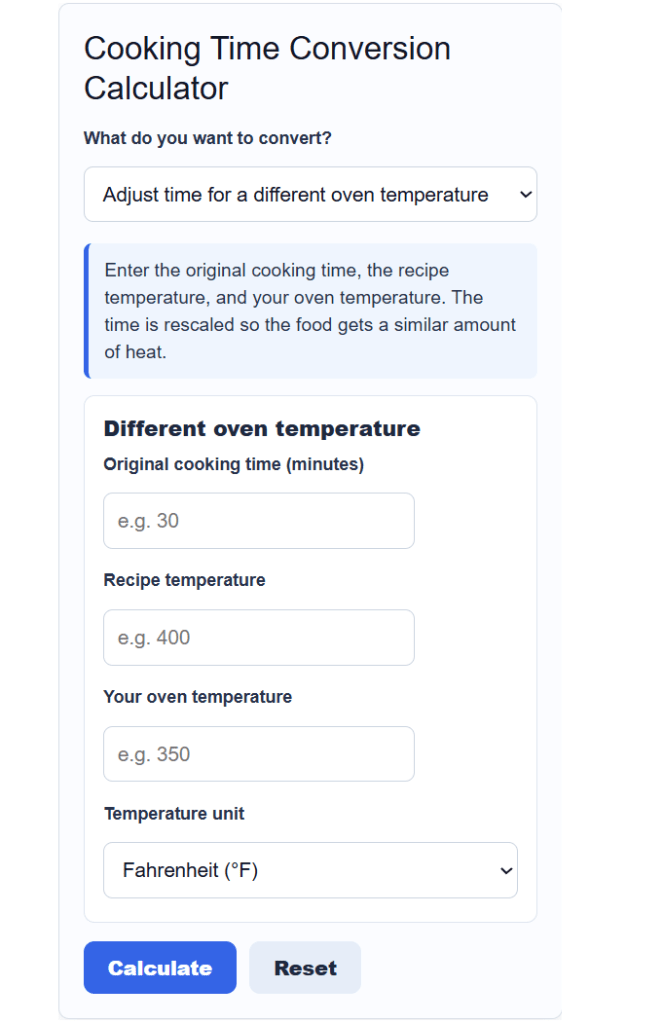
Calculate adjusted cooking times when you change oven temperature, switch between convection and conventional, or use a different microwave wattage.
Cooking Time Conversion Formula
The calculator uses a different formula for each conversion mode. Pick the mode that matches the change you are making.
When you only change the oven temperature, the time is rescaled so the food receives a similar amount of heat:
NT = OT * (Tr / To)
When you switch between a conventional oven and a convection (fan) oven, the temperature is dropped and the time is shortened:
New Temp = T - D New Time = t * (1 - C)
When you change microwave wattage, the time scales inversely with power:
NT = OT * (Wp / Wy)
- NT = New cooking time
- OT = Original cooking time from the recipe or package
- Tr = Recipe (target) temperature
- To = Your oven temperature
- T = Known temperature before the convection conversion
- D = Temperature reduction for the fan oven (about 25 degrees F or 20 degrees C)
- t = Known cooking time before the convection conversion
- C = Time reduction fraction for the fan oven (about 0.10 to 0.15)
- Wp = Wattage printed on the package
- Wy = Wattage of your microwave
In the temperature mode, raising your oven temperature above the recipe value gives a ratio below 1, so the time goes down. Lowering your oven temperature gives a ratio above 1, so the time goes up. In the convection mode, the temperature reduction lowers the dial setting and the time reduction trims the cooking time because moving air transfers heat faster. In the microwave mode, a lower wattage oven delivers less power, so the time is multiplied up to compensate.
Conversion Reference Values
Use these typical values as a starting point, then check the food near the end of cooking since shape, thickness, and pan material also matter.
| Convection conversion | Temperature change | Time change |
|---|---|---|
| Conventional to fan | Lower by 25 F / 20 C | Cut by 10 to 15 percent |
| Fan to conventional | Raise by 25 F / 20 C | Add 10 to 15 percent |
| Package time | 1000 W package on a 700 W oven | 1000 W package on a 1200 W oven |
|---|---|---|
| 2 min | 2 min 51 s | 1 min 40 s |
| 4 min | 5 min 43 s | 3 min 20 s |
| 6 min | 8 min 34 s | 5 min 00 s |
Example Problems
Example 1. A recipe says to bake for 30 minutes at 400 degrees F, but your oven only goes to 350 degrees F. Using the temperature formula, NT = 30 * (400 / 350) = 34.3 minutes. Bake for about 34 minutes and check for doneness.
Example 2. A casserole takes 40 minutes at 350 degrees F in a conventional oven and you want to use the fan setting. Drop the temperature by 25 degrees F to 325 degrees F and cut the time by 12.5 percent: New Time = 40 * (1 - 0.125) = 35 minutes.
Frequently Asked Questions
Does changing the oven temperature change the cooking time exactly? The formula gives a close estimate by keeping the total heat similar, but it is not exact. Browning, rising, and the center reaching temperature all depend on how the food is shaped and how thick it is. Treat the result as a guide and start checking a few minutes before the calculated time.
Why does a lower microwave wattage need more time? Wattage is the power the microwave delivers. A 700 watt oven puts out less energy each second than a 1000 watt oven, so it needs more time to deliver the same total energy. The time scales by the ratio of the package wattage to your wattage.
How much should I reduce time and temperature for a fan oven? A common rule is to lower the temperature by about 25 degrees F or 20 degrees C and cut the time by 10 to 15 percent. You can adjust both values in the calculator if your oven manual suggests something different.