Calculate Coriolis force, mass, velocity, angular velocity, or latitude by choosing the value to solve for using Earth’s rotation formula and unit conversions.
Related Calculators
- Wind Resistance Calculator
- Drag Coefficient Calculator
- Horizontal and Vertical Velocity Calculator
- Froude Number Calculator
- All Physics Calculators
Coriolis Effect Formula
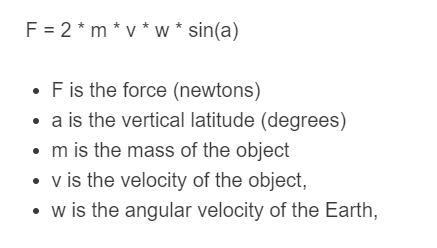
The calculator uses the magnitude of the horizontal Coriolis force:
Rearranged formulas are used for the selected solve mode:
- F = Coriolis force magnitude, in newtons (N)
- m = mass, in kilograms (kg)
- v = horizontal velocity, in meters per second (m/s)
- Ω = angular velocity of Earth, in radians per second (rad/s)
- φ = latitude, in radians inside the sine function
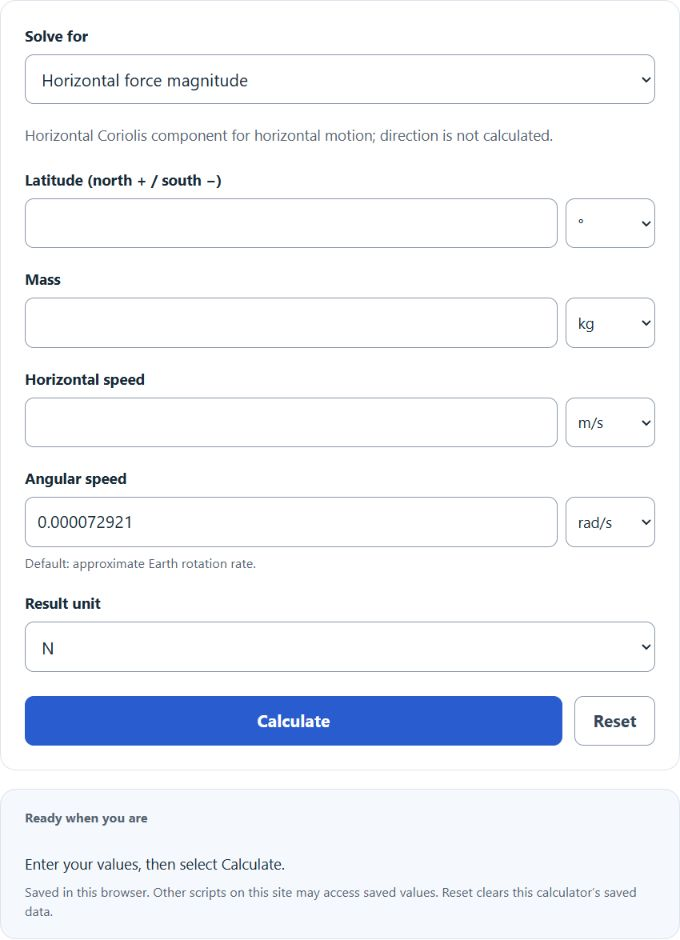
The calculator converts your selected units to base SI units before applying the formula. Latitude is converted to radians, mass to kilograms, velocity to meters per second, angular velocity to radians per second, and force to newtons.
If force is selected, the calculator multiplies the known values to find the Coriolis force magnitude. If mass, velocity, or angular velocity is selected, it divides the force by the remaining factors. If latitude is selected, it solves for the sine of latitude and then uses inverse sine. Because the formula uses |sin(φ)|, the latitude result is a magnitude, not a signed north or south latitude.
Latitude Factors for the Coriolis Effect
The latitude factor is |sin(latitude)|. It is zero at the equator and reaches 1 at the poles.
| Latitude | |sin(latitude)| | Effect on force |
|---|---|---|
| 0° | 0.0000 | No horizontal Coriolis force from this formula |
| 15° | 0.2588 | Weak |
| 30° | 0.5000 | Half of polar value |
| 45° | 0.7071 | Moderate to strong |
| 60° | 0.8660 | Strong |
| 90° | 1.0000 | Maximum |
Common Input Values and Unit Conversions
| Quantity | Common value or conversion | Base unit used |
|---|---|---|
| Earth angular velocity | 0.000072921 rad/s | rad/s |
| 1 degree | π/180 radians | radians |
| 1 lb mass | 0.45359237 kg | kg |
| 1 km/h | 1/3.6 m/s | m/s |
| 1 mph | 0.44704 m/s | m/s |
| 1 lbf | 4.4482216152605 N | N |
Example Calculations
Example 1: Calculate Coriolis force
Suppose latitude is 45°, mass is 10 kg, horizontal velocity is 20 m/s, and Earth’s angular velocity is 0.000072921 rad/s.
The Coriolis force magnitude is about 0.0206 N.
Example 2: Calculate velocity
Suppose force is 0.05 N, latitude is 60°, mass is 20 kg, and Earth’s angular velocity is 0.000072921 rad/s.
The required horizontal velocity is about 19.79 m/s.
FAQs
Why does the calculator use the absolute value of sine latitude?
The calculator returns force magnitude, so it uses |sin(latitude)|. This keeps the result positive for both northern and southern latitudes. A signed formula can show direction, but this calculator is focused on magnitude.
Does this calculator show the direction of the Coriolis effect?
No. It calculates the magnitude of the horizontal Coriolis force only. Direction depends on hemisphere and direction of motion. In general, moving objects are deflected to the right in the Northern Hemisphere and to the left in the Southern Hemisphere.
Why can latitude 0° cause problems when solving for mass, velocity, or angular velocity?
At the equator, sin(0°) = 0, so the formula gives a Coriolis force magnitude of zero for horizontal motion. If you try to solve for mass, velocity, or angular velocity using a nonzero force at 0°, the equation would require division by zero or inconsistent inputs.