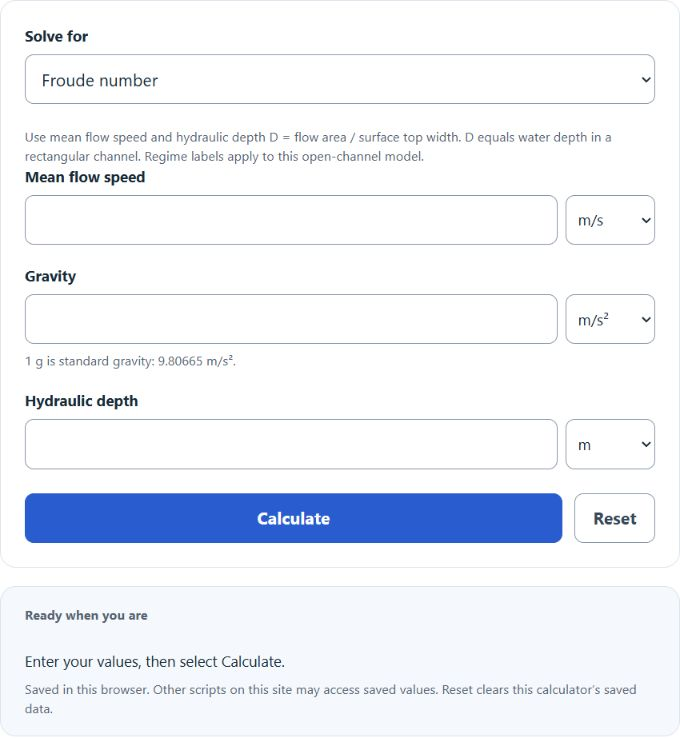
Select Froude number, mean flow speed, gravity or hydraulic depth, then enter the other three values. For this open-channel model, hydraulic depth is flow area divided by free-surface top width; use nonnegative speed and Froude number.
- All Physics Calculators
- Volumetric Flow Rate Calculator
- Water Flow Rate Calculator
- Pipe Flow Calculator
- Stream Velocity Calculator
- Flow Rate Pressure Calculator
Froude Number Calculator
The following equation is used to calculate the Froude number for free-surface (open-channel) flow and surface gravity waves (often called “gravity waves” in hydraulics).
- Where Fr is the Froude number (unitless)
- V is the flow velocity
- g is the acceleration due to gravity
- h is the (mean) flow depth / hydraulic depth used as the length scale
Flow velocity is the speed at which a fluid moves through a particular point or section of a system.
Acceleration due to gravity is the acceleration of a freely falling object near the Earth’s surface, approximately equal to 9.81 meters per second squared (9.80665 m/s²).
Hydraulic depth is the cross-sectional flow area divided by the free-surface top width. It equals the water depth in a rectangular channel and differs from hydraulic radius, which uses wetted perimeter.
Froude Number Definition
Froude Number is a dimensionless parameter used to compare inertial effects to gravitational effects in a fluid flow (often expressed as the ratio of flow speed to gravity-wave speed).
It is important because it helps understand and predict the behavior of fluid flows, such as waves, river currents, and ship motion.
By comparing Froude Numbers, we can determine if a flow is subcritical (Fr < 1, gravity waves/disturbances can travel upstream) or supercritical (Fr > 1, disturbances cannot travel upstream). Note that “smooth vs turbulent” flow is not determined by Froude number alone (turbulence is more closely related to Reynolds number and other factors).
Froude Number Example
How to calculate Froude Number?
- First, determine the flow velocity.
Measure the velocity of flow.
- Next, determine the acceleration due to gravity.
Calculate the acceleration due to gravity.
- Next, determine the mean depth.
Measure the mean depth.
- Finally, calculate Froude Number?
Calculate the Froude Number using the equation above.
FAQ
Why is the Froude Number important in fluid dynamics?
The Froude Number is crucial in fluid dynamics as it helps predict the behavior of flows where gravity effects matter, distinguishing between different open-channel flow regimes such as subcritical (Fr < 1) and supercritical (Fr > 1). This understanding is vital for the design and analysis of hydraulic structures, ships, and other water-related systems.
Can the Froude Number be applied to both liquids and gases?
Yes. The Froude Number can be applied to both liquids and gases because it is dimensionless and is used whenever inertial and gravitational effects are important (for example, free-surface flows, jets in a gravity field, sloshing, and other gravity-influenced flows).
How does the Froude Number affect ship design?
In ship design, the Froude Number (based on ship speed and a length scale such as waterline length) is used for dynamic similarity and to relate speed to wave-making behavior. It is commonly used to compare model tests to full-scale ships and to understand how wave-making resistance trends with speed and hull length.
What is the difference between subcritical and supercritical flow in terms of the Froude Number?
A flow is considered subcritical when the Froude Number is less than 1, meaning gravity waves/disturbances can travel upstream against the flow. Supercritical flow occurs when the Froude Number is greater than 1, meaning disturbances cannot propagate upstream. The Froude Number thus helps in classifying the flow regime based on wave propagation relative to the flow.