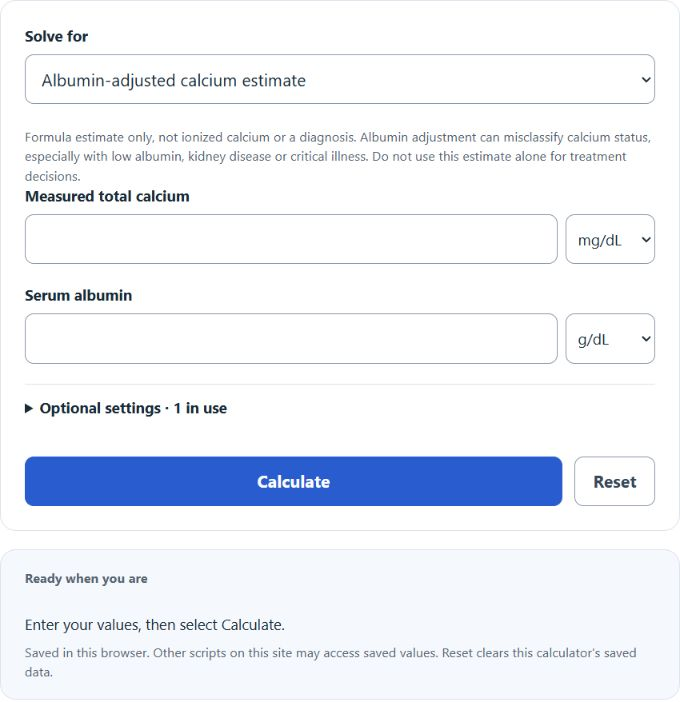
Calculate an albumin-adjusted total calcium estimate, or reverse the same arithmetic formula, in mg/dL or mmol/L. This estimate does not measure ionized calcium or establish a diagnosis.
Corrected Calcium Formula
The calculator uses the commonly applied simplified albumin adjustment shown below. It is an empirical estimate, often called a modified Payne correction, rather than the exact original 1973 equation. In conventional units:
CCa = Ca + 0.8 * (4.0 - Alb)
In SI units, with calcium in mmol/L and albumin in g/L, the commonly rounded approximation is:
CCa = Ca + 0.02 * (40 - Alb)
To reverse this exact arithmetic adjustment, rearrange the formula. The inverse does not recover an actual laboratory measurement unless the formula and reference albumin used on the report are known:
Ca = CCa - 0.8 * (4.0 - Alb)
Variables:
- CCa is the corrected (albumin-adjusted) calcium, in mg/dL or mmol/L
- Ca is the measured total serum calcium, in the same unit as CCa
- Alb is the serum albumin, in g/dL for conventional units or g/L for SI units
- 4.0 g/dL (40 g/L) is the default formula reference albumin
- 0.8 in conventional units (approximately 0.02 in SI) is the empirical correction coefficient, not a universal biological relationship
Choose the estimate or inverse mode. The estimate uses measured total calcium and albumin; the inverse uses a known adjusted value and albumin. Both show mg/dL and mmol/L. Optional settings allow a formula reference albumin (blank uses 4.0 g/dL). Enter both laboratory comparison limits to compare the estimate, or leave both blank to omit comparison. A custom reference changes the arithmetic without validating the formula for a laboratory. The conversion 1 mmol/L = 4.008 mg/dL makes the exact SI coefficient for the implemented 0.8 formula approximately 0.01996008, commonly rounded to 0.02.
Calcium Interpretation and Albumin Correction Amounts
The first table illustrates an interval of 8.5–10.5 mg/dL (approximately 2.12–2.62 mmol/L). It is not a universal diagnostic interval; use the laboratory method and reference interval on the report. An adjusted value cannot establish ionized calcium status.
| Status | Corrected calcium (mg/dL) | Corrected calcium (mmol/L) |
|---|---|---|
| Below example interval | Below 8.5 | Below 2.12 |
| Within example interval | 8.5 to 10.5 | 2.12 to 2.62 |
| Above example interval | Above 10.5 | Above 2.62 |
The second table shows how much the formula adds for each albumin level below normal, along with the corrected result for a sample measured calcium of 8.0 mg/dL. It lets you see the size of the adjustment before you run any numbers.
| Serum albumin (g/dL) | Amount added (mg/dL) | Corrected Ca if measured = 8.0 |
|---|---|---|
| 4.0 | 0.0 | 8.0 |
| 3.5 | 0.4 | 8.4 |
| 3.0 | 0.8 | 8.8 |
| 2.5 | 1.2 | 9.2 |
| 2.0 | 1.6 | 9.6 |
| 1.5 | 2.0 | 10.0 |
| 1.0 | 2.4 | 10.4 |
Example Problems
Example 1: Correct a low-looking calcium for low albumin.
A measured total calcium of 7.8 mg/dL and albumin of 2.5 g/dL give an arithmetic adjustment of 0.8 × (4.0 − 2.5) = 1.2 mg/dL. The estimate is 7.8 + 1.2 = 9.0 mg/dL. This example does not prove that ionized calcium is normal; albumin adjustment can misclassify calcium status.
Example 2: Work back from a corrected value.
A chart lists an adjusted calcium of 9.4 mg/dL at albumin 3.0 g/dL. If this exact formula and reference albumin 4.0 g/dL were used, the adjustment is 0.8 × (4.0 − 3.0) = 0.8 mg/dL and the algebraic pre-adjustment value is 9.4 − 0.8 = 8.6 mg/dL. This is not a substitute for the actual measured laboratory result.
Frequently Asked Questions
What is a normal corrected calcium level?
Reference intervals depend on the laboratory and method. The 8.5–10.5 mg/dL values above are illustrative, not a universal classification. The calculator compares only with both limits you enter and does not diagnose hypocalcemia or hypercalcemia.
When should you correct calcium for albumin?
Albumin adjustment has traditionally been applied with abnormal albumin, but an adjustment is not automatically more accurate. Contemporary clinical evidence reports misclassification, particularly when albumin is low. Near the formula reference albumin, the arithmetic adjustment is small; that alone does not establish normal calcium status.
Is corrected calcium as accurate as ionized calcium?
No. Ionized calcium is the physiologically active fraction. A 2025 population-based study found that albumin-adjusted formulas often added no benefit over unadjusted total calcium and could increase misclassification, especially with hypoalbuminemia. Low albumin, chronic kidney disease and critical illness can reduce reliability. Clinical assessment and appropriate direct measurement should guide interpretation; do not use this estimate alone for treatment decisions.