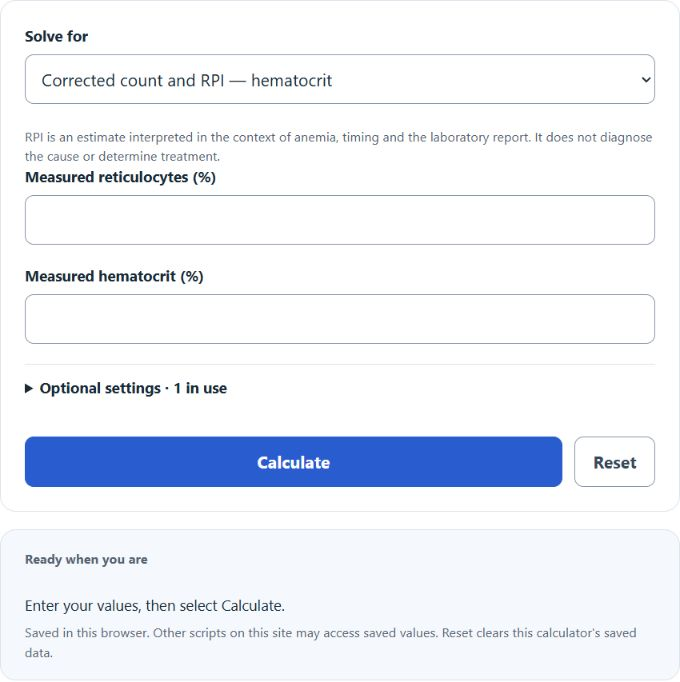
Calculate the corrected reticulocyte count (CRC) and reticulocyte production index (RPI) from a reticulocyte percentage and hematocrit to assess bone marrow response in anemia.
Corrected Reticulocyte Count Formula
The corrected reticulocyte count adjusts the raw reticulocyte percentage for the degree of anemia, and the production index adjusts it a second time for the longer lifespan of reticulocytes released early. The calculator uses three related formulas depending on the mode you choose.
CRC = R * (Hct / Hn)
RPI = CRC / M
ARC = (R / 100) * RBC * 1,000,000
Variables:
- CRC is the corrected reticulocyte count, also called the reticulocyte index (RI), in percent
- RPI is the reticulocyte production index, a unitless value
- ARC is the absolute reticulocyte count, in cells per microliter
- R is the measured (raw) reticulocyte count, in percent
- Hct is the patient's measured hematocrit, in percent
- Hn is the normal reference hematocrit, usually 45 percent
- M is the approximate maturation correction factor from the hematocrit convention below, or the entered override
- RBC is the red blood cell count, in millions per microliter
In the default mode, enter raw reticulocytes and measured hematocrit to calculate the corrected percentage and RPI. Hemoglobin estimate modes instead use hematocrit ≈ 3 × hemoglobin in g/dL; measured hematocrit is preferred. Absolute count uses the raw percentage and RBC count, not the corrected percentage. Reverse modes solve the percentage giving an entered target RPI under the selected hematocrit and maturation assumptions; they do not predict a future laboratory result. Optional settings provide reference hematocrit (blank uses 45%), a maturation-factor override, and RBC count for an additional absolute count.
Maturation Factor and Response Thresholds
The maturation factor is a conventional stepwise estimate associated with earlier reticulocyte release in anemia, not a measurement of an individual cell’s survival. The bands below retain the whole-number convention, assign fractional hematocrit values to intervals bounded at 16%, 26% and 36%, and extend factor 1 above 45%. An entered positive override replaces the estimate.
| Hematocrit (%) | Maturation factor (M) | Reticulocyte survival |
|---|---|---|
| 36 and above | 1.0 | 1.0 day |
| 26 to below 36 | 1.5 | 1.5 days |
| 16 to below 26 | 2.0 | 2.0 days |
| Below 16 | 2.5 | 2.5 days |
The following table reverses the formula for an illustrative target RPI of 2.0 using reference hematocrit 45%. It is a mathematical comparison, not a treatment target or universal threshold for an adequate marrow response.
| Hematocrit (%) | Raw reticulocytes needed for RPI 2.0 |
|---|---|
| 45 | 2.0% |
| 40 | 2.3% |
| 35 | 3.9% |
| 30 | 4.5% |
| 25 | 7.2% |
| 20 | 9.0% |
| 15 | 15.0% |
Reference ranges depend on age, laboratory method and clinical context. In anemia, RPI below 2 may suggest a limited response, values around 2–3 require context, and values above 3 may suggest increased production. These approximate guides do not diagnose a cause, and normal absolute-count intervals should come from the laboratory report.
Example Problems
Example 1: Inadequate response.
For raw reticulocytes 5% and hematocrit 25%, CRC = 5 × (25/45) ≈ 2.7778%. The stepwise maturation factor is 2, so RPI ≈ 1.3889 (about 1.4). In an anemic patient this may suggest a limited response, but interpretation requires clinical and laboratory context.
Example 2: Adequate response.
For raw reticulocytes 8% and hematocrit 30%, CRC = 8 × (30/45) ≈ 5.3333%. The stepwise maturation factor is 1.5, so RPI ≈ 3.5556 (about 3.6). This may indicate increased production in the appropriate context; the index alone does not diagnose red-cell loss.
Frequently Asked Questions
What is the difference between the corrected reticulocyte count and the reticulocyte production index?
The corrected reticulocyte percentage scales the raw percentage by the patient’s hematocrit divided by a reference hematocrit. RPI divides that corrected percentage by an approximate maturation factor. Both depend on the selected assumptions; response guides are interpreted in the setting of anemia rather than used as universal diagnostic cutoffs.
Why do you correct the reticulocyte count at all?
The raw reticulocyte percentage is a fraction of red blood cells. When the total red-cell population is reduced, a percentage alone can overstate production. Hematocrit correction rescales that percentage to a reference hematocrit; the maturation adjustment accounts approximately for longer circulation of early-released cells. Neither calculation establishes the cause of anemia.
Can I use hemoglobin instead of hematocrit?
The hemoglobin estimate modes approximate hematocrit (%) as 3 × hemoglobin (g/dL). For example, 8.3 g/dL gives about 24.9%. This relation can be inaccurate when red-cell indices are abnormal. Prefer measured hematocrit when available, and interpret any hemoglobin-derived RPI as approximate.