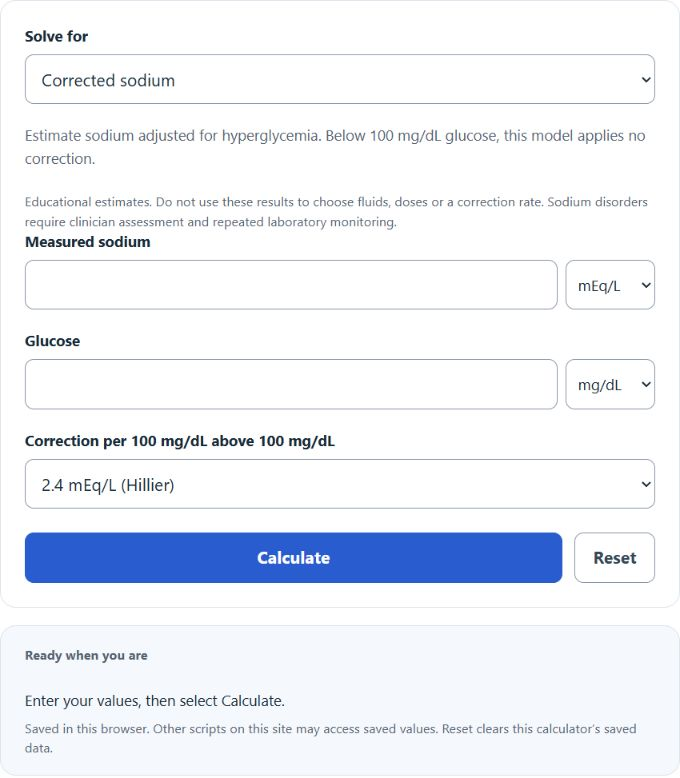
Estimate corrected sodium, calculated osmolality, a fixed-body-water sodium amount difference, and a theoretical closed-system infusion change. These educational estimates do not establish a treatment dose or correction rate.
- All Health and Medical Calculators
- Sodium to Potassium Ratio Calculator
- Glucose to Insulin Ratio Calculator
Corrected Sodium Formula
The following formula is used to calculate the corrected sodium level (for hyperglycemia). Glucose should be in mg/dL (if you have mmol/L, convert first):
Variables:
- Corrected Sodium is the calculated corrected sodium level
- MS is the measured sodium level
- G is the blood glucose level (mg/dL)
- CF is the correction factor, commonly 1.6 (Katz) or 2.4 (Hillier) mEq/L per 100 mg/dL glucose above 100 mg/dL
Select the value to solve for. For corrected sodium, add (CF/100) times glucose above 100 mg/dL to measured sodium; this model applies no adjustment below that baseline. The coefficients are estimates rather than patient-specific guarantees.
What is a Corrected Sodium?
Corrected Sodium, also known as adjusted sodium, is a calculated value used in medical practice to estimate what the serum sodium concentration would be if blood glucose were normal. In hyperglycemia, increased serum osmolality causes water to shift from the intracellular space into the extracellular space, which dilutes serum sodium and produces translocational (hypertonic/dilutional) hyponatremia. The corrected sodium calculation accounts for the elevated glucose to provide an adjusted sodium value that can help interpret true sodium status in conditions such as diabetic ketoacidosis (DKA) or hyperosmolar hyperglycemic state (HHS). (This is different from pseudohyponatremia, which is typically caused by markedly elevated lipids or proteins with certain laboratory measurement methods.)
How to Calculate Corrected Sodium?
The following steps outline how to calculate the Corrected Sodium:
- First, determine the measured sodium level (mSodium) in mEq/L (or mmol/L).
- Next, determine the patient’s glucose level (glucose) in mg/dL (or convert from mmol/L).
- Choose a correction factor (CF), commonly 1.6 (Katz) or 2.4 (Hillier) mEq/L per 100 mg/dL glucose above 100 mg/dL.
- Calculate the sodium correction: correction = (CF/100) × max(glucose − 100, 0).
- Calculate the corrected sodium (cSodium): cSodium = mSodium + correction.
- After inserting the variables and calculating the result, check your answer with the calculator above.
Example Problem:
Use the following variables as an example problem to test your knowledge.
measured sodium level (mSodium) = 140 mmol/L
patient’s glucose level (glucose) = 120 mg/dL
If CF = 1.6 (Katz): correction = (1.6/100) × (120 − 100) = 0.32, so corrected sodium = 140 + 0.32 = 140.32 mmol/L.
If CF = 2.4 (Hillier): correction = (2.4/100) × (120 − 100) = 0.48, so corrected sodium = 140 + 0.48 = 140.48 mmol/L.