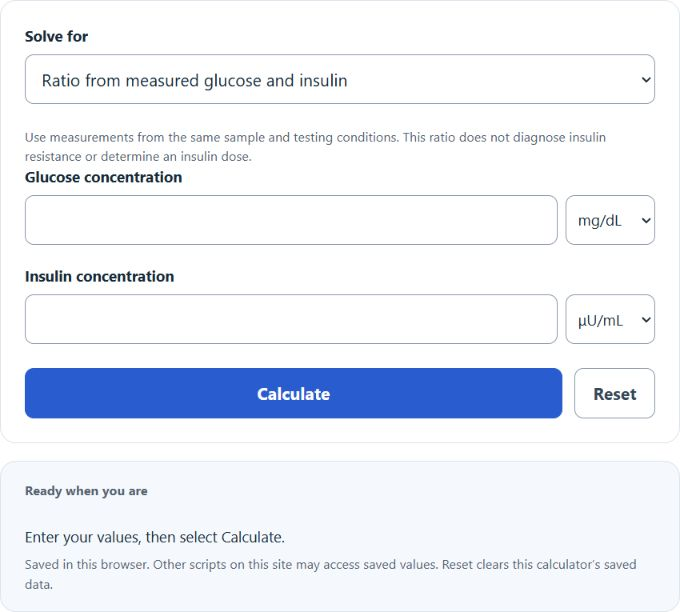
Calculate the glucose-to-insulin ratio from measured concentrations, or solve the inverse arithmetic under an explicitly assumed ratio. The original value of 10 (mg/dL)/(μU/mL) is an example assumption, not a universal physiological relationship or an insulin dosing rule.
- All Health and Medical Calculators
- All Ratio Calculators
- Potassium to Creatinine Ratio Calculator
- Sodium to Potassium Ratio Calculator
Glucose to Insulin Ratio Formula
The glucose to insulin ratio compares a glucose measurement with an insulin measurement taken at the same time. On this page, the calculator finds the ratio by dividing glucose by insulin. When fasting values are used, this is often called the fasting glucose-to-insulin ratio.
- GIR = glucose to insulin ratio
- G = glucose level
- I = insulin level
The fasting ratio has been studied in selected clinical populations, but it is not a stand-alone diagnosis or a universal measure of insulin sensitivity. Use both numbers from the same blood draw, under the same conditions, and interpret them with a clinician.
What the Ratio Tells You
The ratio shows how much glucose is present relative to insulin:
- If insulin rises while glucose stays the same, the ratio falls.
- If glucose rises while insulin stays the same, the ratio rises.
- A lower ratio generally means there is more insulin present relative to glucose.
- A higher ratio generally means there is less insulin present relative to glucose.
Because the body’s glucose-insulin system is complex, the ratio should be interpreted together with fasting status, symptoms, medications, lab method, and the rest of the metabolic picture.
Unit Consistency Matters
The numeric ratio depends on the glucose unit you use. A result calculated with mg/dL will not match the number calculated with mmol/L, even when both describe the exact same glucose concentration. That means you should never compare a mmol/L-based ratio to an mg/dL-based reference value.
For insulin, μU/mL and mU/L are numerically equivalent, so the insulin number does not change when switching between those two labels.
How to Calculate the Glucose to Insulin Ratio
- Obtain a glucose value.
- Obtain an insulin value from the same sample and testing condition.
- Confirm the glucose unit being used: mg/dL or mmol/L.
- Divide glucose by insulin.
- If you plan to compare the result with a lab or published reference, make sure the same glucose units were used there as well.
The calculation only makes sense when the insulin value is greater than zero. Very small insulin values can also produce very large ratios, so extreme results should always be reviewed carefully.
Examples
If the glucose level is 90 mg/dL and the insulin level is 10 μU/mL, the ratio is:
Using the common rounded conversion factor of 18, approximately the same glucose concentration is 5.0 mmol/L. With insulin of 10 mU/L, that rounded example gives:
The ratio’s numerical scale changes with the glucose unit. This calculator uses 18.01559 mg/dL per mmol/L; 90 mg/dL therefore converts to approximately 4.9957 mmol/L, giving a ratio of approximately 0.4996 (mmol/L)/(mU/L).
When This Calculator Is Most Useful
- Reviewing fasting glucose and fasting insulin from the same lab visit
- Checking how the ratio changes over time under similar testing conditions
- Getting a fast, simple comparison between glucose and insulin before moving on to more detailed metabolic assessments
- Educational use when learning how glucose and insulin interact mathematically
Common Interpretation Pitfalls
- Using non-fasting results: post-meal glucose and insulin can change quickly and may distort the ratio.
- Mixing units: a ratio from mmol/L should not be compared with an mg/dL-based threshold or example.
- Assuming one result is diagnostic: this ratio is only one piece of information.
- Ignoring low insulin production: a very high ratio can occur when insulin is low, which does not automatically mean better metabolic health.
- Comparing across different labs: insulin assay methods can vary, so repeat testing is easiest to interpret when performed consistently.
Practical Tips for Better Use
- Use values collected at the same time.
- Keep testing conditions consistent, especially if you are tracking trends.
- Write down the units every time you save a result.
- If a result seems unusually high or low, double-check both the glucose unit and the insulin entry.
- For clinical decisions, review the ratio alongside other lab data rather than by itself.
Frequently Asked Questions
- Is fasting required?
- For most meaningful interpretation, yes. The ratio is commonly discussed using fasting glucose and fasting insulin measured from the same blood draw.
- Are μU/mL and mU/L the same for insulin?
- Yes. Those two insulin labels are numerically equivalent, so the insulin value stays the same.
- Why does my ratio change when I switch glucose units?
- Because mg/dL and mmol/L express glucose on different numeric scales. The underlying glucose level is the same, but the ratio number changes with the unit system.
- Can this ratio diagnose insulin resistance?
- No. It is a simple calculator output that can support understanding, but interpretation requires clinical context and often additional testing.
- What if my insulin value is extremely low?
- The ratio can become very large when insulin is close to zero. In that case, the result should be interpreted cautiously and in context with the full lab picture.