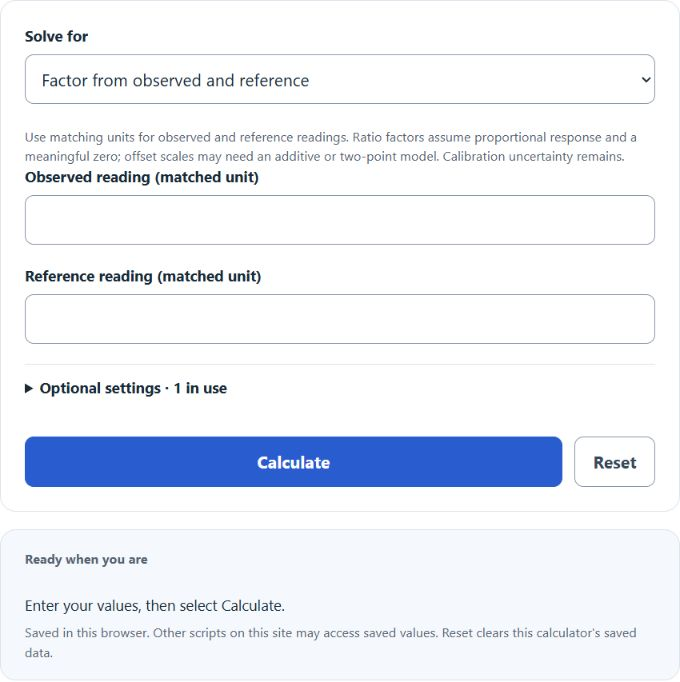
Calculate a measurement correction factor from observed and reference values, apply it to readings, analyze error, or create a two-point linear calibration.
Correction Factor Formula
The fundamental correction factor formula is:
Variables:
- CF is the correction factor (dimensionless ratio)
- TV is the true value (reference standard or known quantity)
- OV is the observed value (instrument reading or measurement)
A factor of 1 means no multiplicative adjustment for that observed/reference pair; it does not prove an instrument is perfect. For positive readings, factors above 1 increase the corrected value and factors between 0 and 1 decrease it. Negative factors reverse sign. Acceptance limits depend on the instrument, calibration conditions and uncertainty; there is no universal 0.95–1.05 interval.
What is a Correction Factor?
A multiplicative correction factor compensates for an estimated proportional systematic effect. The reference is itself subject to uncertainty, and a correction does not prove that the corrected reading equals an unknowable true quantity. Check that a proportional model is appropriate across the intended working range.
Error and additive correction have opposite signs at a comparison point. If a thermometer reads 0.3 degrees below a reference, its error is −0.3 degrees and its additive correction is +0.3 degrees. A ratio also reproduces a nonzero comparison reading, but applying that ratio elsewhere assumes proportional bias. Offset scales such as Celsius temperature require particular care because a ratio depends on the chosen zero.
Correction vs. Error: Sign Convention
Measurement error is observed value minus reference value. The additive correction is reference minus observed: adding it reproduces the reference at that comparison point. A multiplicative factor is reference/observed when observed is nonzero. Error and correction are opposite numerical differences, not reciprocal quantities; the factor is a different correction model.
Both approaches reproduce the same reference at the fitted point, but behave differently elsewhere. Multiplicative correction assumes proportional bias; additive correction assumes a fixed offset. In this calculator, signed percent error uses (observed − reference)/|reference| × 100, so the sign follows the numerical difference. Percent change similarly uses the absolute observed denominator. Both are undefined at a zero denominator and require a meaningful zero for interpretation.
Types of Correction Factors
Multiplicative (ratio) corrections use corrected = factor × observed. Use this model only when proportional response is supported by calibration data and the units have an appropriate zero. A single calibration pair cannot establish that model across a range.
Additive (offset) corrections add a fixed quantity to a reading and can represent a supported zero-point offset. Application-specific corrections such as altitude-dependent pressure adjustments require their own physical model and conditions; a universal fixed increment should not be assumed.
Linear (two-point) calibration combines slope and intercept: reference = m × observed + b. Two distinct observed calibration values determine that assumed line. The calculator’s two-point solve mode maps a new observed reading to the corresponding reference estimate; it does not validate linearity or quantify uncertainty.
Polynomial and nonlinear corrections require a model appropriate to the instrument and temperature or measurement range. Thermocouple reference functions and resistance-temperature models are examples. Their coefficients and validity ranges must come from the applicable reference or manufacturer; they are not implemented by this generic calculator.
Correction Factors by Industry
Gas flow measurement. Ideal-gas volume conversion at unchanged composition uses pressure and absolute-temperature ratios; real-gas work may also require compressibility corrections. Reference pressure and temperature must be specified, and equipment may report actual or reference-condition volume. This generic correction-factor tool does not implement a certified gas-flow conversion.
Heat exchanger design. An LMTD correction factor accounts for a specified exchanger flow configuration relative to an ideal reference arrangement. The factor and design limits depend on configuration and operating temperatures; use the relevant exchanger model or design reference rather than a universal interval or feasibility cutoff.
Electrical power measurement. Metering calibration can involve ratio errors and phase displacement. A scalar correction factor alone cannot represent every phase-dependent effect. Apply the current standard and calibration certificate for the exact meter or transformer; no universal CT/PT accuracy limit is supplied here.
Radiation dosimetry. Clinical ion-chamber work uses protocol-specific calibration and corrections for the beam, dosimeter and measurement conditions. Their values and application must follow the applicable clinical protocol. This generic arithmetic tool does not calculate dose or replace that procedure.
Structural engineering. Design factors can address distinct effects such as size, load duration and temperature, with conditions defined by the applicable material standard. In NDS timber terminology, CD is load duration and CF is size. Use the current project-specific design standard; this calculator does not select structural design factors.
Correction Factor in ANOVA (Statistics)
In analysis of variance (ANOVA), the term "correction factor" has a completely different meaning from its metrology usage. The ANOVA correction factor is defined as CF = T squared / N, where T is the grand total of all observations and N is the total number of observations. This value is subtracted from the raw sum of squares to produce the corrected total sum of squares: SS_total = sum of (Xi squared) minus CF. The correction factor accounts for the fact that deviations are measured from the sample mean rather than from zero. Without it, the sum of squares would include an inflated component due to the overall mean level of the data.
Applying Correction Factors from Calibration Certificates
Calibration certificates and the applicable quality system define the reported results, conditions, corrections and uncertainties. Use the actual certificate and current requirements for the laboratory and application. The methods below are possible numerical approaches; none is automatically acceptable without considering the calibration model and required uncertainty.
Direct application uses a stated correction at the applicable calibration point under its specified conditions. Applying it away from that point requires evidence that the resulting approximation is suitable.
Nearest value selection takes the correction from the closest calibration point. This is a piecewise-constant approximation, not a general accuracy guarantee. For a reading of 52 between points at 50 and 60, the nearer point is 50; whether its correction is suitable depends on the calibration evidence.
Averaging two adjacent corrections gives their midpoint value. For +0.12 and +0.18, the mean is +0.15. Under a linear model this is the correction at the midpoint, not the exact correction at every reading between the points.
Linear interpolation evaluates the assumed line at the actual position. Between corrections +0.12 at 50 and +0.18 at 60, the correction at 52 is 0.12 + (52 − 50)/(60 − 50) × (0.18 − 0.12) = 0.132. To use the calculator’s observed-to-reference map, enter calibration pairs (50, 50.12) and (60, 60.18); it returns corrected 52.132 for an observed 52. This assumes linear response and is not an uncertainty estimate.
Measurement Uncertainty and Correction Factors
Applying a correction does not eliminate uncertainty. Propagate the uncertainties of the readings, calibration parameters and applied corrections through the measurement model. Covariances must be included where quantities are correlated; a root-sum-square shortcut is justified only under its required assumptions.
For corrected = observed × factor, first-order propagation for nonzero quantities gives relative variance (uobs/obs)² + (ufactor/factor)² only when the quantities can be treated as independent. If the factor was derived from the same observation or shared references, correlation can matter. This calculator reports numerical corrections without estimating measurement uncertainty.
Recalibration intervals depend on stability, use, required uncertainty, manufacturer guidance, contracts and applicable regulations. NIST prescribes no universal interval. Review calibration and drift evidence for the specific instrument instead of assuming every instrument needs the same annual schedule.