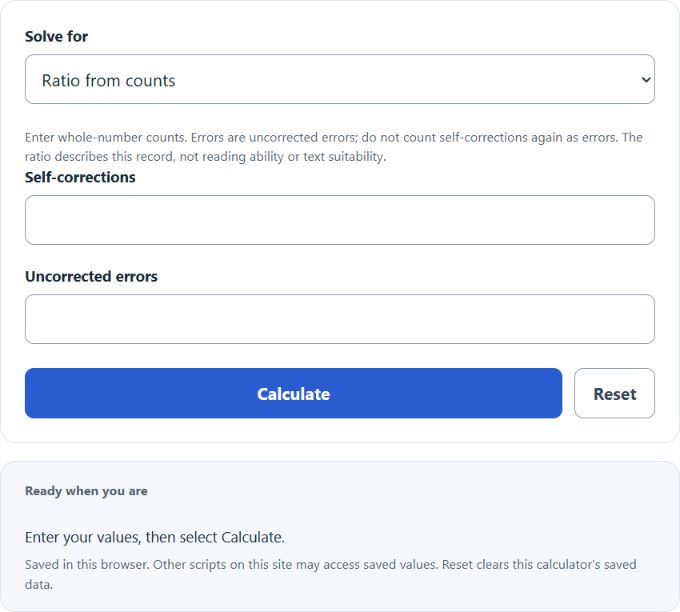
Calculate the self-correction ratio from counts, add reading accuracy from total running words, or solve a missing count from an exact ratio.
- All Statistics Calculators
- All Ratio Calculators
- Error Rate Calculator
- Sampling Error Calculator
- Average Ratio Calculator
- Sampling Frequency Calculator
Self-Correction Ratio Formula
The self-correction ratio measures how often self-corrections occur compared with the total number of counted error events. It is useful anytime you track mistakes and whether those mistakes were independently corrected. A lower ratio indicates more frequent self-correction, while a higher ratio indicates that more errors remain uncorrected relative to the number of self-corrections.
Where:
- SCR = self-correction ratio
- SC = number of self-corrections
- E = number of uncorrected errors
This ratio can also be viewed in an equivalent form that makes the trend easier to understand:
From this form, it is easy to see that the ratio rises when errors increase and falls when self-corrections increase. For non-negative counts, the result cannot be less than 1. A value of 1 means there were self-corrections recorded and no remaining errors.
How to Calculate the Self-Correction Ratio
- Count the number of self-corrections for the same observation period or sample.
- Count the number of errors for that same period or sample.
- Add the self-corrections and errors together.
- Divide that total by the number of self-corrections.
To get a meaningful result, both counts should come from the same dataset. Mixing values from different sessions, passages, tests, or time periods will distort the ratio.
How to Interpret the Result
The output is often read in ratio form such as 1:2 or 1:3. Smaller values indicate more frequent self-corrections relative to the counted events; the ratio alone does not diagnose reading ability or text suitability. Larger values indicate self-corrections are less frequent relative to the number of errors.
| Ratio Result | General Interpretation |
|---|---|
| 1.00 | No remaining errors were counted; all recorded events were self-corrections. |
| 1.50 | Self-corrections are occurring frequently relative to errors. |
| 2.00 | About one self-correction occurs for every two total error-related events. |
| 3.00 or more | Self-corrections are less frequent compared with uncorrected errors. |
Solving for a Missing Variable
If you already know the ratio and one of the counts, you can rearrange the equation to solve for the missing value.
These rearranged forms are helpful when the calculator is used to back-solve for the number of errors or the number of self-corrections.
Example 1
If 30 self-corrections and 20 errors are recorded, the ratio is calculated as follows:
This can be read as approximately 1:1.67. In practical terms, self-corrections are happening fairly often relative to the total number of counted error events.
Example 2
If the self-correction ratio is 2.25 and the number of self-corrections is 16, the number of errors can be found by substitution:
So a ratio of 2.25 with 16 self-corrections corresponds to 20 errors.
Common Input Guidelines
- Use non-negative whole-number counts and keep self-corrections separate from uncorrected errors.
- SC must be greater than zero to calculate the ratio directly.
- Keep the counting method consistent across all observations.
- Round only after the final step if you want a clean ratio for reporting.
Common Mistakes
- Using values collected from different samples or time periods.
- Trying to calculate the ratio when the number of self-corrections is zero.
- Interpreting the ratio as a percentage instead of a comparison measure.
- Rounding too early and introducing unnecessary error into the final result.
Frequently Asked Questions
- Can the self-correction ratio be less than 1?
- No. When the counts are non-negative and at least one self-correction is present, the smallest possible ratio is 1.
- What happens if there are zero self-corrections?
- The ratio is undefined because the calculation requires division by the number of self-corrections.
- Is a lower value usually better?
- A lower value means self-corrections are happening more often relative to the counted events. Interpret it with the passage, observation, and scoring context rather than as a standalone rating.
- What type of data should be used?
- Use simple count data gathered from the same observation window, sample, or task so the comparison remains valid.