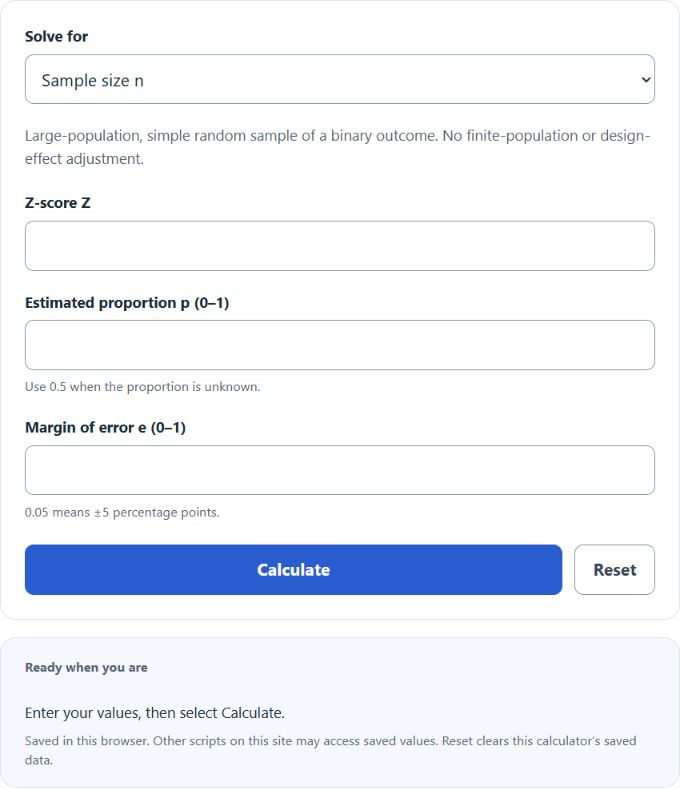
Select sample size, Z-score, estimated proportion or margin of error to solve, then enter the other three values. The proportion inverse can return two complementary roots; it solves the unrounded equality, not a rounded sample-count requirement.
Related Calculators
- Inverse Z Score Calculator
- Relative Accuracy Calculator
- Content Validity Ratio Calculator
- Percentage Accuracy Calculator
- All Statistics Calculators
Cochran’s Sample Size Formula
Cochran’s large-population formula gives a normal-approximation planning sample size for a population proportion under simple random sampling. Round the result up to whole complete responses; it does not guarantee exact confidence coverage:
Variables:
- n0 = unrounded planning sample size (for an infinite or sufficiently large population)
- Z = Z-score corresponding to the desired confidence level
- p = estimated proportion of the attribute in the population (use 0.5 if unknown)
- e = margin of error as a proportion; 0.05 means ±5 percentage points
Z-Score Reference by Confidence Level
For a two-sided normal approximation, Z is the standard-normal critical value for the chosen confidence level. Confidence describes the long-run coverage of intervals across repeated random samples, not the probability that a fixed parameter lies in one observed interval. Reference values are:
| Confidence Level | Z-Score | Meaning |
|---|---|---|
| 80% | 1.282 | About 20% of intervals miss in repeated sampling |
| 85% | 1.440 | About 15% miss in repeated sampling |
| 90% | 1.645 | About 10% miss in repeated sampling |
| 95% | 1.960 | About 5% miss in repeated sampling |
| 99% | 2.576 | About 1% miss in repeated sampling |
| 99.9% | 3.291 | About 0.1% miss in repeated sampling |
Z = 1.96 corresponds to approximately 95% two-sided normal confidence. Choose the confidence level from the study design and reporting requirements; there is no universal level required for every medical or other study.
Why p = 0.5 Gives the Largest Sample Size
The expression p(1 – p) in the numerator of Cochran’s formula reaches its mathematical maximum when p = 0.5, yielding 0.25. At p = 0.3, the product is 0.21. At p = 0.1, just 0.09. Because 0.5 produces the largest possible sample size for any given Z and e, researchers use it as a conservative default when no prior estimate of the proportion exists. If a pilot study or previous research suggests a proportion far from 0.5, using the actual estimate will reduce the required sample size and lower data collection costs.
Pre-Computed Sample Sizes (Infinite Population)
The table below shows minimum sample sizes calculated using Cochran’s formula with p = 0.5 (maximum variability). All values are rounded up to the nearest whole number.
| Margin of Error | 90% Confidence (Z=1.645) | 95% Confidence (Z=1.96) | 99% Confidence (Z=2.576) |
|---|---|---|---|
| 1% | 6,766 | 9,604 | 16,590 |
| 2% | 1,692 | 2,401 | 4,148 |
| 3% | 752 | 1,068 | 1,844 |
| 5% | 271 | 385 | 664 |
| 7% | 139 | 196 | 339 |
| 10% | 68 | 97 | 166 |
At 95% confidence and 5% margin of error, the unadjusted large-population planning count is 385 for either a population of 50,000 or 50 million. This is one of the counterintuitive properties of proportion-based sampling: once the population is large enough, absolute sample size matters far more than the sampling fraction.
Finite Population Correction (FPC)
Cochran’s base formula assumes an infinite (or very large) population. When the population size N is known and the initial sample n0 exceeds roughly 5% of N, the estimate can be tightened using the finite population correction:
For simple random sampling without replacement, N is the finite population size and n0 is the base planning value. Apply the correction and round the final count up. Using the already rounded conservative base 385 and N = 5,000 gives 385 / (1 + 384/5000) ≈ 357.54, so 358 responses. The widget above does not apply this correction.
Finite Population Correction Examples
Using a conservative rounded base of n0 = 385 (Z = 1.96, 5 percentage-point margin, p = 0.5), with adjusted counts rounded up:
| Population (N) | Adjusted Sample (n) | Reduction from n0 |
|---|---|---|
| 500 | 218 | 43% |
| 1,000 | 279 | 28% |
| 2,000 | 323 | 16% |
| 5,000 | 358 | 7% |
| 10,000 | 371 | 4% |
| 50,000 | 383 | 1% |
| 1,000,000+ | 385 | ~0% |
The effect depends on the sampling fraction and required precision. For this example, the correction changes the count substantially for small populations and only slightly for large populations.
Cochran’s Formula vs. Yamane and Slovin
The simplified expression n = N/(1 + Ne²), often labeled Yamane or Slovin, has no explicit confidence or proportion inputs. It is close to the finite-population Cochran expression when Z = 2 and p = 0.5 and the small denominator correction is neglected; it is not identical to using Z = 1.96 for 95% confidence.
| Feature | Cochran (1977) | Yamane (1967) | Slovin |
|---|---|---|---|
| Formula | n = Z²p(1-p)/e² | n = N/(1+Ne²) | n = N/(1+Ne²) |
| Adjustable confidence level | Yes | No explicit Z (roughly 95% only under stated approximation) | No explicit Z (roughly 95% only under stated approximation) |
| Adjustable proportion | Yes | No (fixed at 0.5) | No (fixed at 0.5) |
| Requires known population | No (optional via FPC) | Yes | Yes |
| Best for | Planning a single population proportion under stated assumptions | Known finite populations | Quick estimates |
| Assumption checks | Document Z, p, precision and sampling design | Check fixed approximation and sampling design | Check fixed approximation and sampling design |
The explicit Cochran inputs make the chosen Z, proportion and precision visible. Formulas alone do not establish study quality: document the sampling design, non-response assumptions and whether a normal approximation is appropriate.
Assumptions and Limitations
Cochran’s formula rests on several assumptions that must be satisfied for the result to be valid. First, the sampling method must be simple random sampling or a design that can be approximated as such. Complex designs may need a design-specific design effect (DEFF). Clustering can increase variance; stratification can reduce it. Do not assume a universal multiplier. Second, the formula estimates sample size for a single proportion. Studies measuring means instead of proportions should use the alternative formula n = Z²s²/e², where s is the estimated standard deviation. Third, the formula does not account for non-response. If the expected response rate is 70%, the researcher should inflate the calculated n by dividing by 0.70. Fourth, the formula assumes a single binary outcome. For multiple outcomes, calculate relevant planning requirements separately and account for the analysis and multiplicity strategy; this single-proportion formula is not a general power calculation.
Origin and History
William Gemmell Cochran (1909 to 1980) was a Scottish-born statistician who spent most of his career in the United States. He studied mathematics at the University of Glasgow and Cambridge before joining Rothamsted Experimental Station in 1934, where he worked with Frank Yates on experimental design and sampling, with Ronald Fisher a frequent visitor. After moving to the U.S. in 1939, Cochran held positions at Iowa State, Johns Hopkins, and Harvard. His textbook “Sampling Techniques,” first published in 1953 and revised in its third edition in 1977, remains one of the definitive references on survey sampling methodology. The sample size formula that bears his name appears in Chapter 4 of that text and has become the standard starting point for sample size determination in fields ranging from public health to market research.
Common Applications
Cochran’s formula is used across a wide range of disciplines. In public health, it determines how many individuals to screen when estimating disease prevalence. In market research, it sets the minimum number of consumer surveys needed to gauge brand preference within a stated margin. Political polling organizations use it to establish baseline sample sizes before applying design effects for stratification and clustering. In quality control, it calculates the number of units to inspect when estimating a defect rate. Academic dissertations in education, social sciences, and business administration routinely cite Cochran’s formula when justifying sample size for survey-based studies. For other applications, including environmental monitoring and auditing, use it only when a simple proportion-estimation planning model is appropriate; experimental power and risk-limiting audit designs require their own methods.