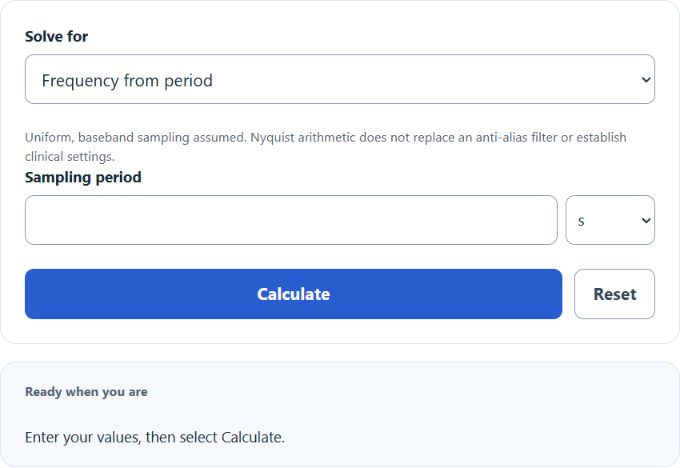
Calculate sampling period, frequency, Nyquist limits, and FFT bin spacing from a uniform sample rate, sample count, and record duration.
- All Physics Calculators
- All Frequency Calculators
- Nyquist Sampling Rate Calculator
- Sampling Rate Calculator
- Hz to Period Calculator
- Samples to Seconds Calculator
- Frequency of Oscillation Calculator
- Angular Frequency Calculator
Sampling Frequency Formula
The following example outlines the steps and information needed to calculate the Sampling Frequency.
Variables:
- fs is the Sampling Frequency (Hz)
- Ts is the sampling period (seconds)
To calculate sampling frequency in hertz, divide 1 by the sampling period in seconds. For ideal band-limited baseband sampling, the rate must exceed twice the highest signal frequency; practical anti-alias filters need additional margin. FFT modes use record duration N / fs and report bin spacing fs / N; when estimating a sample count, the calculator rounds up to whole samples and reports the resulting actual duration.
How to Calculate Sampling Frequency?
The following steps outline how to calculate the Sampling Frequency.
- First, determine the sampling period (seconds).
- Next, gather the formula from above = fs = 1/Ts.
- Finally, calculate the Sampling Frequency.
- After inserting the variables and calculating the result, check your answer with the calculator above.
Example Problem :
Use the following variables as an example problem to test your knowledge.
sampling period (seconds) = 30
fs = 1/Ts = ?