Calculate oscillation frequency, period, and angular frequency from period, cycle count, time, spring constant, mass, or pendulum length and gravity.
Frequency of Oscillation Formula
Select the calculation path for a known period, angular frequency, counted cycles, spring-mass system or simple pendulum.
From a known period or angular frequency:
From counted cycles in a measured time:
From a spring-mass system or simple pendulum:
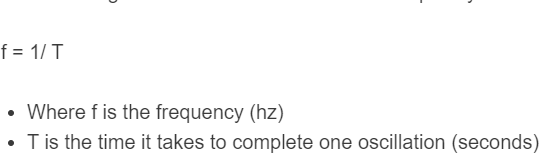
- f = frequency in hertz (Hz, cycles per second)
- T = period, time for one full oscillation (s)
- ω = angular frequency (rad/s)
- N = number of complete oscillations counted
- t = elapsed time over those oscillations (s)
- k = spring constant (N/m)
- m = mass attached to the spring (kg)
- g = acceleration due to gravity (m/s², default 9.80665)
- L = pendulum length from pivot to center of mass (m)
The spring formula assumes an ideal, undamped, massless spring. The pendulum formula assumes a small swing angle (under about 15°) and a point mass on a massless rod. For larger angles, the real period is longer than this estimate.
Reference Values
Frequency converts directly to period and angular frequency. Use this table to sanity-check a result.
| Frequency (Hz) | Period T | ω (rad/s) | Cycles/min |
|---|---|---|---|
| 0.5 | 2 s | 3.14 | 30 |
| 1 | 1 s | 6.28 | 60 |
| 2 | 0.5 s | 12.57 | 120 |
| 10 | 0.1 s | 62.83 | 600 |
| 60 | 16.7 ms | 377 | 3,600 |
Typical oscillators and where their frequencies land:
| System | Approx. frequency |
|---|---|
| 1 m simple pendulum | 0.50 Hz |
| Grandfather clock pendulum (0.994 m) | 0.50 Hz |
| Mass-spring (m = 0.5 kg, k = 200 N/m) | 3.18 Hz |
| Tuning fork (A4) | 440 Hz |
| Quartz watch crystal | 32,768 Hz |
Worked Example
A student counts 20 complete swings of a pendulum in 30 seconds.
f = N / t = 20 / 30 = 0.667 Hz
The period is T = 1 / 0.667 = 1.5 s, and ω = 2π·f = 4.19 rad/s. To check the length: L = g / (2π·f)² = 9.81 / (4.19)² ≈ 0.559 m.
FAQ
Is frequency the same as angular frequency? No. Frequency f is in cycles per second (Hz). Angular frequency ω is in radians per second. They are linked by ω = 2πf.
Why does mass not appear in the pendulum formula? Both the restoring force and inertia scale with mass, so it cancels. Only length and gravity set the frequency for small swings.
Does damping change the frequency? Slightly. Light damping lowers the observed frequency a small amount. The system formulas above ignore damping and apply to idealized oscillators; measurements require checking whether those assumptions fit.
What if my pendulum swings more than 15°? The true period is longer than the small-angle estimate. At 30°, expect roughly a 1.7% increase in T, or about a 1.7% drop in f.