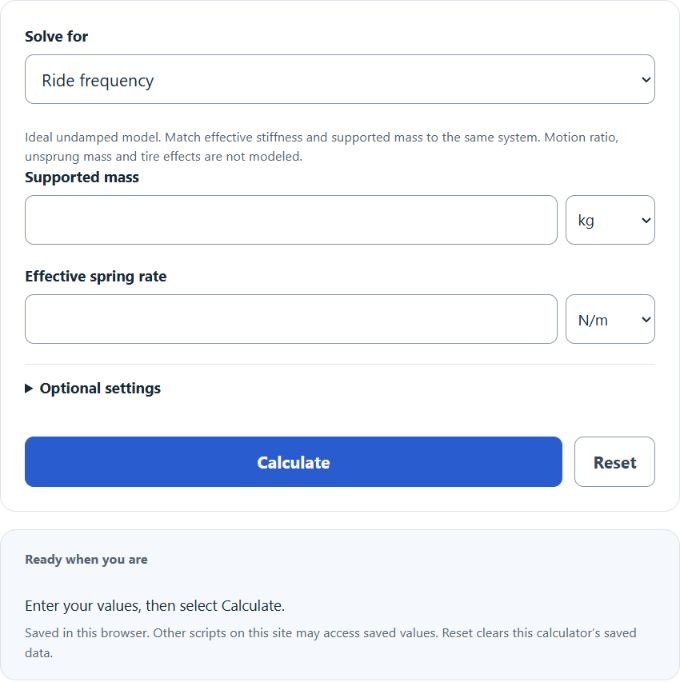
Calculate undamped natural frequency, effective spring rate, or supported mass, and explore simplified front and rear estimates from entered loaded mass, weight distribution and corner rates.
- Natural Frequency Calculator
- Spring Constant Calculator (F=-kx)
- Every Day Life And Education Calculators
Ride Frequency Formula
The following equation gives the undamped natural frequency of an ideal linear system with one degree of freedom and matching stiffness and supported mass.
- Where f is the undamped natural frequency (Hz)
- K is the effective stiffness of the modeled system (N/m)
- M is the matching supported mass of that system (kg)
To calculate frequency, divide stiffness K by matching mass M, take the square root, then divide by 2π. For a corner estimate, use effective wheel stiffness and its supported sprung mass. The simplified front/rear mode allocates all entered loaded vehicle mass equally left/right within each axle, assumes the entered corner spring rates equal wheel rates, and does not subtract unsprung mass or apply motion-ratio corrections.
What is a Ride Frequency?
Definition:
Ride natural frequency describes a modeled vehicle body’s free oscillation about equilibrium after a disturbance. This calculator estimates an ideal undamped mass–spring frequency, rather than the frequency of arbitrary road excitation.
A natural frequency is a property of a system’s mass and stiffness, describing free vibration after a disturbance. A continuing external force can excite the system at a different frequency. Real vehicles have multiple coupled modes; this one-degree-of-freedom model omits damping, tire effects and those couplings.
The natural frequency of a vehicle moving on a bumpy surface is determined by its suspension system, tires, mass and stiffness of the body.
For an underdamped system, the period of free oscillations after a disturbance gives the damped frequency, which generally differs from the undamped frequency calculated here.
This term is not limited to automobiles, but encompasses trains and other vehicles that run on rails or wheels.