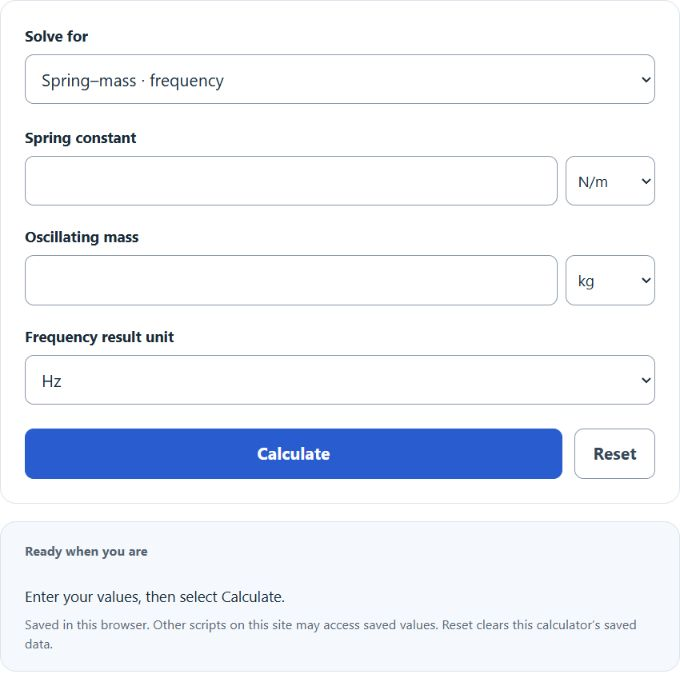
Calculate natural frequency from spring constant and mass, beam properties, torsional stiffness and inertia, or damping ratio in Hz or rad/s.
- All Physics Calculators
- Fundamental Frequency Calculator
- Resonant Frequency Calculator
- Spring Constant Calculator (F=-kx)
Natural Frequency Formula
The following formula is used to calculate the natural frequency of a spring.
- Where f is the natural frequency (Hz)
- k is the spring constant (N/m)
- m is the oscillating mass (kg)
To calculate natural frequency, take the square root of the spring constant divided by the mass, then divide the result by 2 times pi.
Natural Frequency Definition
A natural frequency is a frequency that a system will naturally oscillate at.
Natural Frequency Example
How to calculate natural frequency?
- First, determine the spring constant.
Determine the spring constant by applying a force and measuring the displacement.
- Next, determine the oscillating mass.
Measure the mass of the attached oscillating body, using a consistent effective mass for your model. The simple formula assumes negligible spring mass.
- Finally, calculate the natural frequency.
Enter the spring constant and mass into the formula to calculate the natural frequency.
FAQ
A natural frequency is a certain frequency at which a system will naturally oscillate.
Oscillation is the back-and-forth movement of a vibrating object.