Calculate fundamental frequency from wave speed, wavelength, string length, tension, density, pipe length, or audio, plus pitch and harmonics.
Related Calculators
- Beat Frequency Calculator
- Sampling Frequency Calculator
- Delay Time Calculator
- Magnitude Of Transfer Function Calculator
- All Physics Calculators
Fundamental Frequency Formula
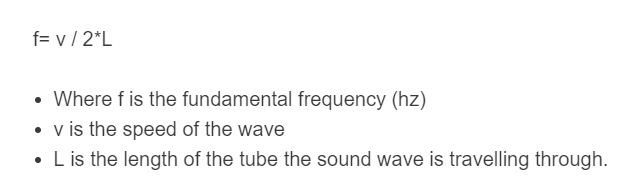
For an ideal uniform tube open at both ends, the fundamental frequency is:
- Where f is the fundamental frequency (Hz)
- v is the speed of the wave
- L is the length of the tube the sound wave is traveling through.
For a tube open at both ends, divide wave speed by twice the effective tube length: f = v/(2L). For a tube closed at one end, use f = v/(4L). The calculator can add an approximate correction for each unflanged open end.
Fundamental Frequency Definition
A fundamental frequency is the lowest resonant frequency of a system. Its value depends on wave speed, geometry and boundary conditions.
Fundamental Frequency Example
How to calculate the fundamental frequency of a tube open at both ends?
- First, determine the speed of the wave.
Calculate the velocity of the sound wave.
- Next, determine the length of the tube.
Measure the length of the tube.
- Finally, calculate the fundamental frequency.
Calculate the frequency using the formula above.
FAQ
A fundamental frequency is the lowest frequency of the system that is resonating. This frequency is used in both physics and music.
For an ideal uniform tube open at both ends, f = v/(2L). For a tube closed at one end, f = v/(4L). Here v is wave speed and L is effective tube length, including an end correction when selected.