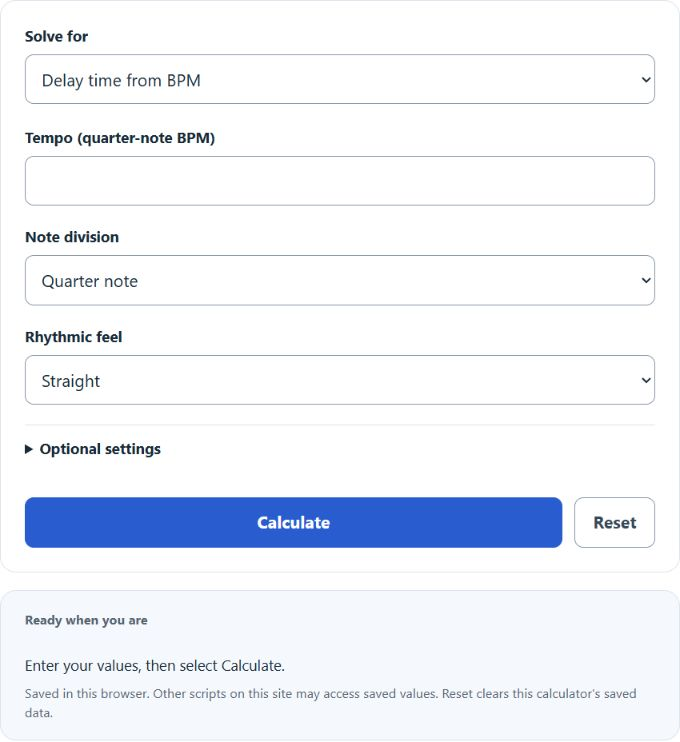
Convert quarter-note BPM to straight, dotted, or triplet delay times, reverse a known delay to tempo, or calculate constant-speed signal travel time from distance and speed. Audio results include note tables, equivalent repeat rates, repeat timing and optional early/late offsets.
Related Calculators
- Sound Pressure Level Calculator
- 3 dB Rule Calculator
- Broadcast Distance Calculator
- Speed Length Ratio Calculator
- All Physics Calculators
Delay Time Formula
For Signal travel time mode, use the following distance/speed formula. Audio modes instead use delay (ms) = 60,000 / quarter-note BPM × note division × rhythmic feel; dotted notes multiply the straight duration by 1.5 and triplets by 2/3.
Variables:
- DT is the delay time (seconds)
- D is the distance the signal has to travel (meters)
- S is the speed of the signal (meters/second)
To calculate the delay time, divide the distance the signal has to travel by the speed of the signal. This will give you the time it takes for the signal to travel from the point of initiation to the point of effect.
What is Delay Time?
Delay time refers to the period between when an action is initiated and when it takes effect. It is commonly used in various fields such as audio engineering, physics, and computer science. In audio engineering, for example, delay time is the period between when a sound is produced and when it is heard. This concept is often used in creating echo effects. In computer science, it could refer to the time it takes for data to travel from one point to another in a network.
How to Calculate Delay Time?
Select Signal travel time to use the following steps. For musical delay, select Delay time from BPM or BPM from delay time and choose the note division and rhythmic feel.
- First, determine the distance the signal has to travel (D) in meters.
- Next, determine the speed of the signal (S) in meters/second.
- Next, gather the formula from above: DT = D / S.
- Finally, calculate the Delay Time.
- After inserting the variables and calculating the result, check your answer with the calculator above.
Example Problem :
Use the following variables as an example problem to test your knowledge.
distance the signal has to travel (D) = 500 meters
speed of the signal (S) = 50 meters/second; DT = 500 / 50 = 10 seconds, assuming constant speed and no additional processing latency.