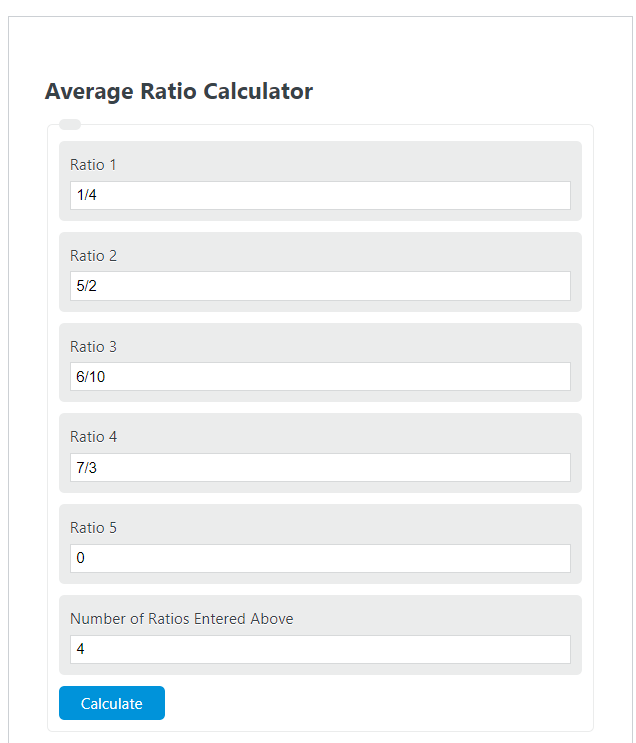
Calculate a ratio of totals, arithmetic mean of item ratios, or custom weighted mean, and compare how denominator size changes the combined result.
- All Math and Numbers Calculators
- All Ratio Calculators
- Unit Ratio Calculator
- Common Ratio Calculator
- Inverse Ratio Calculator
- Decimal to Ratio Calculator
- Percent to Ratio Calculator
Average Ratio Formula
The calculator first converts each ratio into a decimal value, then averages those decimal values. The final result is shown as a ratio in the form average : 1.
Simple average ratio
Weighted average ratio
- AR = simple average ratio
- ARw = weighted average ratio
- ri = decimal value of each ratio
- ai = first number in the ratio
- bi = second number in the ratio
- wi = weight assigned to a ratio
- n = number of ratios
In simple mode, each ratio counts equally. For example, 2:3 becomes 2 / 3 = 0.6667, and that decimal is averaged with the other ratio decimals.
In weighted mode, each ratio is multiplied by its weight before averaging. A ratio with a larger weight has more influence on the final average ratio.
The calculator accepts ratios written with a colon, fraction slash, or decimal. The result is displayed as AR : 1, with decimal, percent, and inverse forms also shown.
Accepted Ratio Formats and Result Meaning
| Input format | Example | Decimal value used |
|---|---|---|
| Colon ratio | 2:3 | 2 / 3 = 0.6667 |
| Fraction | 5/4 | 5 / 4 = 1.25 |
| Decimal | 0.8 | 0.8 |
| Weighted line | 2:3, 10 | 0.6667 with weight 10 |
| Average ratio result | Meaning | Equivalent idea |
|---|---|---|
| 1 : 1 | The two sides are equal on average. | 100% |
| 1.5 : 1 | The first term is 1.5 times the second on average. | 150% |
| 0.5 : 1 | The first term is half of the second on average. | 50% |
Average Ratio Examples
Example 1: Simple average ratio
Find the average ratio of 2:3, 5:4, and 7:6.
- 2:3 = 2 / 3 = 0.6667
- 5:4 = 5 / 4 = 1.25
- 7:6 = 7 / 6 = 1.1667
Add the decimal values and divide by 3:
(0.6667 + 1.25 + 1.1667) / 3 = 1.0278
The average ratio is approximately 1.0278 : 1.
Example 2: Weighted average ratio
Find the weighted average ratio for these entries:
- 2:3 with weight 10
- 5:4 with weight 25
- 7:6 with weight 8
Convert each ratio to a decimal and multiply by its weight:
- 2:3 = 0.6667, so 0.6667 × 10 = 6.6667
- 5:4 = 1.25, so 1.25 × 25 = 31.25
- 7:6 = 1.1667, so 1.1667 × 8 = 9.3333
Divide the total weighted value by the total weight:
(6.6667 + 31.25 + 9.3333) / (10 + 25 + 8) = 47.25 / 43 = 1.0988
The weighted average ratio is approximately 1.0988 : 1.
Average Ratio Calculator FAQ
What is an average ratio?
An average ratio is the average of multiple ratio values after each ratio is converted to a decimal. For example, 2:3 is treated as 2 / 3. After all ratios are converted, the calculator finds their arithmetic mean and displays it as a ratio against 1.
When should you use a weighted average ratio?
Use a weighted average ratio when some ratios should count more than others. For example, if one ratio is based on 100 observations and another is based on 10 observations, the ratio based on 100 observations should usually receive the larger weight.
Why is the result shown as something like 1.25 : 1?
The calculator standardizes the result so the second term is 1. A result of 1.25 : 1 means the first term is 1.25 times the second term on average. The same value can also be read as 125% or inverted as 1 : 0.8.