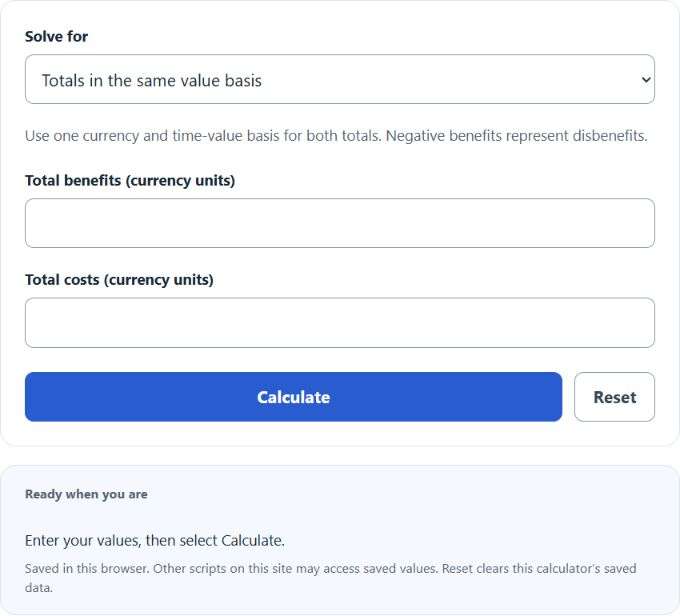
Calculate cost-benefit analysis results from benefits, costs, and discount rate, including net benefit, benefit-cost ratio, ROI, and payback.
- All Business Calculators
- Fixed Cost Calculator
- Average Cost Calculator
- Marginal Utility Calculator
- Marginal Benefit Calculator
Cost Benefit Analysis Formula
The following equations are commonly used in cost–benefit analysis.
Benefit–Cost Ratio (BCR) = (Sum of present value of expected benefits) / (Sum of present value of associated costs)
Net Present Value (NPV) = (Sum of present value of expected benefits) − (Sum of present value of associated costs)
Present value (PV) discounts future benefits and costs to time zero. Select Discounted period cash flows for year-, quarter-, or month-end amounts using an effective annual rate; missing trailing entries count as zero. Totals mode assumes both totals already use the same time-value basis. Discounted payback reports the first period-end crossing and a separately labeled within-period interpolation estimate.
Cost Benefit Analysis Definition
Cost Benefit Analysis (CBA) is a decision-making tool that evaluates the potential costs and benefits of a project or action to determine its overall value.
CBA involves comparing the total costs associated with a particular course of action to the total benefits it is expected to generate. By quantifying and comparing the costs and benefits, CBA enables individuals and organizations to make informed choices.
CBA is crucial as it provides a systematic approach to assess the feasibility and desirability of a proposed project or policy. It helps in determining whether the benefits of undertaking an action outweigh the costs associated with it.
This analysis allows decision-makers to prioritize projects based on their impact and efficiency, ensuring the allocation of limited resources to the most beneficial endeavors.
The key advantage of CBA is its ability to provide a standardized framework for decision-making. It allows decision-makers to compare different options and objectively assess their value.
CBA also enables transparency and accountability in decision-making by providing a clear rationale for the chosen course of action.
Cost Benefit Analysis Example
How to calculate a cost-benefit analysis?
- First, determine the present value of benefits.
Determine and sum all of the present value of benefits.
- Next, determine the present value of costs.
Determine and sum all of the present value of the costs.
- Finally, calculate the cost benefit analysis.
Using the formula above, calculate the cost-benefit analysis.
FAQ
A cost–benefit analysis compares the total benefits and total costs of a proposed project or decision (often using present values). It can be summarized using metrics such as net present value (benefits minus costs) and the benefit–cost ratio (benefits divided by costs).