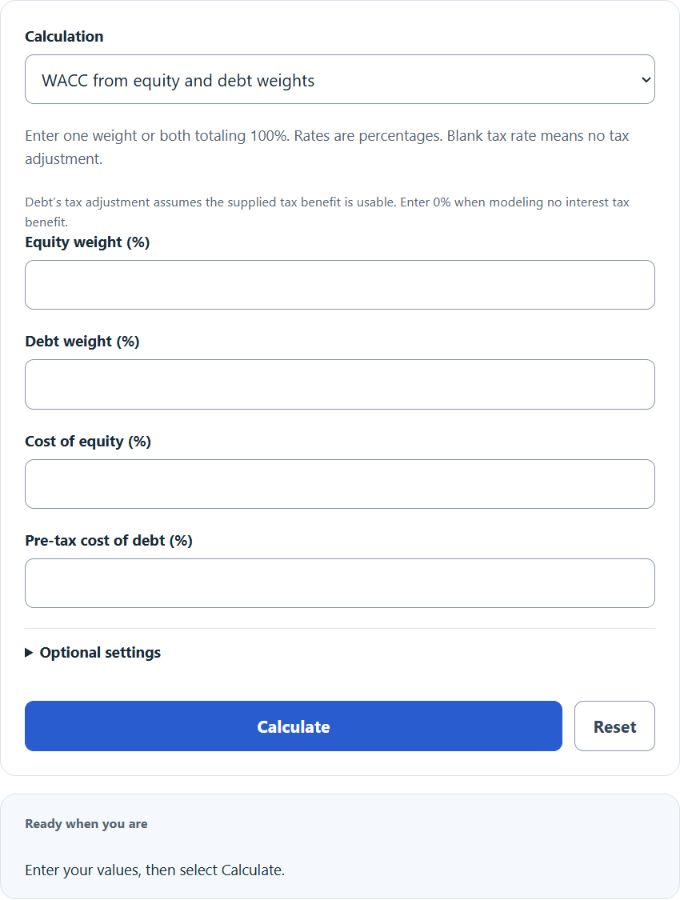
Calculate cost of capital or WACC from equity, debt, preferred stock values, component costs, weights, and tax rate, or solve a missing rate.
- Cost of Debt Calculator
- WACC Calculator (Weighted Average Cost of Capital)
- All Business Calculators
- Cost of Funds Calculator
Cost of Capital Formula
The basic cost of capital calculation uses the weighted cost of equity and after-tax cost of debt.
- CoC = cost of capital, or WACC, as a percentage
- wE = equity weight as a decimal
- CE = cost of equity as a percentage
- wD = debt weight as a decimal
- CD = cost of debt as a percentage
- TC = corporate tax rate as a decimal
The market-value calculation finds each capital weight first. It can also include preferred stock.
- V = total market value of capital
- E = market value of equity
- D = market value of debt
- Ps = market value of preferred stock
- Cps = cost of preferred stock as a percentage
Select WACC, implied cost of equity, or implied pre-tax cost of debt and enter the required rates. Enter one capital weight or both totaling 100%. A blank tax adjustment rate means no adjustment; a nonzero rate assumes that the interest tax benefit can be used.
In the market-value calculation, you enter market values and costs for each source of capital. The calculator divides each source by total capital, applies the correct cost, adjusts debt for taxes, and returns WACC.
Common Cost of Capital Inputs
| Input | What to Use | Notes |
|---|---|---|
| Market value of equity | Share price × shares outstanding | Use market value when possible, not book value. |
| Market value of debt | Market value of bonds and interest-bearing debt | Book value is often used as an estimate if market value is not available. |
| Cost of equity | Expected return required by shareholders | Often estimated with CAPM or dividend growth models. |
| Cost of debt | Current borrowing rate or yield to maturity | Use the pre-tax cost of debt. The formula applies the tax adjustment. |
| Corporate tax rate | Marginal tax rate | This reduces the effective cost of debt. |
How to Interpret Cost of Capital
| Result | General Meaning |
|---|---|
| Lower WACC | The company can fund operations or projects at a lower required return. |
| Higher WACC | Investors and lenders require a higher return, often because of higher risk. |
| Project return above WACC | The project may create value, assuming the risk level is comparable. |
| Project return below WACC | The project may destroy value, unless there are strategic reasons to accept it. |
Example Problems
Example 1: Basic cost of capital
You have 60% equity and 40% debt. The cost of equity is 10%, the pre-tax cost of debt is 6%, and the tax rate is 25%.
The cost of capital is 7.80%.
Example 2: WACC with preferred stock
A company has $800,000 of equity, $400,000 of debt, and $100,000 of preferred stock. The cost of equity is 11%, the cost of debt is 5%, the cost of preferred stock is 8%, and the tax rate is 21%.
The WACC is about 8.60%.
FAQs
Is cost of capital the same as WACC?
Cost of capital is a broad term for the required return a company must earn on its funding. WACC is the most common way to calculate it when the company uses more than one source of capital, such as equity and debt.
Why is debt adjusted for taxes?
Interest expense is usually tax-deductible for a company. This creates a tax shield, so the after-tax cost of debt is lower than the stated interest rate. The calculator applies this with CD × (1 - TC).
Should you use book values or market values?
Use market values when available. WACC is based on the current required return from investors and lenders, so market values usually give a better estimate of the current capital structure. Book values can be used as an approximation when market values are not available.