Estimate the monthly and yearly cost of owning a horse, boarded or at home, with hay worked out from its weight and farrier visits from the trim schedule.
- All Everyday Life and Education Calculators
- Horse Value Calculator
- Horse Weight Calculator
- Hay Bale Weight Calculator
- Horse Per Acre Calculator
Calculator Functions
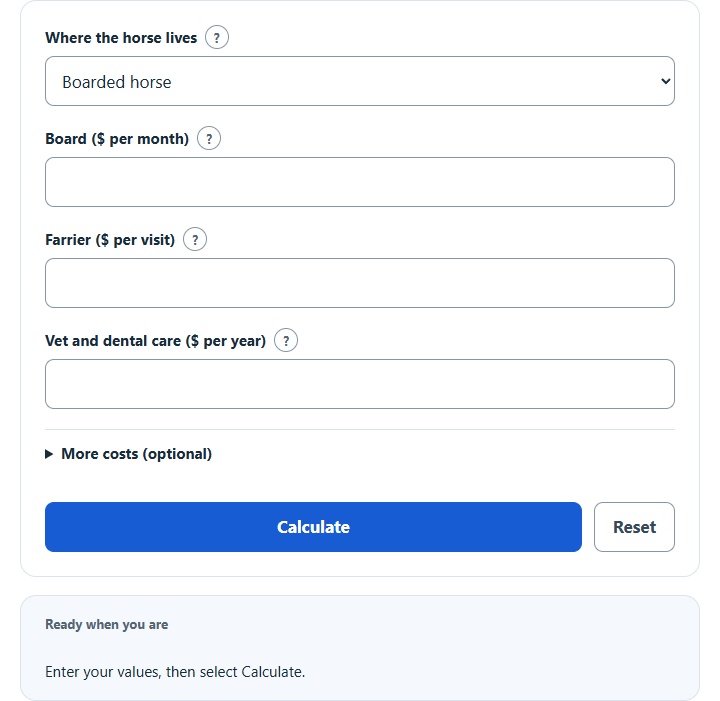
The calculator adds up what a horse costs to keep from the prices you pay, as a monthly and a yearly figure with a cost for each item. Select a function to open it in the calculator.
| Function | Use it when | You enter |
|---|---|---|
| Boarded horse | The horse lives at a boarding stable | Monthly board, the farrier’s price and yearly vet costs |
| Horse kept at home | You buy the hay and feed the horse yourself | The horse’s weight, your hay price, and the farrier and vet costs |
Leave a cost blank to leave it out. More costs (optional) holds the weeks between farrier visits, insurance, bedding, charges on top of board, and other monthly or yearly costs such as tack, lessons or shows.
Horse Cost Formulas
Monthly cost = Y ÷ 12
| Y | Cost per year, $ |
| M | Monthly costs: board and any extras on top of it, or bedding and other monthly costs for a horse at home |
| F | Farrier price per visit |
| V | Farrier visits per year: 365 ÷ (7 × weeks between visits) |
| A | Yearly costs: vet and dental care, insurance and other yearly costs; at home, also the hay and grain for the year |
Most horses need a trim or new shoes at least every 6 to 8 weeks in summer and every 6 to 12 weeks in winter, when hooves grow more slowly [3]. A budget should at least cover a trim every 8 weeks [1], which the calculator uses when the field is blank: about 6.5 visits a year. Every 6 weeks is 8.7 visits.
Hay and grain for a horse kept at home
H is the hay needed per year in pounds, W the horse’s weight in pounds, s the share of its weight eaten as hay each day (2% is 0.02), and m the months of the year it is fed hay. Mature horses at maintenance eat about 1.5% to 2% of their body weight a day in hay and other feed. Horses in light work eat 1.5% to 2.5%, with 0.5% to 1% of it as grain or another concentrate [2]. The University of Maine budget uses hay at 1.5% and grain at 0.5% of body weight [1]. The calculator’s default, hay only at 2%, is the top of the maintenance range, so the budget is not short.
or H ÷ 2,000 × t
Here b is the bale weight in pounds, p the price per bale and t the price per ton. Grain is priced the same way, by the bag. A 1,000 lb horse eating hay at 2% of its weight needs 20 lb a day, or 7,300 lb (3.65 tons) a year: 146 bales of 50 lb. Set Months fed hay each year below 12 if the horse grazes good pasture for part of the year.
Worked example
Take an 1,100 lb horse kept at home on hay at 1.5% of its weight for 9 months of the year and grain at 0.5% all year, the basis of the University of Maine budget [1]. Hay is 16.5 lb a day for 273.75 days, or 4,517 lb. At $10 per 50 lb bale ($0.20 per lb), that costs $903. Grain is 5.5 lb a day, or 2,007.5 lb a year, which at $20 per 50 lb bag costs $803. A $50 trim every 8 weeks adds 6.52 × $50 = $326, and vet and dental care add $400. The total is $2,432 a year, or about $203 a month.
For comparison, a 2012 survey of Maine horse owners found an average of $3,876 and a median of $2,419 per horse per year for hay and grain, pasture upkeep, vet care, the farrier, bedding, building upkeep and training. The University of Maine adds that feed costs have risen 35% to 80% since that survey [1].
Limits of This Estimate
- The total is only as good as the prices you enter. Hay and board prices vary widely by region and from year to year.
- How much hay a horse eats depends on the horse, its work and the hay. Hay fed on the ground or lost around feeders is wasted, and you still have to buy it [2].
- Board covers different things at different stables, from pasture only to a stall with daily turnout, and some stables charge extra for grain or added bedding [1].
- Buying the horse, emergency vet care and facilities are not included. A horse kept at home also takes your own labor, and fences, sheds and tack need repairs and lose value over time [4].
Sources
- University of Maine Cooperative Extension, Bulletin #1004, Equine Facts: Guide to First-Time Horse Ownership: hay at 1.5% and grain at 0.5% of body weight, trimming at least every eight weeks, boarding options and extra charges, and the 2012 survey of owners’ costs
- University of Nebraska–Lincoln Extension, NebGuide G1781, Basics of Feeding Horses: Feeding Management (2007): expected daily feed intake by class of horse as a percent of body weight, and feed wasted on the ground
- University of Minnesota Extension, Caring for your horse’s hooves: how often to trim or shoe in summer and in winter
- eXtension Horses, Cost of Horse Ownership (2020): costs of keeping a horse at home, including repairs, depreciation and unpaid labor