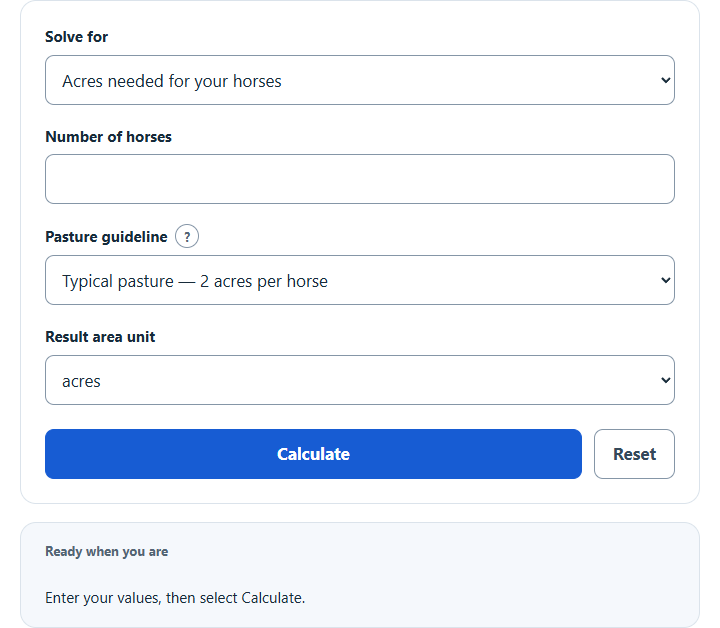
Calculate how many acres your horses need or how many horses per acre a pasture supports, using a typical 2 acres per horse or your own forage data.
Related Calculators
- Acreage Calculator – Find Acres From Land Dimensions
- Goats Per Acre Calculator
- Units Per Acre Calculator
- Carrying Capacity Calculator
- Farm Area Calculator
- Hay Per Acre Calculator
- All Everyday Life and Education Calculators
Calculator Functions
| Function | What it does | What it requires |
|---|---|---|
| Acres needed for your horses | Finds the pasture area a number of horses needs | Requires number of horses and a pasture guideline or custom stocking density |
| Horses per acre | Finds the stocking density of an existing pasture | Requires number of horses and usable pasture area |
| Horses an area can support | Finds how many horses a pasture carries at a chosen density | Requires usable pasture area and a pasture guideline or custom stocking density |
| Forage-based capacity | Estimates how many horses the grass grown on a pasture can feed | Requires pasture area, dry matter produced, usable forage fraction, grazing days, horse weight and daily intake |
| Forage-based required area | Estimates the area needed to feed a set number of horses from pasture | Requires desired number of horses, dry matter produced, usable forage fraction, grazing days, horse weight and daily intake |
Area is entered in acres, hectares, square feet, square metres or square miles, and density in horses per any of those. The forage functions start from 50% usable forage, a 1,000 lb horse and an intake of 2.5% of body weight per day, all of which can be changed.
Horse Per Acre Formulas
| D | Stocking density (horses per acre) |
| H | Number of horses |
| A | Usable pasture area (acres). Barns, arenas and dry lots do not count |
Acres needed for your horses
The typical guideline is 2 acres for each 1,000 lb horse when pasture is meant to supply most of the feed in the growing season, a density of 0.5 horses per acre [1]. Three horses then need 3 ÷ 0.5 = 6 acres. The lush, well-managed option uses 1 acre per horse, which fits fertile, well-kept pasture used mainly for exercise and supplemental grazing [1]. Poorly managed pasture on weak soil can need as much as 5 acres per horse [1], which is entered as a custom density of 0.2.
Horses per acre
Four horses on 10 acres is a density of 4 ÷ 10 = 0.4 horses per acre, or 2.5 acres per horse. The figure describes the pasture as it is stocked now. It does not say whether that stocking is sustainable.
Horses an area can support
Ten acres at the typical guideline carries 10 × 0.5 = 5 horses. The result can be a fraction, and the whole-horse line rounds it down.
Forage-based capacity
(W × I × d) [2]
Y is the dry matter grown per acre over the grazing period (lb/acre), U the usable fraction, W the horse weight (lb), I the daily intake as a fraction of body weight and d the grazing days. This is the standard stocking calculation: usable forage divided by what the animals eat over the period [2]. Horses eat 2 to 3% of body weight in dry matter a day, about 2% for a mature horse at maintenance and 3% for young, pregnant or working horses [3]. Ten acres growing 3,000 lb/acre, half of it usable, over a 150-day season supports 10 × 3,000 × 0.5 ÷ (1,000 × 0.025 × 150) = 4 horses of 1,000 lb eating 2.5% a day.
Forage-based required area
(Y × U)
The same balance solved for land. Four 1,000 lb horses eating 25 lb each a day for 150 days need 15,000 lb of dry matter. At 1,500 lb of usable forage per acre that takes 10 acres, or 2.5 acres per horse. A yield entered in kg/ha is converted at 1 kg/ha = 0.8922 lb/acre.
Limits of This Estimate
- The acres-per-horse guidelines are planning figures for open grazing land. Soil, rainfall, pasture management and how much hay is fed all change the land a horse needs [1].
- The forage functions use a general livestock stocking calculation applied to horses [2]. These estimates are based on the best available data and estimations.
- Dry matter, usable fraction and grazing days must describe the same period, and regrowth should not be counted twice.
- The result is a feed balance only. It does not cover rest periods, trampling, mud or diet quality, so local extension advice and the condition of the pasture should decide the final stocking.
Sources
- University of Minnesota Extension, Managing established horse pastures: acres per horse guidelines
- University of Maine Cooperative Extension, Grazing Period Stock Density: the forage-based stocking calculation
- University of Maryland Extension, Determining your Pasture Stocking Rate: daily dry matter intake as a share of body weight