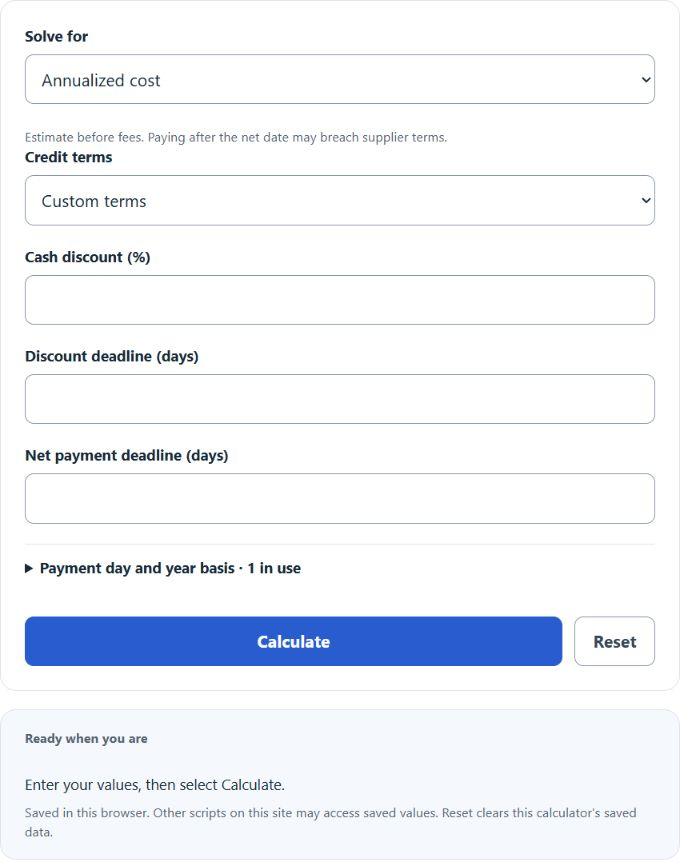
Calculate the annualized cost of trade credit from terms like 2/10 net 30, including nominal and effective rates, dollar cost, and discount vs. borrowing decisions.
Cost of Trade Credit Formula
Nominal Cost = (d / (1 - d)) * (365 / (N - D))
EAR = (1 + d / (1 - d))^(365 / (N - D)) - 1
- d is the cash discount expressed as a decimal (a 2% discount is 0.02)
- D is the discount period in days (the deadline for taking the discount)
- N is the day the invoice is actually paid, which defaults to the net deadline unless you enter an actual payment day
- 365 is the day-count basis (the calculator can also use a 360-day basis)
The term d / (1 – d) is the cost of one credit period. When you skip a 2% discount, you pay the full invoice instead of 98% of it, so you effectively pay 2/98 = 2.04% to keep your money for N – D extra days. The nominal formula scales that periodic cost linearly across the year, while the EAR formula uses compound annualization. For a positive discount, the EAR is higher when the extra credit period is shorter than the selected year basis, equal for a full basis year, and lower for a longer period. A zero discount gives zero in both formulas.
The calculator has three modes built on these formulas. The annualized cost mode converts credit terms such as 2/10 net 30 into both the nominal and effective annual rate. The dollar cost mode shows the discount you give up on an invoice, rounded once to the nearest cent as an estimate. The decision mode compares trade credit and borrowing over the same extra financing period, using your selected simple annual or effective annual borrowing rate. An optional actual payment day changes the financing interval; paying after the net date may violate the supplier’s terms and incur costs this model excludes.
Annualized Cost of Common Credit Terms
The table below shows the annualized cost of forgoing the discount under common trade credit terms, assuming payment on the net date and a 365-day year.
| Credit terms | Cost per period | Nominal annual cost | Effective annual cost |
|---|---|---|---|
| 1/10 net 30 | 1.01% | 18.43% | 20.13% |
| 2/10 net 30 | 2.04% | 37.24% | 44.59% |
| 3/10 net 30 | 3.09% | 56.44% | 74.35% |
| 2/10 net 60 | 2.04% | 14.90% | 15.89% |
| 2/15 net 45 | 2.04% | 24.83% | 27.86% |
| 3/15 net 45 | 3.09% | 37.63% | 44.86% |
Forgoing a cash discount can be expensive short-term financing. Compare a simple annual borrowing rate with the nominal annual cost in the table, or an effective annual borrowing rate with the effective annual cost, using the same year basis and allowing for lender fees. A nominal APR with compounding must first be converted to a matching effective rate. The second table shows how paying later lowers the annualized discount cost because the same discount buys more financing days. It uses 2/10 net 30 terms and excludes late-payment costs.
| Day actually paid | Extra days of financing | Nominal annual cost | Effective annual cost |
|---|---|---|---|
| Day 30 (net date) | 20 | 37.24% | 44.59% |
| Day 40 | 30 | 24.83% | 27.86% |
| Day 50 | 40 | 18.62% | 20.24% |
| Day 60 | 50 | 14.90% | 15.89% |
Stretching payables reduces the measured cost, but it risks late fees, damaged supplier relationships, tighter future terms, and a weaker trade credit history, so treat the lower rate as an analytical result rather than a recommendation.
Example Problems
Example 1. A supplier offers terms of 2/10 net 30 and you plan to pay on day 30. The discount is d = 0.02, so the cost per period is 0.02 / 0.98 = 2.0408%. The extra financing lasts 30 – 10 = 20 days, and 365 / 20 = 18.25 periods fit in a year. The nominal annual cost is 0.020408 * 18.25 = 37.24%. Compounding instead, the effective annual cost is (1.020408)^18.25 – 1 = 44.59%. Enter 2, 10, and 30 in the calculator’s annualized cost mode to confirm both numbers.
Example 2. You receive a $12,000 invoice with 2/10 net 30 terms and want the cost in dollars. Paying by day 10 costs $12,000 * 0.98 = $11,760, while paying on day 30 costs the full $12,000. Skipping the discount therefore charges you $240 to keep $11,760 for 20 extra days, a periodic cost of 240 / 11,760 = 2.04%. In the calculator’s dollar cost mode, enter the same terms with an invoice amount of 12,000 to see the $240 cost along with the 37.24% nominal and 44.59% effective annual rates.
Frequently Asked Questions
When is the effective annual cost higher than the nominal cost?
The nominal cost multiplies the periodic cost by the number of periods in the selected basis year. The effective annual rate uses compound annualization. For a positive discount and a financing interval shorter than that year, the effective rate is higher: 2/10 net 30 on a 365-day basis produces 37.24% nominal and 44.59% effective. The rates are equal for a one-year interval, and the effective rate is lower for a longer interval. A bank’s annual quote is not automatically an effective rate. For the decision, convert it to the cost over the same financing days: simple annual rate × days/year basis, or (1 + effective annual rate)^(days/year basis) – 1.
Should you always take an early payment discount?
Taking the discount has a lower modeled financing cost when the interest and fees needed to fund early payment are less than the discount forgone. Compare matching rate conventions and financing periods rather than comparing a simple annual borrowing quote directly with the trade credit EAR. For example, 2/10 net 30 on a 365-day basis costs 37.24% simple annual or 44.59% effective annual. A 40% simple annual borrowing rate is more expensive over the 20-day interval, while a 40% effective annual borrowing rate is cheaper. The decision mode distinguishes these cases. Available credit, liquidity needs, fees and supplier terms can affect the actual choice.
What does the cost of trade credit mean for the supplier offering the terms?
The same percentage works in reverse. A supplier offering 2/10 net 30 is effectively paying customers an annualized 44.59% to collect 20 days sooner, which is expensive financing for the supplier as well. Suppliers accept this cost to accelerate cash flow, reduce collection risk, and shorten their cash conversion cycle. If a supplier can borrow more cheaply than the discount costs them, tightening the discount or financing receivables another way may be the better choice.