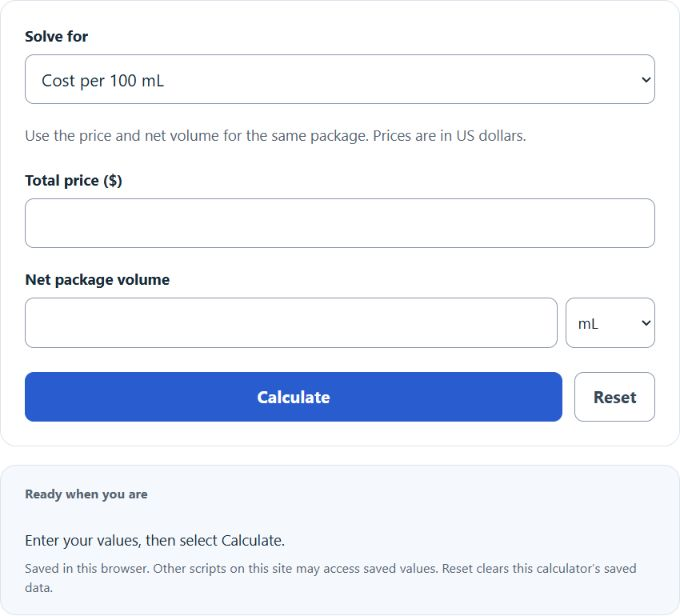
Choose cost per 100 mL, total price, or volume, then enter the requested values. Use milliliters or liters for the same package as the price.
- Business Finance Calculators
- Cost Per Bit Calculator
- Cost Per Bullet Calculator
- Cost Per Call Calculator
Cost Per 100mL Formula
The following equation is used to calculate the Cost Per 100mL.
- Where CPH is the cost per 100 milliliters ($/100mL)
- TC is the total cost ($)
- V is the total volume (mL)
To calculate the cost per 100mL, divide the total cost by the total volume (in mL), then multiply by 100.
What is a Cost Per 100mL?
Definition:
Cost per 100mL represents the standardization of a product’s cost to a set volume—100 milliliters. This metric helps compare products of varying sizes and prices on an equivalent volume basis.
How to Calculate Cost Per 100mL?
Example Problem:
The following example outlines the steps and information needed to calculate the cost per 100mL.
First, determine the total volume. In this example, the product volume is 500mL.
Next, determine the total cost of the product. In this example, the cost is $3.00.
Finally, calculate the cost per 100mL using the formula above:
CPH = (TC / V) * 100
CPH = ($3.00 / 500mL) * 100
CPH = $0.60 per 100mL
FAQ
Why calculate cost per 100mL?
Calculating the cost per 100mL allows you to compare different products of varying sizes and prices on a common basis. This helps you determine the best value, especially when facing products with confusing or non-standard volumes and packaging sizes.
How can I use cost per 100mL to save money?
By comparing the cost per 100mL of similar products, you can identify which option offers the best value for your budget. It’s especially useful when shopping for beverages, cosmetics, or household cleaning supplies that are sold in multiple sizes.
Are there any limitations to using cost per 100mL?
While cost per 100mL is a straightforward comparison, it doesn’t account for factors such as product quality, brand reputation, or additional features. It also assumes products are similarly formulated. You should consider performance, efficacy, and personal preferences alongside cost to make the best decision.