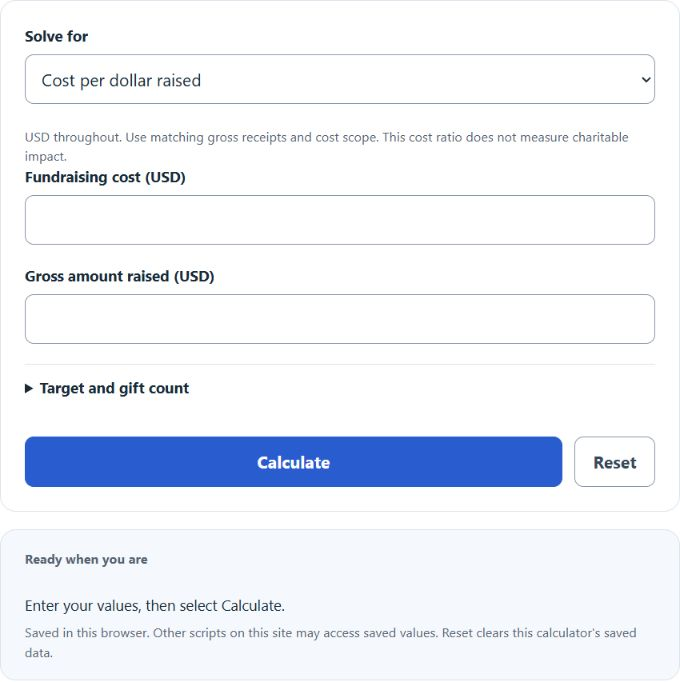
Calculate cost per dollar raised, fundraising cost or gross revenue, then review net funds, efficiency, average gift and target variance.
Cost Per Dollar Raised Formula
The cost per dollar raised shows how much you spent to raise each $1 of funding. A lower value means less recorded cost per gross dollar raised, using the same cost and revenue definitions. It does not by itself establish charitable impact or overall effectiveness.
- CPDR = cost per dollar raised, in dollars spent per dollar raised
- C = total fundraising cost, in dollars
- F = total funding raised, in dollars
The calculator can also rearrange the formula to solve for the missing value.
- To calculate cost per dollar raised: enter cost and funding raised. The calculator divides cost by funding raised.
- To calculate cost: enter funding raised and cost per dollar raised. The calculator multiplies them.
- To calculate funding raised: enter cost and cost per dollar raised. The calculator divides cost by cost per dollar raised.
Illustrative Cost Per Dollar Raised Ranges
These ranges illustrate the arithmetic only; they are not verified industry benchmarks or quality ratings. Choose a documented target appropriate to the campaign and compare consistent periods and cost definitions.
| Cost Per Dollar Raised | Meaning | Example |
|---|---|---|
| $0.05 to $0.15 | 5% to 15% of gross raised | Spending 5 to 15 cents to raise $1 |
| $0.16 to $0.35 | 16% to 35% of gross raised | Spending 16 to 35 cents to raise $1 |
| $0.36 to $0.50 | 36% to 50% of gross raised | Spending 36 to 50 cents to raise $1 |
| Above $0.50 | More than 50% of gross raised | Spending more than 50 cents to raise $1 |
Common Fundraising Costs to Include
| Cost Category | Examples | Include? |
|---|---|---|
| Advertising and promotion | Digital ads, mailers, print materials | Usually yes |
| Event expenses | Venue, catering, equipment, permits | Yes, for event-based fundraising |
| Fundraising platform fees | Payment processing, donation platform fees | Yes |
| Staff or contractor time | Fundraiser wages, consultant fees | Yes, if tracking full campaign cost |
Example Calculations
Example 1: Calculate cost per dollar raised
You spent $2,500 on a fundraising campaign and raised $20,000.
The cost per dollar raised is $0.125 per $1 raised, or 12.5 cents per dollar raised.
Example 2: Calculate funding raised
Your fundraising cost was $4,000 and your cost per dollar raised was $0.20.
The funding raised was $20,000.
FAQ
What is a good cost per dollar raised?
There is no universal good CPDR threshold. A target of $0.20 means spending 20 cents per gross dollar raised; whether it is appropriate depends on the campaign scope, objectives and documented comparison basis. Cost ratios alone do not measure mission outcomes.
Should cost per dollar raised include staff time?
Include staff time if you want a full view of fundraising efficiency. If you only include direct expenses, such as ads, mail, event costs, and platform fees, your result will show direct campaign efficiency but not the total cost of raising funds.
Is cost per dollar raised the same as fundraising ROI?
CPDR is cost divided by gross funds raised. Gross return per cost is the reciprocal when cost is positive: $5,000 raised on $1,000 cost gives a 5× gross multiple. Net ROI uses (gross raised − cost) / cost, or 4× (400%) in that example. State the convention rather than using ROI ambiguously.