How do I use this calculator?
The Coterminal Angle Calculator allows you to find coterminal angles based on the angle you input, either in degrees or radians.
Calculator Operations:
- Choose a calculation: Coterminal angles, Normalize angle, or Reference angle and quadrant.
- Select whether your input angle is in Degrees or Radians.
- Optionally choose a suggested common value in the Angle field.
- Enter your angle in the provided field.
- Select whether you want the results in Degrees or Radians (where applicable).
- Click the Calculate button to get the results for the selected calculation.
- Use the Reset button to clear all fields if needed.
This calculator includes tools to generate coterminal angles (by adding/subtracting full rotations), normalize an angle into a standard range, and find an acute reference angle and quadrant/axis. Quadrantal angles on an axis have no acute reference angle.
Make sure to fill in all required fields correctly before clicking the calculate button to ensure accurate results.
Calculate coterminal angles, normalize degree or radian inputs, and find reference angles and quadrants with positive or negative rotations.
- All Math and Numbers Calculators
- Reference Angle Calculator
- Arc length calculator
- Exterior Angle Calculator
Coterminal Angle Formula
The following formulas are used to calculate coterminal angles.
To calculate coterminal angles, add and/or subtract one full rotation from the current angle: 360° in degrees or 2π in radians.
The formulas above show the general rule using an integer k. In reality, there is an infinite number of coterminal angles. The definition is simply an angle that ends at the same point as another angle on a coordinate plane. Since the unit circle has a total rotation of 360 degrees (2π radians), adding or subtracting that amount yields a coterminal angle, as does the coterminal angle calculator above.
To calculate a coterminal angle between 0 and 2π (in radians), add or subtract 2π until the result is in the desired interval. For example:
Find the coterminal angle of 11π/3:
Since 11π/3 > 2π, subtract 2π from the given angle. (If the given angle were negative, you would add 2π until it falls between 0 and 2π.)
11π/3 – 2π = 11π/3 – 6π/3 = 5π/3.
Coterminal Angle Definition
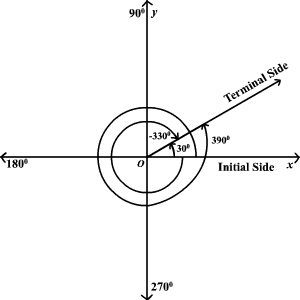
A coterminal angle is an angle that ends at the same geometric point on the coordinate plane as another angle.
Common Coterminal Angle Values
The following list outlines the coterminal angles of the most commonly calculated angles.
How to calculate a coterminal angle
Let’s take a look at an example of how you might calculate the coterminal angle.
- Let’s assume you are given an angle in radians. For this example, the angle is 2.5 radians.
- Convert radians to degrees using 180/π: 2.5 × 180/π ≈ 143.2394 degrees. The calculator can convert automatically.
- Last, we need to add 360 degrees to that angle to find an angle that is coterminal with the original angle, so 143.2394 + 360 ≈ 503.2394 degrees.
- Check the answer using the calculator above.
FAQ
A coterminal angle is an angle that ends at the same location as another angle. For example, 1 degree and 361 degrees are at the same location since one full rotation is 360 degrees.
Coterminal angles differ by a full rotation. In degrees: Angle + 360k. In radians: Angle + 2πk, where k is any integer.