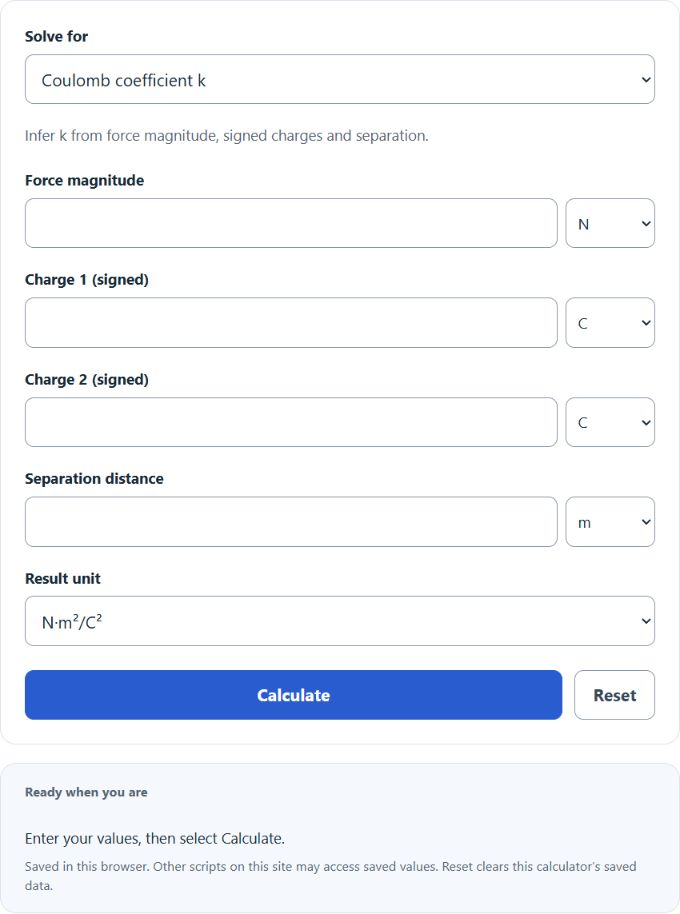
Choose a quantity to solve with Coulomb’s law, then enter the four known values and select units. Inverse charge modes return magnitude; force magnitude alone does not determine charge sign.
- All Physics Calculators
- Coulomb’s Law Calculator
- Coulombs To Newtons Calculator
- Coulombs To Joules Calculator
Coulomb’s Constant Formula
The calculator is based on Coulomb’s law. It uses SI base units internally: newtons for force, coulombs for charge, meters for distance, and N·m²/C² for Coulomb’s constant.
- F = nonnegative electrostatic force magnitude
- k = positive Coulomb coefficient for the applicable medium
- q1 = first electric charge
- q2 = second electric charge
- r = distance between the charges
Choose the quantity to solve, enter the four displayed known values, and select units. The default k is a rounded vacuum value. Use the coefficient specified by your problem.
- Force: Uses the two charges, distance, and Coulomb’s constant to find the magnitude of the electrostatic force.
- Charge 1 or Charge 2: Finds the missing charge magnitude when force magnitude, the other charge, distance, and coefficient are known. A nonzero result can have either sign.
- Distance: Solves for the separation distance needed to produce the given force between two charges.
- Coulomb’s Constant: Solves for k from force, charge, and distance values. In a vacuum, k is normally about 8.98755 × 10⁹ N·m²/C².
Common Values and Unit Conversions
Use these values to check that your inputs are in the expected range and unit system.
| Quantity | Value | Notes |
|---|---|---|
| Coulomb’s constant in vacuum | Approximately 8.9875517862 × 10⁹ N·m²/C² | Derived from 2022 CODATA permittivity; often rounded to 8.99 × 10⁹ |
| Coulomb’s constant in lbf·ft²/C² | Approximately 2.17483 × 10¹⁰ lbf·ft²/C² | 1 lbf·ft²/C² = 0.41325331065141085 N·m²/C² |
| Elementary charge | 1.602176634 × 10⁻¹⁹ C | Charge of one proton in magnitude |
| Unit | Equivalent in base units | Used for |
|---|---|---|
| 1 lbf | 4.4482216152605 N | Force |
| 1 mC | 0.001 C | Charge |
| 1 μC | 0.000001 C | Charge |
| 1 cm | 0.01 m | Distance |
| 1 in | 0.0254 m | Distance |
| 1 ft | 0.3048 m | Distance |
Example Calculations
Example 1: Calculate force
Find the force between two charges of 2 μC and 3 μC separated by 0.5 m. Use k = 8.98755 × 10⁹ N·m²/C².
Convert the charges to coulombs:
2 μC = 0.000002 C and 3 μC = 0.000003 C
Apply Coulomb’s law:
F = 8.98755 × 10⁹ × |0.000002 × 0.000003| / 0.52
F ≈ 0.215701 N
Example 2: Calculate distance
Two charges are 5 μC and 4 μC. The force between them is 2 N. Use k = 8.98755 × 10⁹ N·m²/C².
Convert the charges to coulombs:
5 μC = 0.000005 C and 4 μC = 0.000004 C
Apply the distance formula:
r = sqrt((8.98755 × 10⁹ × |0.000005 × 0.000004|) / 2)
r ≈ 0.299792 m
FAQ
What value should I enter for Coulomb’s constant?
For most physics problems in air or vacuum, enter 8.98755 × 10⁹ N·m²/C². Many textbooks round this to 9.0 × 10⁹ N·m²/C². If your problem gives a specific value for k, use the value from the problem.
Why does the calculator use the absolute value of the charges for force?
The calculator gives the magnitude of the electrostatic force. Magnitude is nonnegative. Nonzero like charges repel, and opposite charges attract. A zero charge gives zero force. Zero-charge inverse cases can have no solution or no unique solution, which the calculator identifies.
Can Coulomb’s law be used for any charged objects?
Coulomb’s law works best for point charges or objects that can be treated like point charges. For large charged objects, irregular shapes, or charges spread over a surface, the simple two-charge formula may not be enough without additional physics methods.