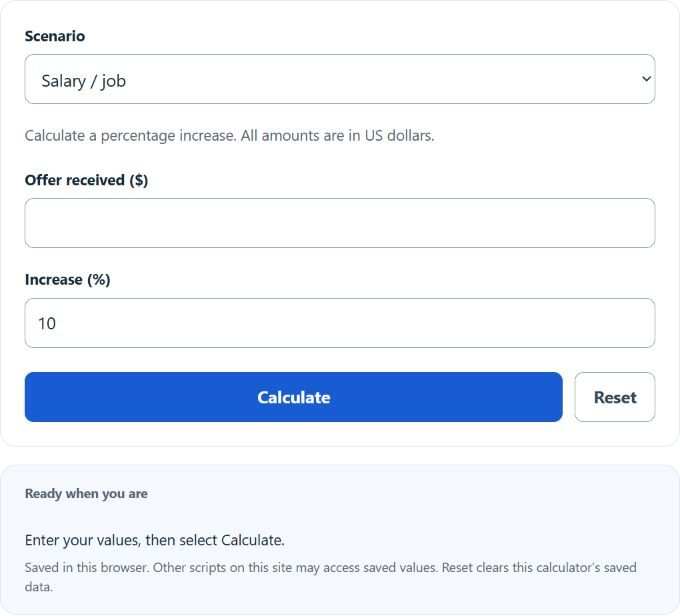
Calculate a counter offer for salary negotiations, buying a listed price, or meeting in the middle with percentage-based strategies for easy comparison.
Discount-Based Counter Offer Formula
The following formula is used to calculate a price-only counter offer when you want your offer to be a specific discount (or markup) from the original offer amount.
Variables:
- CO is the counter offer amount ($)
- O is the original offer amount ($)
- D is the discount/markup rate (decimal). For example, 0.20 means 20% off, and −0.10 means a 10% increase.
To calculate the counter offer, multiply the original offer amount by (1 − D). This gives the counter offer amount.
What is a Counter Offer?
A counter offer is a response given to an initial offer, indicating that the initial offer is not acceptable as it stands, but could be acceptable if certain changes are made. It is a common practice in various transactions such as real estate deals, business sales, and salary negotiations. A counter offer effectively rejects the original offer and puts a new offer on the table for consideration. Note that real-world counteroffers can change more than just price (for example, closing dates, contingencies, benefits, warranties, or delivery terms); this calculator compares percentage-based price changes and an equal-price midpoint; it does not predict acceptance or establish fairness.
How to Calculate Counter Offer?
Choose Salary / job, Buying a price, or Meet in the middle. The formula below describes Buying a price; a salary increase uses CO = O(1 + P/100), and the midpoint averages the two prices.
- First, choose the scenario and enter the original offer or both prices in US dollars.
- For a salary increase or buying discount, enter the percentage directly (20 means 20%). The adjustable preset percentages are examples, not negotiation recommendations.
- For the discount formula CO = O(1 − D), divide the percentage by 100 to obtain D.
- Select Calculate to compare the counter offer. Amounts round to the nearest cent; half-cent ties round upward.
- After calculating the result, check your answer for accuracy.
Example Problem:
Use the following variables as an example problem to test your knowledge.
Original offer amount ($) = 500
Discount entered in the calculator = 20% (D = 0.2)
Counter offer (CO) = 500(1 − 0.2) = 500(0.8) = 400